Loading page, please wait…
HomeCurrent AffairsEditorialsGovt SchemesLearning ResourcesUPSC SyllabusPricingAboutBest UPSC AIUPSC AI ToolAI for UPSCUPSC ChatGPT

© 2026 Vaidra. All rights reserved.

PrivacyTerms
Vaidra Logo
Vaidra

Top 4 items + smart groups

UPSC GPT
New
Current Affairs
Daily Solutions
Daily Puzzle
Mains Evaluator

Version 2.0.0 • Built with ❤️ for UPSC aspirants

Myanmar Junta Chief Min Aung Hlaing Sworn in as President – Continuation of Military Rule Post‑2021 Coup | GS2 UPSC Current Affairs April 2026
Myanmar Junta Chief Min Aung Hlaing Sworn in as President – Continuation of Military Rule Post‑2021 Coup
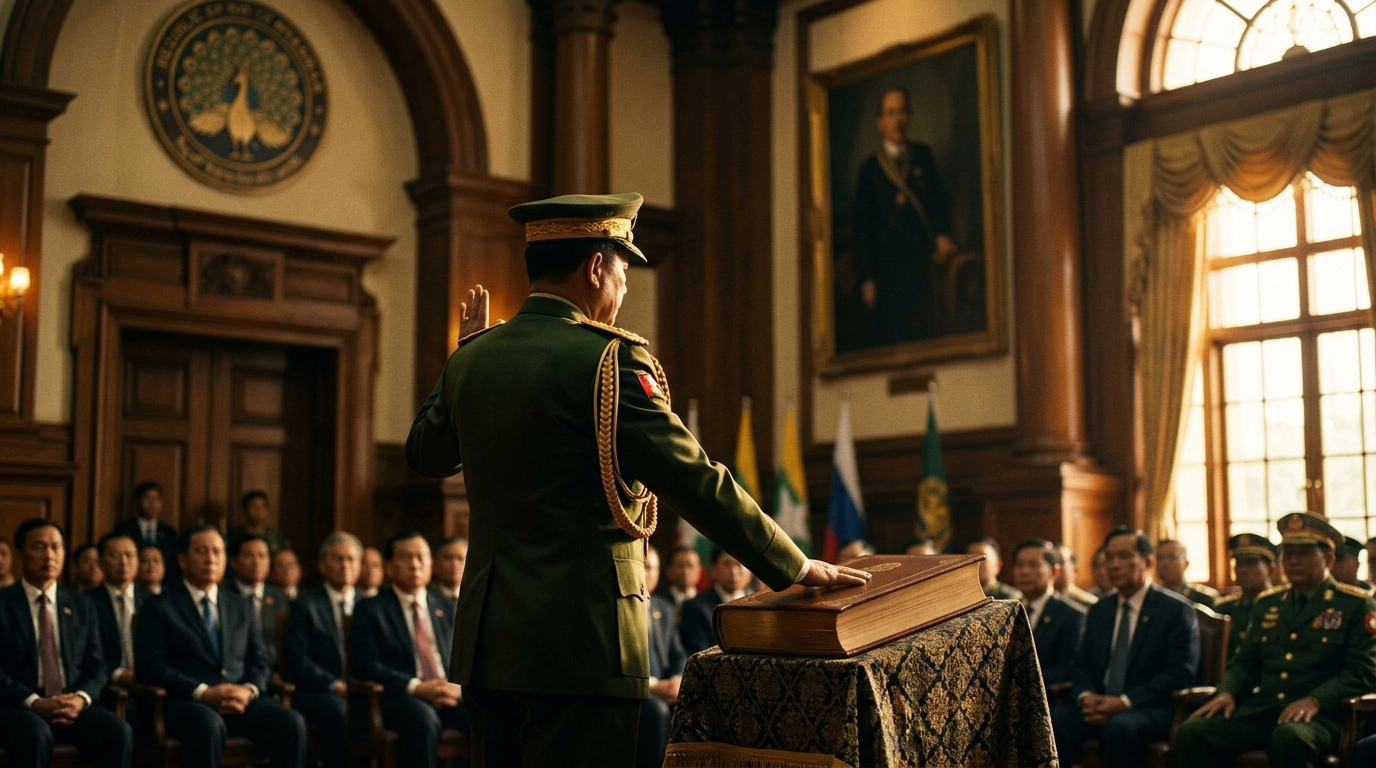
On 10 April 2026, Myanmar’s army chief <span class="key-term" data-definition="Min Aung Hlaing – senior military officer who became chief of the Myanmar armed forces and later assumed the presidency (GS2: Polity)">Min Aung Hlaing</span> was sworn in as <span class="key-term" data-definition="President (civilian post) – constitutional head of state; his assumption of the role by a military chief blurs the civil‑military divide (GS2: Polity)">President</span>, extending the junta’s rule that began after the 2021 <span class="key-term" data-definition="military coup – sudden overthrow of an elected government by the armed forces; a recurring feature in South‑Asian political history (GS1: History)">military coup</span>. The move consolidates power amid an ongoing <span class="key-term" data-definition="civil war – armed conflict between the state and various ethnic armed groups in Myanmar since 2021; raises issues of human rights and national integration (GS4: Ethics, GS2: Polity)">civil war</span> and highlights challenges to democratic restoration, a key topic for UPSC aspirants.
Overview On 10 April 2026 , the head of Myanmar’s armed forces, Min Aung Hlaing , was sworn in as President . This marks the first time a junta chief has taken a civilian post, extending the rule that began after the military coup of 2021. Key Developments Swearing‑in ceremony held in Naypyidaw, confirming Myanmar Junta 's decision to legitimize its rule through a civilian title. Five years after ousting the elected government of Aung San Suu Kyi , the military continues to dominate political institutions. The ongoing civil war shows no sign of abating, with increased reports of clashes in border states. Important Facts Min Aung Hlaing has been the commander‑in‑chief of the Tatmadaw (Myanmar armed forces) since 2011. The 2021 coup displaced the National League for Democracy (NLD) government, leading to international sanctions and diplomatic isolation. Despite the civilian title, the constitution‑drafting committee remains under junta control, limiting any democratic transition. UPSC Relevance The episode illustrates the challenges of civil‑military relations in a post‑colonial state, a recurring theme in GS2: Polity . It also underscores the impact of authoritarian governance on regional stability, human rights, and international diplomacy—areas covered under GS4: Ethics and GS1: History . Aspirants should analyse how the consolidation of power by a military leader affects constitutional norms, federalism, and the prospects for democratic restoration in Myanmar. Way Forward For policymakers, the focus should be on: Strengthening regional mechanisms (e.g., ASEAN) to pressure the junta for a credible political dialogue. Supporting civil‑society groups and ethnic minorities to negotiate cease‑fires and inclusive governance. Monitoring sanctions and humanitarian aid to ensure they target the regime without worsening civilian suffering. Understanding this development equips UPSC candidates to answer questions on South‑Asian geopolitics, democratic backsliding, and the role of the military in governance.
  1. Home
  2. Prepare
  3. Current Affairs
  4. Myanmar Junta Chief Min Aung Hlaing Sworn in as President – Continuation of Military Rule Post‑2021 Coup
Must Review
Login to bookmark articles
Login to mark articles as complete

Overview

gs.gs282% UPSC Relevance

Myanmar junta chief assumes presidency, cementing military rule post‑2021 coup

Key Facts

  1. Min Aung Hlaing was sworn in as President of Myanmar on 10 April 2026 in Naypyidaw.
  2. He has served as commander‑in‑chief of the Tatmadaw since 2011 and led the 2021 coup that ousted the NLD government.
  3. The 2021 coup resulted in international sanctions and diplomatic isolation of the Myanmar junta.
  4. Five years after displacing Aung San Suu Kyi’s elected government, the military continues to dominate political institutions.
  5. The constitution‑drafting committee remains under junta control, limiting any democratic transition.
  6. Ongoing civil war with ethnic armed groups persists, with intensified clashes in border states.

Background & Context

The appointment blurs the civil‑military divide, contravening the constitutional separation of powers envisaged in Myanmar’s 2008 Constitution. It underscores the broader UPSC theme of military interference in governance, its impact on federalism, human rights, and regional stability in South Asia.

UPSC Syllabus Connections

Essay•International Relations and Geopolitics

Mains Answer Angle

GS2 (Polity) – Analyse the constitutional and geopolitical implications of a military chief assuming a civilian presidency in Myanmar.

Full Article

<h3>Overview</h3> <p>On <strong>10 April 2026</strong>, the head of Myanmar’s armed forces, <span class="key-term" data-definition="Min Aung Hlaing – senior military officer who became chief of the Myanmar armed forces and later assumed the presidency (GS2: Polity)">Min Aung Hlaing</span>, was sworn in as <span class="key-term" data-definition="President (civilian post) – constitutional head of state; his assumption of the role by a military chief blurs the civil‑military divide (GS2: Polity)">President</span>. This marks the first time a junta chief has taken a civilian post, extending the rule that began after the <span class="key-term" data-definition="military coup – sudden overthrow of an elected government by the armed forces; a recurring feature in South‑Asian political history (GS1: History)">military coup</span> of 2021.</p> <h3>Key Developments</h3> <ul> <li>Swearing‑in ceremony held in Naypyidaw, confirming <span class="key-term" data-definition="Myanmar Junta – the ruling military council that seized power in 2021, overseeing all state functions (GS2: Polity)">Myanmar Junta</span>'s decision to legitimize its rule through a civilian title.</li> <li>Five years after ousting the elected government of <span class="key-term" data-definition="Aung San Suu Kyi – Nobel Peace Prize laureate and former civilian leader of Myanmar; symbol of democratic aspirations (GS1: History)">Aung San Suu Kyi</span>, the military continues to dominate political institutions.</li> <li>The ongoing <span class="key-term" data-definition="civil war – armed conflict between the state and various ethnic armed groups in Myanmar since 2021; raises issues of human rights and national integration (GS4: Ethics, GS2: Polity)">civil war</span> shows no sign of abating, with increased reports of clashes in border states.</li> </ul> <h3>Important Facts</h3> <ul> <li>Min Aung Hlaing has been the commander‑in‑chief of the Tatmadaw (Myanmar armed forces) since 2011.</li> <li>The 2021 coup displaced the National League for Democracy (NLD) government, leading to international sanctions and diplomatic isolation.</li> <li>Despite the civilian title, the constitution‑drafting committee remains under junta control, limiting any democratic transition.</li> </ul> <h3>UPSC Relevance</h3> <p>The episode illustrates the challenges of civil‑military relations in a post‑colonial state, a recurring theme in <strong>GS2: Polity</strong>. It also underscores the impact of authoritarian governance on regional stability, human rights, and international diplomacy—areas covered under <strong>GS4: Ethics</strong> and <strong>GS1: History</strong>. Aspirants should analyse how the consolidation of power by a military leader affects constitutional norms, federalism, and the prospects for democratic restoration in Myanmar.</p> <h3>Way Forward</h3> <p>For policymakers, the focus should be on:</p> <ul> <li>Strengthening regional mechanisms (e.g., ASEAN) to pressure the junta for a credible political dialogue.</li> <li>Supporting civil‑society groups and ethnic minorities to negotiate cease‑fires and inclusive governance.</li> <li>Monitoring sanctions and humanitarian aid to ensure they target the regime without worsening civilian suffering.</li> </ul> <p>Understanding this development equips UPSC candidates to answer questions on South‑Asian geopolitics, democratic backsliding, and the role of the military in governance.</p>
Read Original on hindu

Analysis

Practice Questions

GS2
Easy
Prelims MCQ

Military coup and consolidation of power in Myanmar

1 marks
4 keywords
GS2
Medium
Mains Short Answer

Military coup and consolidation of power in Myanmar

10 marks
4 keywords
GS2
Hard
Mains Essay

Military coup and consolidation of power in Myanmar

250 marks
6 keywords
Related:Daily•Weekly

Loading related articles...

Loading related articles...

Tip: Click articles above to read more from the same date, or use the back button to see all articles.

Quick Reference

Key Insight

Myanmar junta chief assumes presidency, cementing military rule post‑2021 coup

Key Facts

  1. Min Aung Hlaing was sworn in as President of Myanmar on 10 April 2026 in Naypyidaw.
  2. He has served as commander‑in‑chief of the Tatmadaw since 2011 and led the 2021 coup that ousted the NLD government.
  3. The 2021 coup resulted in international sanctions and diplomatic isolation of the Myanmar junta.
  4. Five years after displacing Aung San Suu Kyi’s elected government, the military continues to dominate political institutions.
  5. The constitution‑drafting committee remains under junta control, limiting any democratic transition.
  6. Ongoing civil war with ethnic armed groups persists, with intensified clashes in border states.

Background

The appointment blurs the civil‑military divide, contravening the constitutional separation of powers envisaged in Myanmar’s 2008 Constitution. It underscores the broader UPSC theme of military interference in governance, its impact on federalism, human rights, and regional stability in South Asia.

UPSC Syllabus

  • Essay — International Relations and Geopolitics

Mains Angle

GS2 (Polity) – Analyse the constitutional and geopolitical implications of a military chief assuming a civilian presidency in Myanmar.

Explore:Current Affairs·Editorial Analysis·Govt Schemes·Study Materials·Previous Year Questions·UPSC GPT