Key Developments
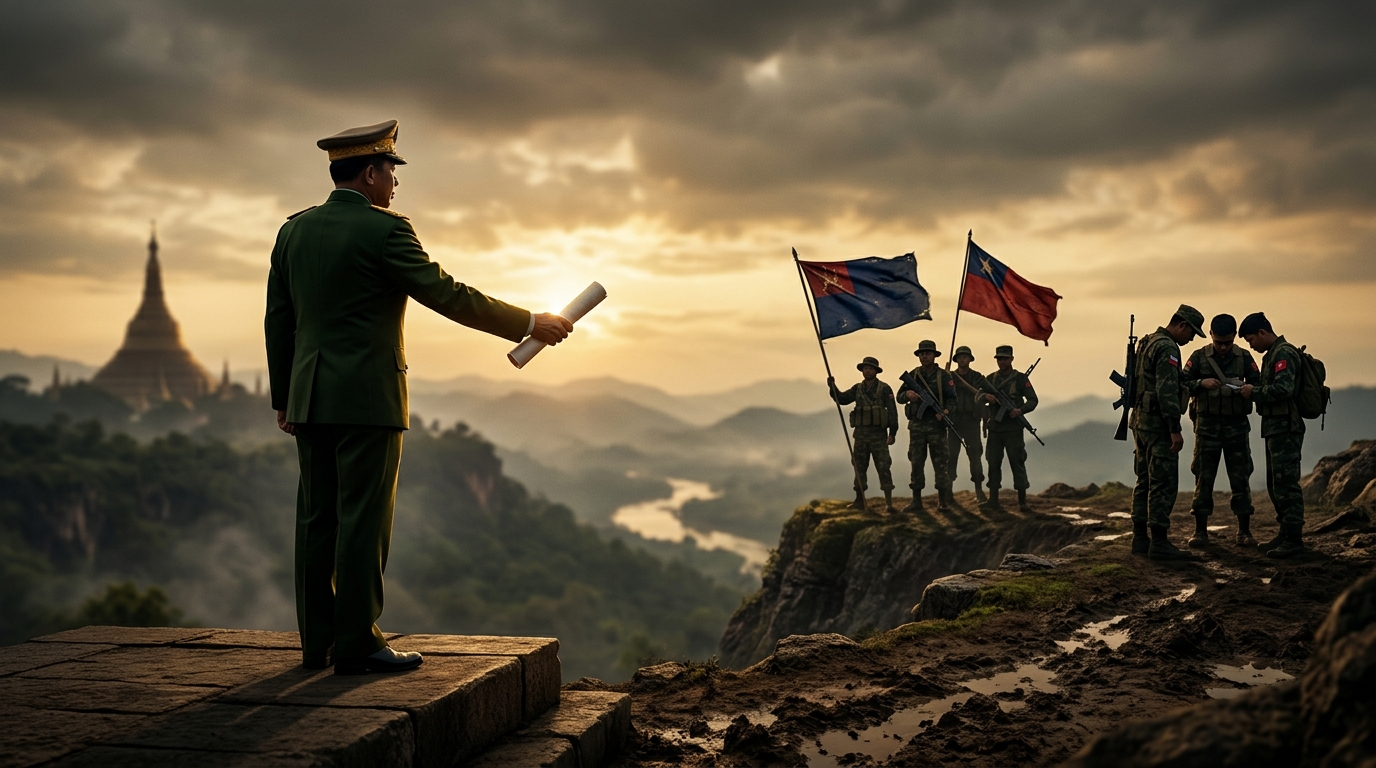
Myanmar’s new military-backed government announced a fresh push for dialogue with insurgent forces. On April 21, 2026, the junta’s leader‑turned‑president, President Min Aung Hlaing, said peace talks with the Opposition armed groups would be convened by the end of July, i.e., within the next 100 days.
Key Developments (Bullet Points)
- Government aims to bring non‑signatory rebel factions into a July‑2026 peace process.
- Two prominent insurgent groups rejected the invitation on the same day, signalling deep mistrust.
- The proposal targets groups that have not yet entered any ceasefire deal with the junta.
- State media quoted the president emphasizing a “100‑day window” for initiating talks.
Important Facts
The coup that brought the current junta to power occurred five years ago, in 2021, and has since escalated into a protracted civil war. The conflict has fragmented the country into multiple armed factions, many of which operate along ethnic lines. The two rebel groups that declined the offer are among the most influential in the eastern and northern regions, where fighting has been most intense.
Exam Relevance
Understanding this development is crucial for several UPSC domains:
- GS2 – Polity & Governance: The move reflects the junta’s attempt to legitimize its rule through negotiated settlements, a pattern observed in other post‑coup regimes.
- GS1 – International Relations: Ongoing instability in Myanmar affects regional security, refugee flows, and ASEAN’s conflict‑resolution mechanisms.
- GS4 – Ethics & Integrity: The ethical dimension of negotiating with armed groups that have been accused of human rights violations raises questions about state responsibility and the limits of political compromise.
Way Forward
Analysts suggest that for talks to succeed, the junta must address three core issues: (i) genuine power‑sharing arrangements, (ii) guarantees for the safety of civilians in conflict zones, and (iii) a credible monitoring mechanism for any ceasefire. Failure to secure the participation of major insurgents could prolong the civil war, further destabilising the region and complicating India’s diplomatic engagement with ASEAN.
For UPSC candidates, tracking the evolution of this peace initiative offers insight into conflict resolution, state‑society relations, and the challenges of governance in a fragmented polity.