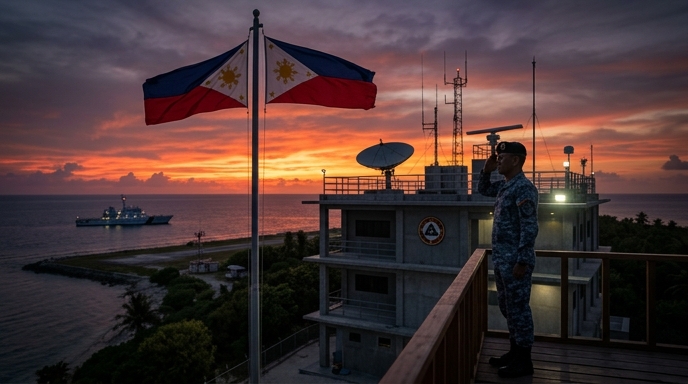
<p>The <span class="key-term" data-definition="Philippine Coast Guard — maritime law‑enforcement and search‑and‑rescue agency of the Philippines, responsible for safeguarding its waters and maritime interests (GS2: Polity)">Philippine Coast Guard</span> on <strong>April 9, 2026</strong> commissioned its inaugural dedicated <span class="key-term" data-definition="Command Centre — a purpose‑built hub that houses monitoring, communication and decision‑making facilities for maritime operations (GS3: Security)">command centre</span> on the <span class="key-term" data-definition="Spratly Islands — a cluster of reefs, islets and rocks in the South China Sea claimed by China, the Philippines, Vietnam, Malaysia, Brunei and Taiwan (GS2: Polity, GS4: International Relations)">Spratly island chain</span>. The facility marks a tangible step in Manila’s effort to assert presence in the contested <span class="key-term" data-definition="South China Sea dispute — a protracted territorial and maritime conflict involving overlapping claims by China and several ASEAN members, affecting regional security and resource exploitation (GS2: Polity, GS4: International Relations)">South China Sea</span>, where confrontations with <span class="key-term" data-definition="Chinese vessels — ships operated by the People’s Republic of China, often deployed in disputed waters to project maritime claims (GS4: International Relations)">Chinese vessels</span> have been frequent.</p>
<h3>Key Developments</h3>
<ul>
<li>Inauguration of the first dedicated <span class="key-term" data-definition="Command Centre — a purpose‑built hub that houses monitoring, communication and decision‑making facilities for maritime operations (GS3: Security)">command centre</span> on the Spratly Islands.</li>
<li>Establishment of a new <span class="key-term" data-definition="Coast Guard District — an administrative subdivision of a coast guard that oversees operations within a defined maritime zone (GS2: Polity)">coast guard district</span>, previously managed from <span class="key-term" data-definition="Palawan — a Philippine province bordering the South China Sea, serving as a logistical base for maritime activities (GS2: Polity)">Palawan</span>.</li>
<li>The district’s jurisdiction spans roughly <strong>68,000 square kilometres (26,000 square miles)</strong> of contested waters.</li>
</ul>
<h3>Important Facts</h3>
<p>The new district consolidates command, control, communications, computers, intelligence, surveillance and reconnaissance (C4ISR) capabilities in a single location. By shifting oversight from <span class="key-term" data-definition="Palawan — a Philippine province bordering the South China Sea, serving as a logistical base for maritime activities (GS2: Polity)">Palawan</span> to the Spratlys, response times to incidents are expected to improve markedly. The centre is equipped with modern radar, satellite linkages and a dedicated operations room to monitor vessel movements, issue warnings, and coordinate interdiction actions.</p>
<h3>UPSC Relevance</h3>
<p>Understanding the strategic calculus behind the Philippines’ maritime infrastructure is vital for GS II (International Relations) and GS III (Security). The move illustrates how smaller states employ institutional upgrades to counterbalance a dominant claimant’s naval assertiveness. It also underscores the importance of maritime domain awareness in safeguarding exclusive economic zones (EEZs) and ensuring freedom of navigation—key themes in India’s own Indo‑Pacific strategy.</p>
<h3>Way Forward</h3>
<p>Analysts suggest that the Philippines may further augment the Spratly command centre with joint exercises involving allied navies, especially the United States and Japan, to enhance deterrence. Continuous investment in surveillance assets and legal diplomacy at regional forums (e.g., ASEAN, UNCLOS) will be essential to translate the physical presence into lasting strategic advantage.</p>