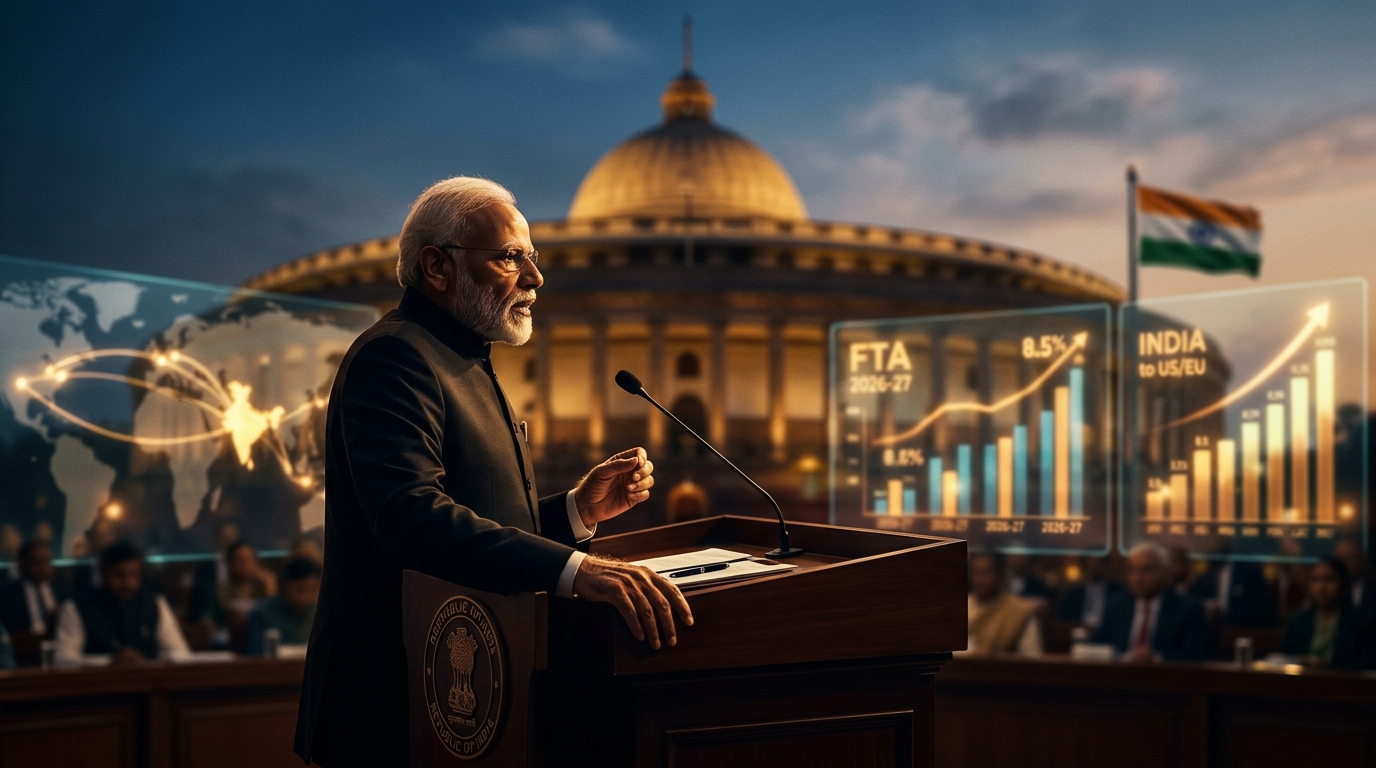
PM Modi Calls for Quality‑Driven Investment to Leverage FTAs – Budget 2026‑27 Highlights — UPSC Current Affairs | March 4, 2026
PM Modi Calls for Quality‑Driven Investment to Leverage FTAs – Budget 2026‑27 Highlights
On 3 March 2026, Prime Minister Narendra Modi urged industries to invest confidently, adopt new technologies and prioritize research to exploit opportunities from India's expanding FTAs, emphasizing quality and outlining sector‑specific missions such as BioPharma Shakti and CCUS. The Budget 2026‑27 earmarks record capital spending for infrastructure, reforms MSME incentives, and targets strategic areas like rare‑earth corridors, signalling a push for higher‑value manufacturing and sustainable growth—key themes for UPSC GS‑3.
Key Takeaways from Prime Minister’s Budget 2026‑27 Webinar On 3 March 2026 , Prime Minister Narendra Modi addressed a second webinar on the Union Budget 2026‑27 . He urged industry leaders to boost investments, adopt emerging technologies and intensify research to harness opportunities created by the country’s expanding network of FTAs . The emphasis was on delivering quality products that meet global standards, thereby positioning India as a reliable partner in the evolving global supply chain. Key Developments Call for confident investment and rapid adoption of new technologies across manufacturing and services. Mandate to increase research spending; the era of “frugal research” is declared over. Stress on “Quality, Quality, Quality” as the core mantra for all export‑oriented initiatives. Highlight of sector‑specific missions: BioPharma Shakti Mission and CCUS Mission . Promotion of Dedicated Rare Earth Corridors and container manufacturing to strengthen the trade ecosystem. Reforms in MSMEs to improve credit access, technology upgrades and capacity building. Important Facts The Budget proposes a **record level of capital expenditure** for infrastructure and logistics, recognizing them as the backbone of growth. The Prime Minister underscored that manufacturing, logistics, MSMEs, and urban development are inter‑linked pillars; strengthening one amplifies the others. He also noted that reforms in MSME classification now allow firms to expand without losing government benefits. UPSC Relevance Understanding these initiatives is essential for GS‑3 (Economy) and GS‑2 (Polity) papers. The push for quality aligns with India’s strategy to move up the value chain in global trade, a recurring theme in questions on external sector policy. The emphasis on research, rare‑earth corridors and biopharma reflects the government's focus on **strategic sectors** for self‑reliance (Atmanirbhar Bharat). The CCUS Mission ties into sustainability and climate‑change commitments, linking to international agreements such as the Paris Accord. Way Forward For aspirants, the take‑away is to analyse how fiscal measures translate into sectoral growth. Track the implementation of the highlighted missions, monitor MSME performance indicators, and assess India’s positioning in global supply chains post‑FTA expansions. Linking these policy moves to broader themes—industrial policy, trade strategy, and sustainable development—will help answer both descriptive and analytical UPSC questions.
Union Budget 2026‑27 proposes a record capital expenditure of ₹12 lakh crore for infrastructure and logistics.
PM Modi stressed “Quality, Quality, Quality” for export‑oriented sectors, linking it to leveraging FTAs with 12 partner countries.
BioPharma Shakti Mission allocated ₹1.5 lakh crore to make India a global hub for biologics and next‑generation therapies.
Carbon Capture, Utilisation and Storage (CCUS) Mission earmarked ₹30,000 crore for developing carbon‑capture technologies.
Dedicated Rare‑Earth Corridors will be set up in four states to boost high‑tech and defence manufacturing.
MSME classification reforms now allow firms with turnover up to ₹500 crore to retain benefits while scaling up.
Target to raise R&D spending to 2.5 % of GDP by 2030, signalling the end of “frugal research”.
Background & Context
The budget’s focus on quality, technology adoption and strategic sector missions aligns with India’s ambition to move up the global value chain and fully utilise its expanding network of FTAs. This dovetails with UPSC themes of industrial policy, external sector strategy, and sustainable development under GS‑3 and GS‑2.
UPSC Syllabus Connections
Essay•Economy, Development and InequalityPrelims_GS•National Current AffairsGS3•Government BudgetingGS2•Government policies and interventions for developmentGS2•Functions and responsibilities of Union and StatesGS2•Effect of policies of developed and developing countries on IndiaEssay•Science, Technology and SocietyGS3•Effects of liberalization on economy, industrial policy and growthPrelims_CSAT•Decision Making
Mains Answer Angle
In GS‑3, candidates can discuss how quality‑driven investment, enhanced R&D and sector‑specific missions can help India leverage FTAs to improve export competitiveness and achieve self‑reliance.