<h3>Overview</h3>
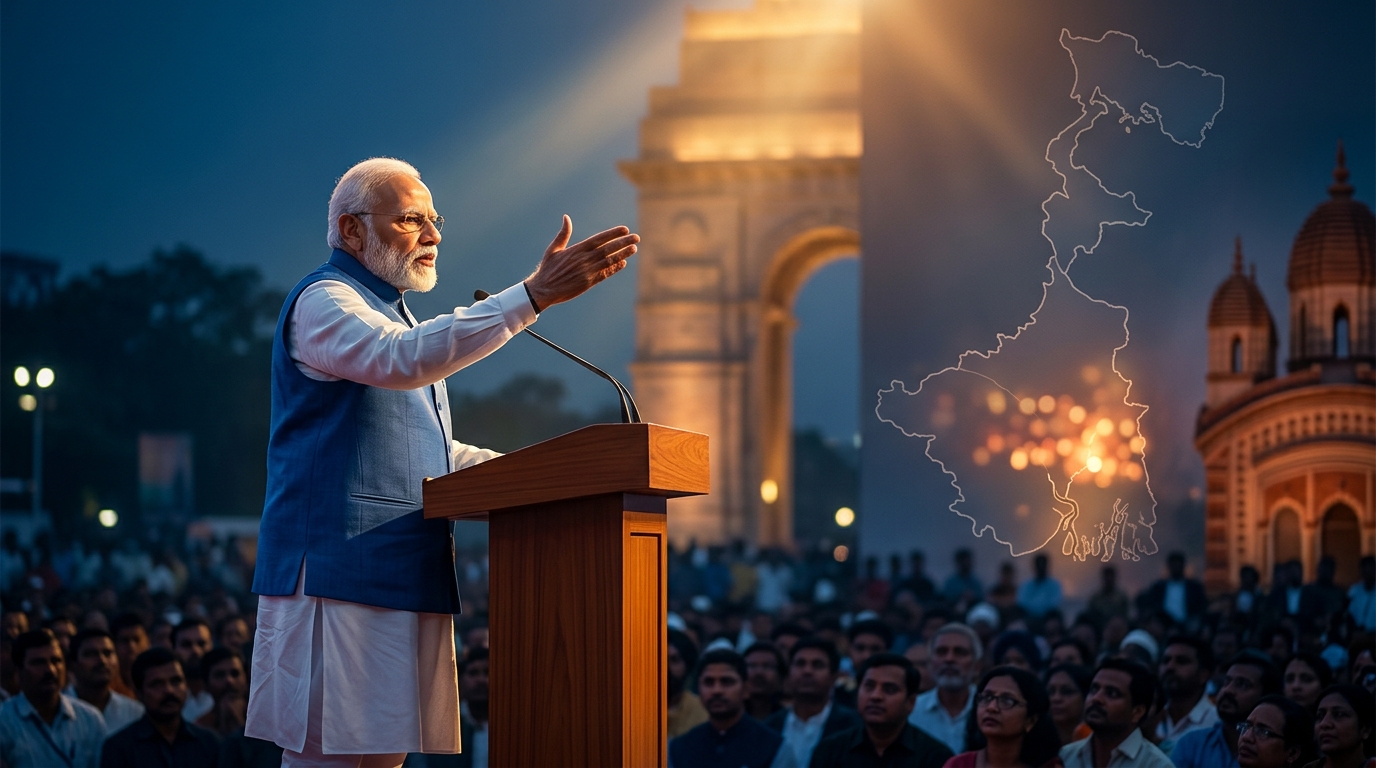
<p>On <strong>April 11, 2026</strong>, <strong>Prime Minister Narendra Modi</strong> addressed a rally in <span class="key-term" data-definition="Murshidabad district – a district in West Bengal with a Muslim‑majority population; often cited in discussions on communal politics (GS2: Polity)">Murshidabad district</span>. He announced that the <span class="key-term" data-definition="Uniform Civil Code — a proposed Indian law to replace personal laws based on religion with a common set of civil statutes (GS2: Polity)">Uniform Civil Code</span> will be implemented in West Bengal to end what he termed the ‘politics of appeasement’. Modi warned that the <span class="key-term" data-definition="Bharatiya Janata Party — India’s ruling party, known for its nationalist agenda and emphasis on cultural integration (GS2: Polity)">Bharatiya Janata Party</span> will not allow Bengalis to become a ‘minority’ in their own state.</p>
<h3>Key Developments</h3>
<ul>
<li>Modi pledged the rollout of the <span class="key-term" data-definition="Uniform Civil Code — a proposed Indian law to replace personal laws based on religion with a common set of civil statutes (GS2: Polity)">Uniform Civil Code</span> in West Bengal.</li>
<li>The announcement was made at a rally in <span class="key-term" data-definition="Murshidabad district – a district in West Bengal with a Muslim‑majority population; often cited in discussions on communal politics (GS2: Polity)">Murshidabad district</span>, underscoring the communal angle of the speech.</li>
<li>The <span class="key-term" data-definition="Election manifesto – a document released by a political party outlining its policy promises and agenda for voters (GS2: Polity)">election manifesto</span>, unveiled by Union Home Minister <strong>Amit Shah</strong> a day earlier, was cited as the roadmap to curb the <span class="key-term" data-definition="Trinamool Congress – the regional party governing West Bengal, known for its strong regional identity politics (GS2: Polity)">Trinamool Congress</span>’s ‘maha jungleraj’.</li>
<li>Modi emphasized that the BJP will prevent any demographic shift that could render Bengalis a ‘minority’ in West Bengal.</li>
</ul>
<h3>Important Facts</h3>
<p>The rally in <span class="key-term" data-definition="Murshidabad district – a district in West Bengal with a Muslim‑majority population; often cited in discussions on communal politics (GS2: Polity)">Murshidabad</span> attracted a large crowd, reflecting the BJP’s strategy to project itself as a champion of cultural integration. The <span class="key-term" data-definition="Uniform Civil Code — a proposed Indian law to replace personal laws based on religion with a common set of civil statutes (GS2: Polity)">Uniform Civil Code</span> has been a long‑standing demand of the ruling party, framed as a step toward national unity and legal uniformity. The <span class="key-term" data-definition="Election manifesto – a document released by a political party outlining its policy promises and agenda for voters (GS2: Polity)">election manifesto</span> released by <strong>Amit Shah</strong> outlines measures to dismantle what the BJP calls the ‘politics of appeasement’ in the state.</p>
<h3>UPSC Relevance</h3>
<p>Understanding the push for a <span class="key-term" data-definition="Uniform Civil Code — a proposed Indian law to replace personal laws based on religion with a common set of civil statutes (GS2: Polity)">Uniform Civil Code</span> is crucial for GS 2 (Polity) as it touches upon constitutional provisions (Article 44) and the balance between personal law autonomy and national integration. The role of the <span class="key-term" data-definition="Bharatiya Janata Party — India’s ruling party, known for its nationalist agenda and emphasis on cultural integration (GS2: Polity)">Bharatiya Janata Party</span> in shaping federal‑state relations, and the political dynamics with the <span class="key-term" data-definition="Trinamool Congress – the regional party governing West Bengal, known for its strong regional identity politics (GS2: Polity)">Trinamool Congress</span>, illustrate centre‑state power equations, a frequent UPSC topic. The concept of ‘politics of appeasement’ also links to ethical considerations in governance (GS 4). Finally, the timing of the manifesto release by the Home Minister underscores the importance of party documents in electoral strategy, a key point for political analysis.</p>
<h3>Way Forward</h3>
<p>For aspirants, monitor the legislative process that would be required to enact the <span class="key-term" data-definition="Uniform Civil Code — a proposed Indian law to replace personal laws based on religion with a common set of civil statutes (GS2: Polity)">Uniform Civil Code</span> in West Bengal, including potential challenges in the Parliament and courts. Analyze how the BJP’s narrative of preventing a ‘minority’ status for Bengalis may influence communal politics and electoral calculations in the upcoming state elections. Keep an eye on reactions from civil society, legal experts, and opposition parties, as these will shape the discourse on personal law reform and federalism in India.</p>