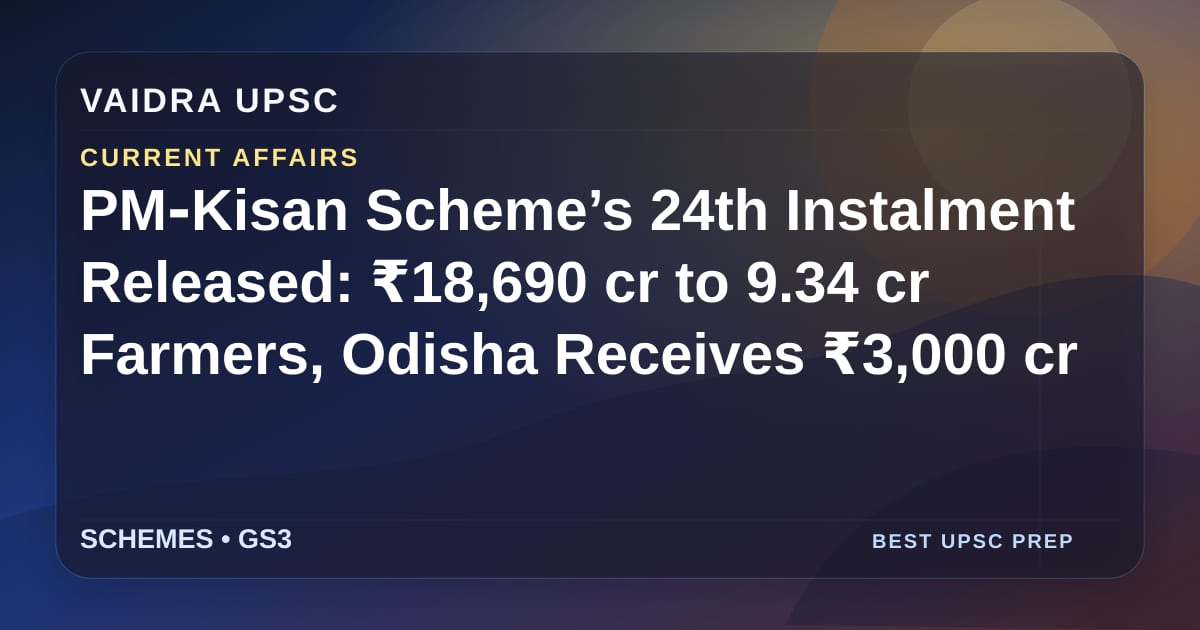
Overview: On 30 October 2026, Prime Minister Narendra Modi launched the 24th instalment of the PM‑Kisan scheme. Over ₹18,690 crore was transferred to the bank accounts of more than 9.34 crore farmers nationwide, including a share of ₹3,000 crore for 35.38 lakh beneficiaries in Odisha.
Key Developments
- Release of the 24th instalment of the PM‑Kisan scheme on 30 Oct 2026.
- Direct transfer of ₹3,000 crore to DBT accounts of 35.38 lakh Odisha farmers.
- Chief Minister Mohan Charan Majhi addressed farmers virtually from Bhubaneswar, highlighting complementary state schemes.
- State announced revival of millet cultivation across all 30 districts.
- Assistance promised to flood‑affected families in Ganjam, Gajapati and other districts.
- One‑minute silence observed for the mother of Union Agriculture Minister Shivraj Singh Chouhan.
Important Facts
The scheme’s core objective is to provide financial security to the Annadata class, who often face income volatility. In Odisha, the state government complements the central cash assistance with several programmes:
- Subhadra Yojana: Direct support for seeds, fertilizers and equipment.
- Krushi Vidyanidhi scholarship: Encourages higher studies among farmer families.
- PM Dhan‑Dhanya Krushi Yojana: Boosts production of millets, pulses and oilseeds.
- Procurement price for paddy set at ₹3,100 per quintal, providing a floor price for growers.
Exam Relevance
Understanding the PM‑Kisan scheme is essential for GS II (Polity) and GS III (Economy) as it illustrates:
- Centre‑State coordination in agricultural welfare.
- Use of DBT to minimise leakages and ensure transparency.
- Policy focus on small‑holder farmers, a key demographic in India’s agrarian economy.
- Linkage of cash assistance with procurement price support and input subsidies, reflecting a multi‑pronged approach to farm income security.
Way Forward
For sustained impact, the following steps are recommended:
- Strengthen monitoring mechanisms to verify that the transferred funds reach intended beneficiaries.
- Integrate climate‑resilient practices, especially in flood‑prone districts, to reduce crop loss.
- Expand awareness campaigns on the complementary state schemes like Subhadra Yojana and Krushi Vidyanidhi to maximise utilisation.
- Promote millet cultivation as a climate‑smart crop, aligning with national food‑security goals.
Effective implementation of these measures will reinforce the government's commitment to farmer welfare and contribute to rural economic stability.