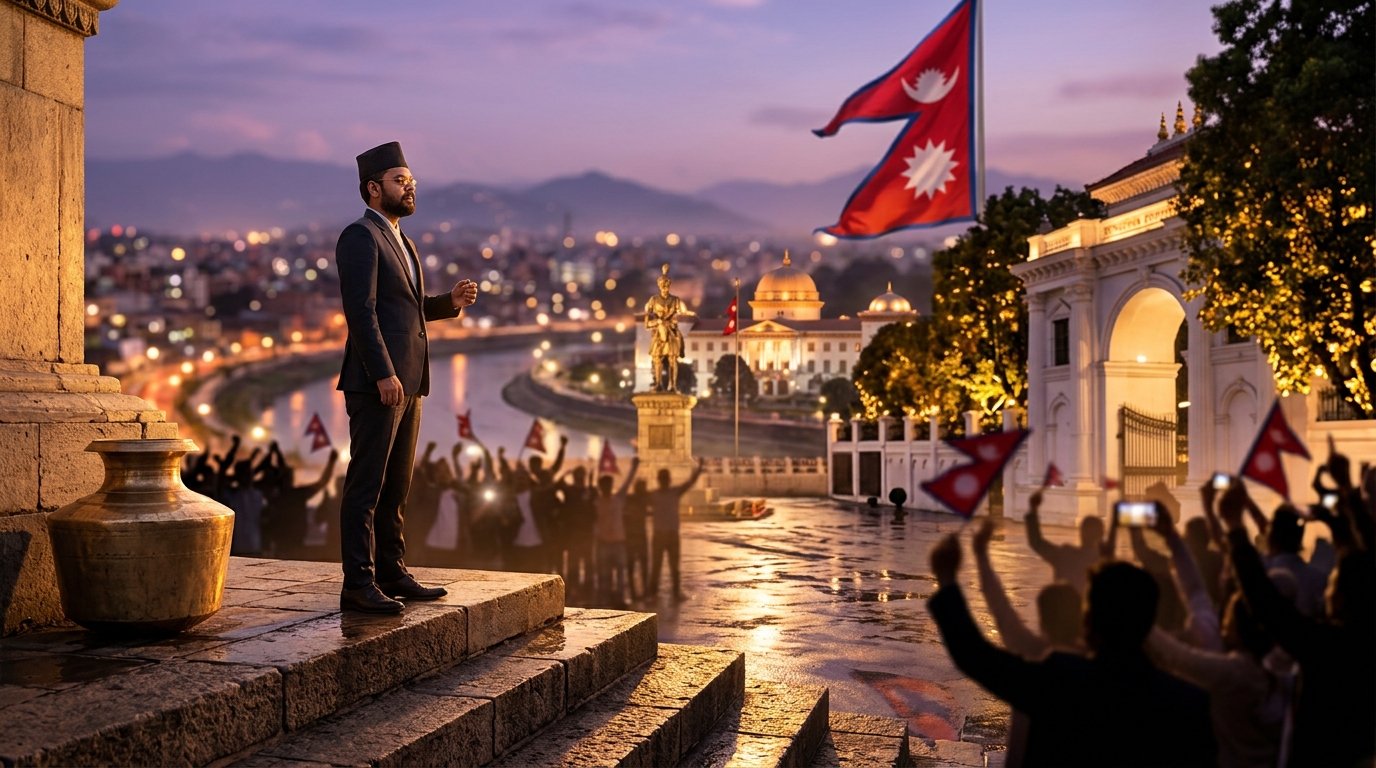
Rastriya Swatantra Party Wins 2026 Majority – Balendra Shah Becomes Nepal’s Youngest PM — UPSC Current Affairs | March 28, 2026
Rastriya Swatantra Party Wins 2026 Majority – Balendra Shah Becomes Nepal’s Youngest PM
In March 2026, Nepal’s newly‑formed <span class="key-term" data-definition="Rastriya Swatantra Party — a political party founded in 2022 that captured a parliamentary majority in the 2026 elections, reflecting anti‑establishment sentiment (GS2: Polity)">RSP</span> won an absolute majority, with rapper‑turned‑politician <strong>Balendra Shah</strong> defeating former PM K.P. Sharma Oli. The victory followed the violent September 2025 Gen‑Z uprising against a social‑media ban, marking a potential structural break in Nepal’s chronic political instability and economic dependence on remittances.
Rastriya Swatantra Party Wins 2026 Majority – Balendra Shah Becomes Nepal’s Youngest PM In the March 2026 general election, the RSP secured an absolute majority in the House of Representatives and topped the PR system. Balendra Shah , a former rapper and Kathmandu mayor, defeated ex‑PM K.P. Sharma Oli in Jhapa‑5, becoming the youngest prime minister at 35. Key Developments (Bullet Summary) RSP wins 132 of 275 seats, the first single‑party majority in Nepal in 27 years. Shah’s victory marks a decisive rejection of the traditional trio – Nepali Congress, CPN‑UML, and CPN (Maoist Centre) – which together fell to a combined 80 seats . The election followed the September 2025 Gen Z uprising that toppled the Oli government and caused ~76 deaths. Interim PM Sushila Karki dissolved parliament and scheduled elections for 5 March 2026. RSP’s earlier coalition experience (2022‑24) raises questions about its ability to govern without patronage politics. Important Facts • Nepal has witnessed 30 government changes since 1990 with no prime minister completing a full term. • Youth unemployment (15‑24 yr) stood at 22.7 % in 2022‑23. • Remittances constitute 33 % of GDP , reflecting a labour‑export model. • The country’s hydropower potential exceeds 80 GW, yet remains largely untapped. UPSC Relevance The episode illustrates several recurring themes in the UPSC syllabus: Muluki Ain and its legacy of extractive politics. The transition from Panchayat to multi‑party democracy and now to a possible new order. Impact of federalism debates on nation‑building. Role of remittances in sustaining a low‑development economy. How youth‑driven digital protests reshape political legitimacy – a case study for contemporary governance. Way Forward For the RSP to break the cycle of patronage politics, it must: Leverage its majority to pass land‑reform and industrial‑policy bills that unlock the hydropower potential and reduce reliance on remittances. Implement a comprehensive youth‑employment programme, targeting the 22.7 % unemployment rate. Address federalism concerns by ensuring equitable resource allocation to Madhesi and Janajati regions, avoiding a rollback of the 2015 Constitution. Strengthen institutional checks on the executive to prevent a return to elite‑driven patronage. Whether the RSP can translate its anti‑establishment mandate into structural reforms will determine if Nepal’s 2025‑26 moment is a genuine rupture or merely a generational change of guard.
Login to bookmark articles
Login to mark articles as complete
Overview
RSP’s 2026 landslide signals a youth‑driven shift in Nepal’s democratic trajectory
Key Facts
RSP secured 132 of 275 seats in the House of Representatives – first single‑party majority in 27 years.
Balendra Shah, 35‑year‑old former rapper and ex‑Mayor of Kathmandu, became Nepal’s youngest Prime Minister.
Traditional parties (NC, CPN‑UML, CPN‑Maoist Centre) together won only 80 seats, a historic decline.
Youth unemployment (age 15‑24) stood at 22.7% in 2022‑23, a key electoral issue.
Remittances account for 33% of Nepal’s GDP, underscoring the labour‑export model.
Untapped hydropower potential exceeds 80 GW, crucial for economic diversification.
Since 1990 Nepal has witnessed 30 government changes with no Prime Minister completing a full term.
Background & Context
The 2026 election outcome reflects the aftermath of the 2025 Gen‑Z uprising that toppled the Oli government, highlighting a decisive move away from entrenched patronage politics toward a youth‑led, anti‑establishment mandate. It ties into UPSC themes of democratic consolidation, federalism, and the economic challenges of a remittance‑dependent economy.
UPSC Syllabus Connections
GS2•Government policies and interventions for developmentGS2•Historical underpinnings, evolution, features, amendments, significant provisions and basic structureEssay•Democracy, Governance and Public AdministrationPrelims_GS•Constitution and Political SystemEssay•Society, Gender and Social JusticeGS1•Significant events, personalities and issues from mid-18th century to presentGS1•Social Empowerment, Communalism, Regionalism and SecularismEssay•Economy, Development and InequalityEssay•International Relations and GeopoliticsGS1•Poverty and Developmental Issues
Mains Answer Angle
GS 2 – Analyse how a single‑party majority under a youthful leader could reshape Nepal’s democratic institutions, governance reforms and federal‑state relations, and assess the risks and opportunities for political stability.