Overview
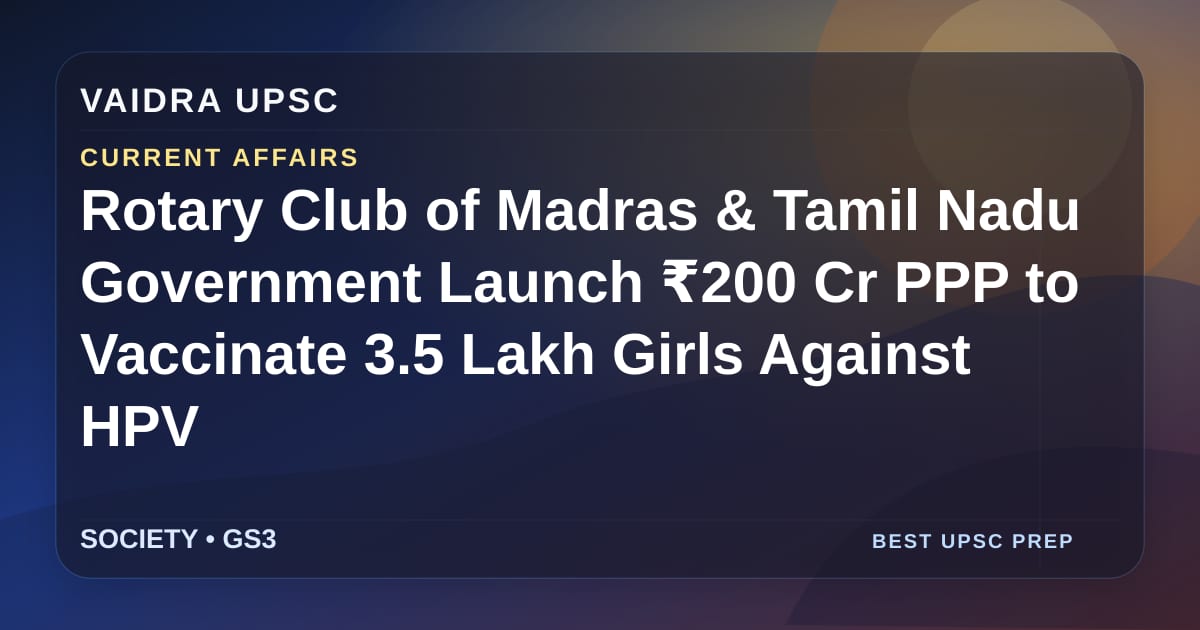
The Rotary Club of Madras and the Tamil Nadu government have signed a public‑private partnership worth about ₹200 crore. The deal aims to provide HPV vaccination to 3.5 lakh adolescent girls in Tamil Nadu, thereby preventing future cases of cervical cancer. The announcement was made in the presence of Darez Ahamed, Secretary, Health and Family Welfare Department, Tamil Nadu.
Key Developments
- Agreement signed between Rotary Club of Madras and the state government.
- Funding of ₹200 crore earmarked for procurement and delivery of HPV vaccination.
- Target group: 3.5 lakh girls aged 9‑14 years, the age window where vaccine efficacy is highest.
- Goal aligns with Rotary’s broader health agenda, including the Polio Plus programme, and a pledge to vaccinate one million children by the centenary year 2028‑29.
Important Facts
High‑risk HPV infections are responsible for more than 95 % of cervical cancer cases worldwide. Immunising girls before sexual debut can cut the incidence dramatically, reducing long‑term treatment costs and mortality.
Exam Relevance
This initiative touches upon multiple GS papers. GS 2 (Polity) examines the role of state governments and civil society in health delivery. GS 1 (Health) requires knowledge of disease burden, preventive strategies, and vaccination programmes. GS 3 (Economy) looks at financing of large‑scale public health interventions, especially PPP models. Finally, GS 4 (Ethics) evaluates the ethical dimension of partnering with NGOs for equitable health access.
Way Forward
To maximise impact, the partnership should focus on:
- Robust monitoring and real‑time data collection to track coverage.
- Community awareness campaigns that address vaccine hesitancy.
- Integration with existing school health programmes for seamless delivery.
- Scaling the model to other high‑burden states, creating a template for nationwide rollout.
Successful execution will not only curb cervical cancer but also showcase how NGOs and governments can co‑create sustainable health solutions.