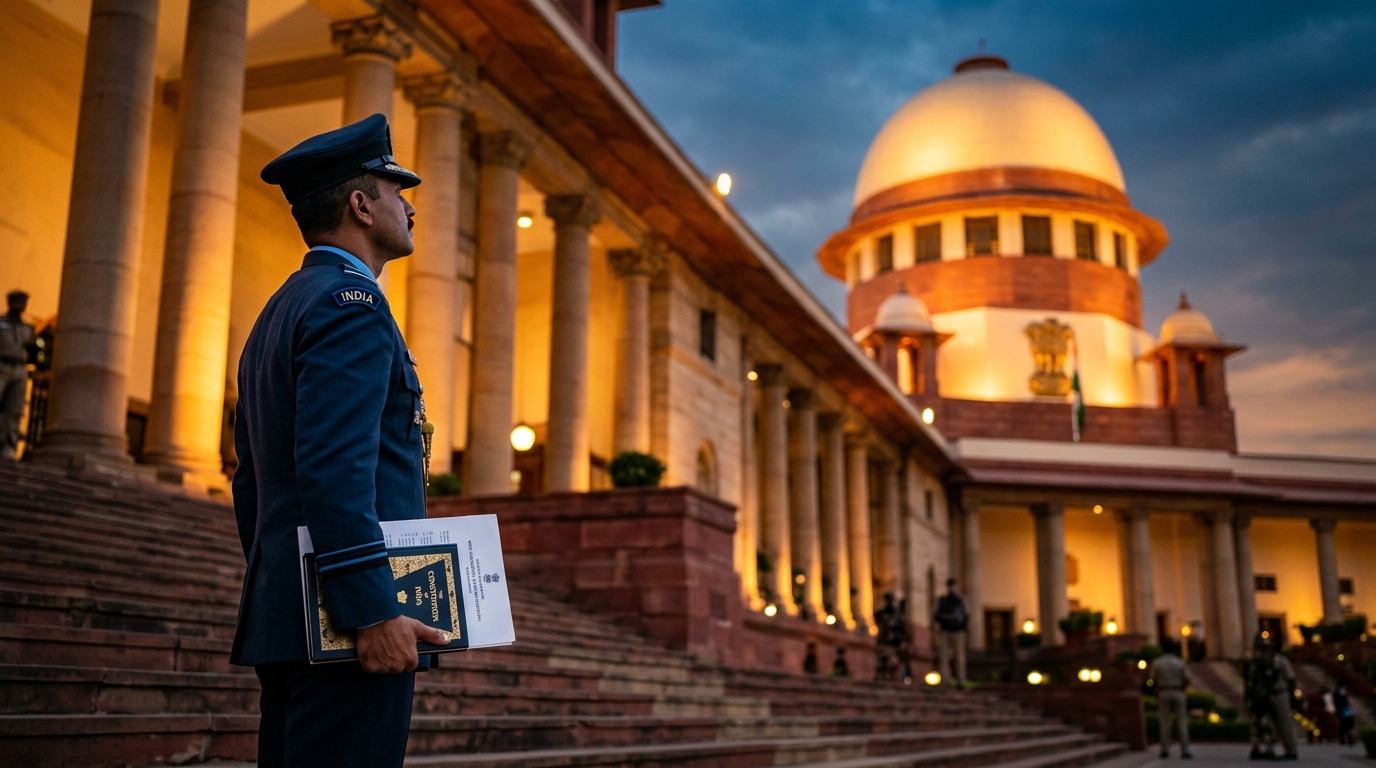
Supreme Court Declares Air Force Group Insurance Society a ‘State’ under Article 12 – Writ Jurisdiction Implications — UPSC Current Affairs | March 16, 2026
Supreme Court Declares Air Force Group Insurance Society a ‘State’ under Article 12 – Writ Jurisdiction Implications
The Supreme Court, in a bench of Justices Sanjay Karol and Vipul M. Pancholi, held that the <span class="key-term" data-definition="Air Force Group Insurance Society — a welfare and insurance body for Indian Air Force personnel, established under the President’s sanction; considered a State instrument for constitutional purposes (GS2: Polity)">Air Force Group Insurance Society</span> (AFGIS) is a ‘State’ under <span class="key-term" data-definition="Article 12 of the Indian Constitution defines ‘State’ and determines the scope of fundamental rights enforcement (GS2: Polity)">Article 12</span>, making it amenable to writ jurisdiction. The decision overturns the Delhi High Court’s view and has implications for the applicability of fundamental rights to quasi‑governmental bodies.
Overview The apex court has ruled that the Air Force Group Insurance Society (AFGIS) qualifies as a ‘State’ within the meaning of Article 12 . Consequently, the Society is subject to the Supreme Court’s writ jurisdiction . The judgment overturns a contrary finding of the Delhi High Court and clarifies the constitutional status of bodies performing public welfare functions for armed forces personnel. Key Developments Bench composition: Justices Sanjay Karol and Vipul M. Pancholi delivered the judgment. The Court applied the public function test and examined financial, functional and administrative control. Factors such as presidential sanction, deputation rules, compulsory membership, and a Board composed solely of serving IAF officers were deemed indicative of State control. The decision reverses the Delhi High Court’s view that AFGIS was a self‑contained welfare scheme funded by member contributions. The case originated from a pay‑scale dispute after the Board initially aligned with the Sixth Central Pay Commission and later delinked from it. Important Facts Establishment: AFGIS was created by a sanction from the President of India, with deputation rules also approved at the presidential level. Governance: Both the Board of Trustees and the Managing Committee consist exclusively of serving Indian Air Force officers appointed for fixed tenures. Financial oversight: Monthly cash‑flow reports are sent to the Assistant Chief of Air Staff, ensuring continuous monitoring by senior IAF officials. Compulsory nature: Membership and premium deductions are mandatory for all IAF personnel, reflecting an employer‑mandated scheme rather than a voluntary private arrangement. Legal trajectory: Employees filed writ petitions under Article 226 in 2017; the High Court dismissed them, prompting the Supreme Court appeal. UPSC Relevance This judgment is a landmark for instrumentality of State jurisprudence. Aspirants should note: The test for ‘State’ is not limited to ownership; it includes the nature of functions, degree of governmental control, and accountability. Entities performing a public function (e.g., welfare, insurance for armed forces) can be treated as a State. The case illustrates the interplay between constitutional law (Article 12, writ jurisdiction) and administrative law (deputation, financial oversight). Understanding such precedents aids in answering GS2 questions on constitutional provisions, judicial review, and the definition of ‘State’. Way Forward Following the judgment, the Delhi High Court has been directed to dispose of the pending writ petitions expeditiously. The ruling may prompt a re‑examination of other welfare societies, autonomous bodies, and public‑private partnerships to assess their constitutional status. For policymakers, the decision underscores the need for clear statutory demarcation when creating quasi‑governmental institutions, ensuring transparency in control mechanisms and funding sources.
Must Review
Login to bookmark articles
Login to mark articles as complete
Overview
SC expands ‘State’ definition, pulling welfare societies like AFGIS under writ jurisdiction
Key Facts
Supreme Court, bench of Justices Sanjay Karol & Vipul M. Pancholi, held AFGIS a ‘State’ under Article 12.
AFGIS was created by a presidential sanction; deputation rules and Board appointments are also presidentially approved.
Board of Trustees and Managing Committee consist exclusively of serving Indian Air Force officers appointed for fixed tenures.
Membership and premium deductions are compulsory for all IAF personnel, making it an employer‑mandated scheme.
Monthly cash‑flow reports of AFGIS are sent to the Assistant Chief of Air Staff, ensuring continuous governmental financial oversight.
Writ petitions filed under Article 226 in 2017 were dismissed by Delhi High Court; SC reversed the decision, directing the High Court to dispose of pending petitions.
The Court applied the public function test, examining financial, functional and administrative control to deem AFGIS a State instrument.
Background & Context
Article 12 defines ‘State’ for the enforcement of fundamental rights. The Supreme Court’s reliance on the public function test broadens the scope beyond ownership, encompassing entities that perform public duties under governmental control—crucial for understanding State liability and judicial review in Indian polity.
UPSC Syllabus Connections
Essay•Democracy, Governance and Public AdministrationPrelims_GS•Constitution and Political SystemGS4•Concept of public service, philosophical basis of governance and probityGS4•Dimensions of ethics - private and public relationshipsGS2•Functions and responsibilities of Union and StatesGS2•Executive and Judiciary - structure, organization and functioningPrelims_CSAT•Decision MakingGS2•Welfare schemes for vulnerable sectionsPrelims_GS•National Current AffairsGS4•Integrity, impartiality, non-partisanship, objectivity and dedication to public service
Mains Answer Angle
GS‑2: Discuss how the Supreme Court’s interpretation of ‘State’ under Article 12 impacts the accountability of quasi‑governmental bodies like welfare societies, and its implications for governance and judicial review.