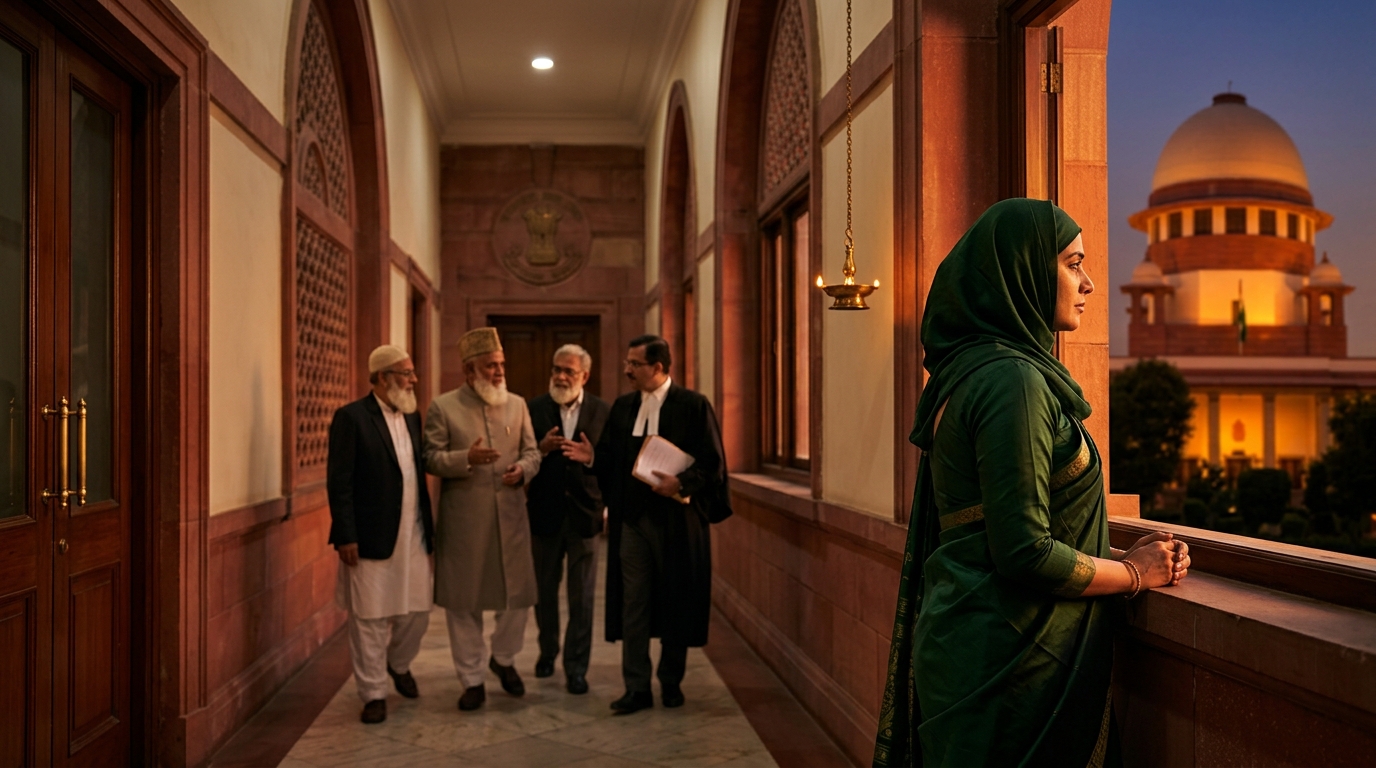
Supreme Court Deliberates Women’s Access to Mosques
On Thursday, 23 April 2026, the Supreme Court heard arguments from the AIMPLB regarding women’s right to enter mosques and offer namaz. The petitions are part of the larger Sabarimala reference, where constitutional questions under Article 25 and Article 26 are being examined.
Key Developments
- Senior Advocate MR Shamsahd argued that there is no doctrinal prohibition against women entering a mosque; the only restriction is that congregational prayer is not obligatory for women.
- The bench, headed by CJI Surya Kant, sought factual clarity on whether women are allowed to enter mosques.
- Shamsahd cited prophetic traditions stating that the Prophet Muhammad did not forbid women from attending mosques, emphasizing that the practice is historically accepted across Islamic denominations.
- The counsel highlighted that while women may pray at home, they are free to join the congregation if they wish; the issue is not about mandatory participation.
- The petition also seeks entry through the main door and unrestricted visual and auditory access to the musalla, which the counsel described as an attempt to import the “sanctum sanctorium” concept from dargahs into mosques.
- Shamsahd contended that the ERP framework has been misapplied to Islam, noting that courts have repeatedly declared mosque‑related practices non‑essential.
- Reference was made to the Ismail Farooqui case where the court held that prayer can be performed in open spaces, thereby questioning the “essentiality” of a mosque.
Important Facts
- All major Islamic schools of thought concur that women are not barred from mosque entry, though congregational prayer is not compulsory for them.
- The counsel warned that imposing a barrier or segregated space inside the mosque would contravene the internal discipline prescribed by Islamic jurisprudence.
- Previous judgments have misinterpreted Arabic Hadith translations, leading to skewed ERP assessments.
- A parallel case involving a Muslim soldier’s beard was cited to illustrate how courts sometimes deem a religious symbol non‑essential, a stance the counsel argues is inconsistent with Sikh law where a beard is a mandated principle.
- The ASI rule limiting monument usage to daylight hours could, if applied to a mosque, prevent three daily prayers, showcasing how neutral‑seeming regulations may disproportionately affect religious practice.
Exam Relevance
The debate touches upon core constitutional provisions (Article 25 and Article 26), the judiciary’s role in interpreting religious freedom, and the methodology of the ERP test. Aspirants should note how the Supreme Court balances individual rights with community customs, a recurring theme in GS2 (Polity) and GS1 (Society). Understanding the interplay of personal law boards, constitutional articles, and judicial precedents is essential for answering questions on religious liberty, secularism, and minority rights.
Way Forward
- Monitor the bench’s final judgment to gauge how the Court will delineate “essential” religious practices for Islam.
- Analyse the impact of any ruling on future litigation concerning other places of worship, especially where “sanctum sanctorium” concepts are contested.
- Prepare comparative case studies (e.g., Sabarimala, temple entry, Sikh beard) to illustrate the Court’s evolving jurisprudence on religious freedom.
- For UPSC preparation, focus on constitutional safeguards, the role of personal law boards, and the methodological challenges of applying ERP across diverse faiths.