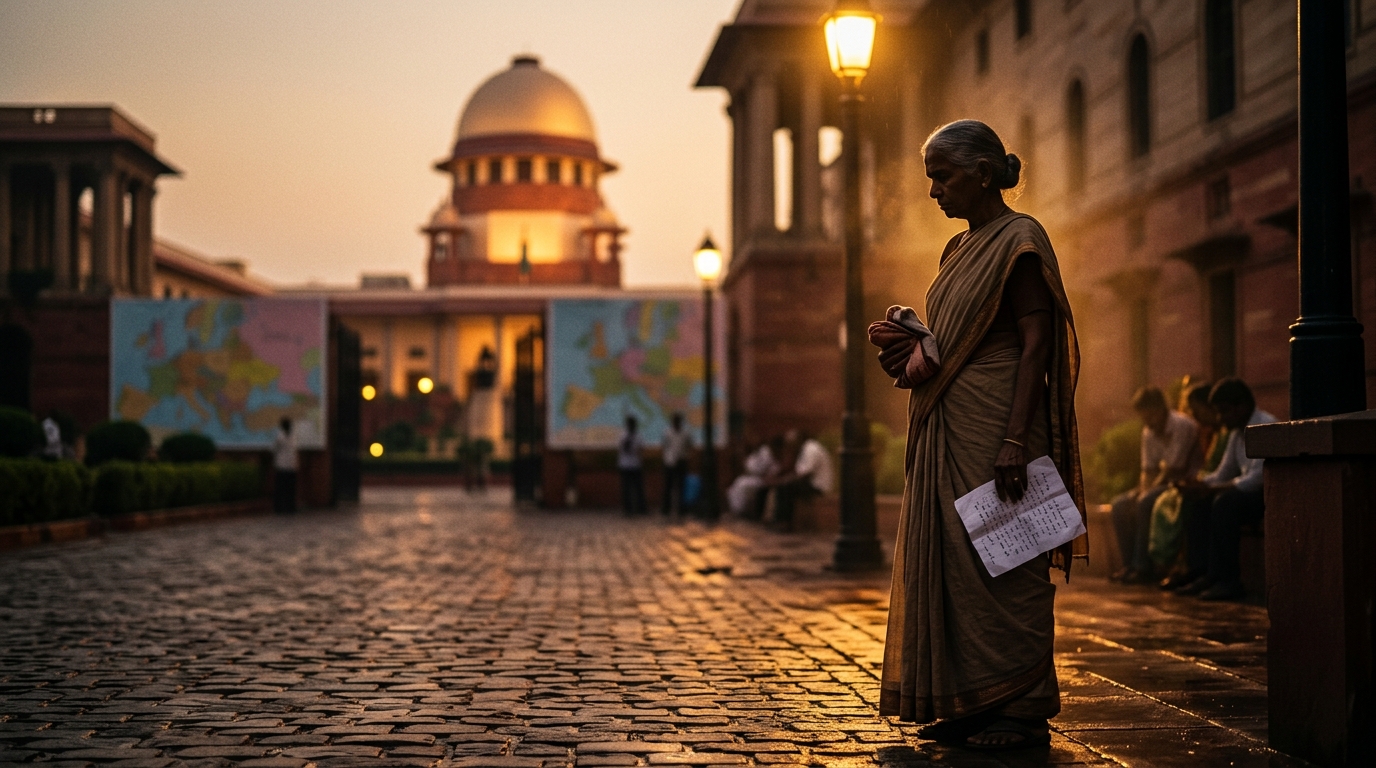
Supreme Court Hearing on Deaths of Indian Nationals in Ukraine War – Govt’s Response
The Supreme Court on 24 April 2026 heard a writ petition filed by families of 26 Indians who had gone to Russia seeking employment and were later caught up in the Ukraine war. The Union Government, represented by Additional Solicitor General Aiswharya Bhati, informed the bench that 10 of the 26 petitioners have died, most of them having joined the Russian forces under voluntary contracts. The bench comprised Chief Justice of India Surya Kant, Justice Joymalya Bagchi and Justice Vipul Pancholi.
Key Developments
- Union Government confirmed that 10 Indian citizens have died while fighting in the Ukraine war.
- The Ministry of External Affairs (MEA) has been in regular contact with families, according to the ASG.
- One petitioner is in prison on a criminal charge; another continues to serve voluntarily in Russia.
- The court directed MEA to submit a detailed status report on actions taken.
- Instances of misleading recruitment agents were highlighted; one such agent has been arrested.
Important Facts
- Total Indians who travelled to Russia: 215.
- Families of 26 individuals approached the Court.
- Government has arranged for the return of mortal remains, but faces logistical hurdles and lack of cooperation from some families.
- Petitioners allege that passports were confiscated and they were coerced into combat.
- MEA claims it has been guiding potential migrants to avoid such contracts.
Exam Relevance
This case touches upon several GS topics. The role of the Supreme Court and the Chief Justice of India illustrates judicial oversight in matters of citizen welfare abroad. The involvement of the MEA underscores diplomatic challenges in conflict zones. The phenomenon of voluntary contracts with foreign entities raises concerns about labour migration, human trafficking, and the need for robust regulatory frameworks. Finally, the incident reflects India’s broader foreign‑policy dilemma of balancing strategic ties with Russia against the safety of its citizens.
Way Forward
- MEA should expedite the detailed status report and share it with the Court and petitioners.
- Strengthen monitoring of overseas recruitment agencies to prevent misinformation and coercion.
- Establish a fast‑track consular mechanism for repatriation of mortal remains and identification of deceased citizens.
- Consider legislative measures to regulate foreign‑based employment contracts and protect Indian workers abroad.
- Engage with Russian authorities to secure the safe return of Indian nationals still in the conflict zone.
Case: DIVYA vs. UNION OF INDIA W.P.(C) No. 000451/2026.