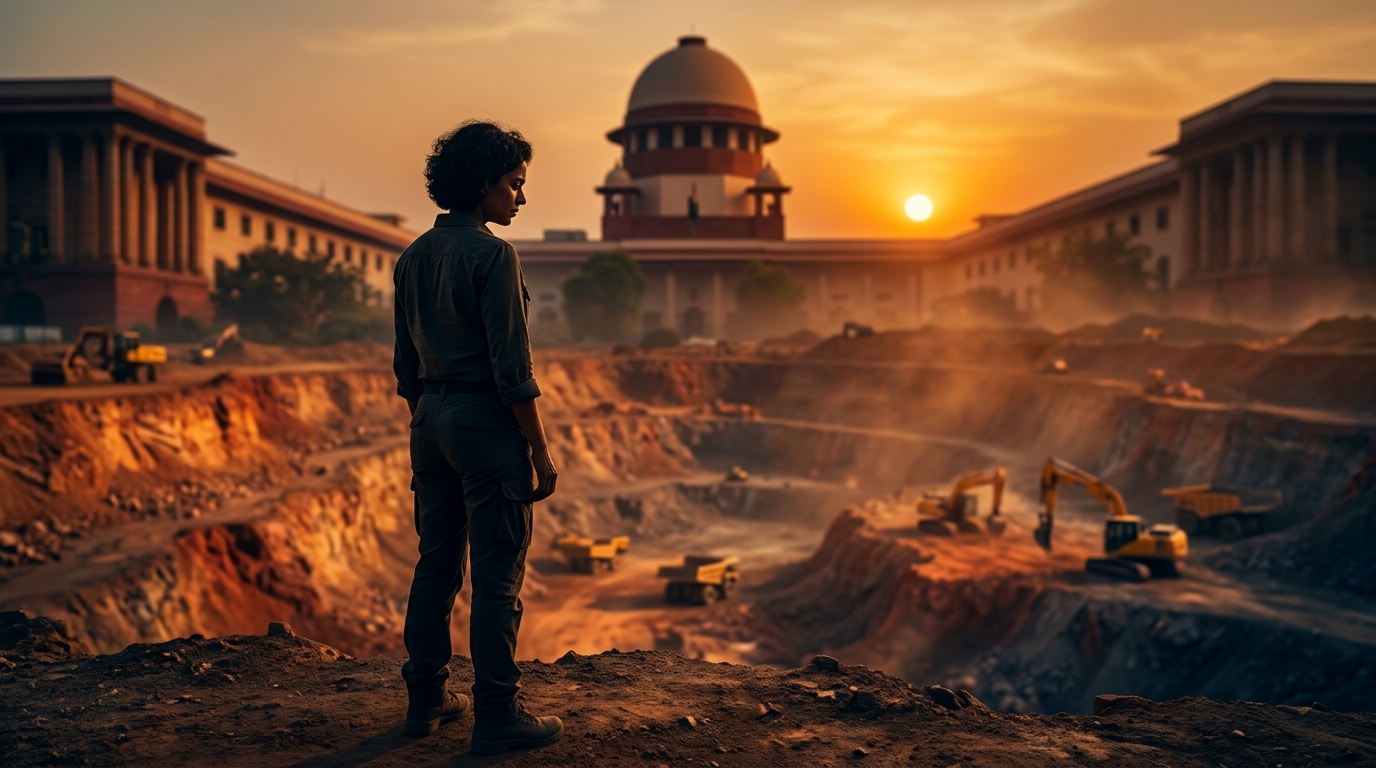
Supreme Court Review of Post‑Facto Environmental Clearances
The Supreme Court bench comprising CJI Surya Kant, Justice Joymalya Bagchi and Justice Vipul Pancholi heard a writ petition filed by the NGO Vanashakti challenging the legality of granting environmental clearances after a project has already commenced.
Key Developments
- Senior Advocate Gopal Sankaranarayanan argued that ex post facto clearance cannot be justified under Environment Protection Act (EPA) Section 3.
- Justice Bagchi acknowledged that limited regularisation might be permissible where environmental harm is minimal and public interest (e.g., roads, hospitals) is high.
- The bench noted that India’s contribution to global pollution is under 10%, raising a paradox about national strictness versus global outcomes.
- Both sides cited the 2017 notification (one‑time amnesty) and the 2021 Standard Operating Procedure (SOP) as the only legal windows for post‑facto clearance.
- Vanashakti highlighted that penalties imposed under the current framework are modest, undermining deterrence.
Important Facts
According to the Ministry of Environment, Forest and Climate Change affidavit, 417 violation cases received clearance under the 2017 notification, 514 were pending at the state level, and 366 clearances were granted under the July 7 2021 SOP, effectively creating a back‑door for fresh regularisations.
The petition contends that such blanket regularisation violates Articles 14 and 21 because it creates arbitrary advantage for violators over compliant promoters.
Justice Bagchi suggested that coupling post‑facto clearances with the Polluter‑Pays Principle and punitive costs could act as a deterrent, but acknowledged the need for robust safeguards.
Exam Relevance
This case touches upon several core UPSC topics:
- Environmental Governance: Interpretation of the EPA and the role of the judiciary in environmental regulation.
- Constitutional Law: Application of Articles 14 & 21 to administrative actions.
- Policy‑Making vs. Judicial Review: Balancing public‑interest projects (roads, hospitals) against the principle of prior environmental clearance.
- International Environmental Ethics: The paradox of national compliance versus global climate outcomes, relevant for GS4 (Ethics) and GS3 (Environment).
Way Forward
For a sustainable legal framework, the following steps are suggested:
- Amend Section 3 to expressly prohibit blanket post‑facto clearances, limiting them to narrowly defined public‑interest cases.
- Introduce a tiered penalty structure where violations attract fines of at least 200‑300% of the project cost, aligning with Vanashakti’s demand for deterrence.
- Ensure any post‑facto clearance is conditioned on compliance with the Polluter‑Pays Principle and mandatory remedial measures.
- Set a clear expiry for amnesty schemes (like the 2017 notification) to prevent their misuse as a permanent regularisation route.
- Strengthen inter‑agency coordination between the Ministry of Environment, State Pollution Control Boards, and the judiciary to monitor implementation.
These measures would uphold constitutional guarantees, reinforce the rule of law, and ensure that environmental protection remains a priority in India’s development agenda.