TDB‑DST Supports InfinityX Innovations for Automated Battery Swapping Stations to Accelerate EV Adoption — UPSC Current Affairs | March 24, 2026
TDB‑DST Supports InfinityX Innovations for Automated Battery Swapping Stations to Accelerate EV Adoption
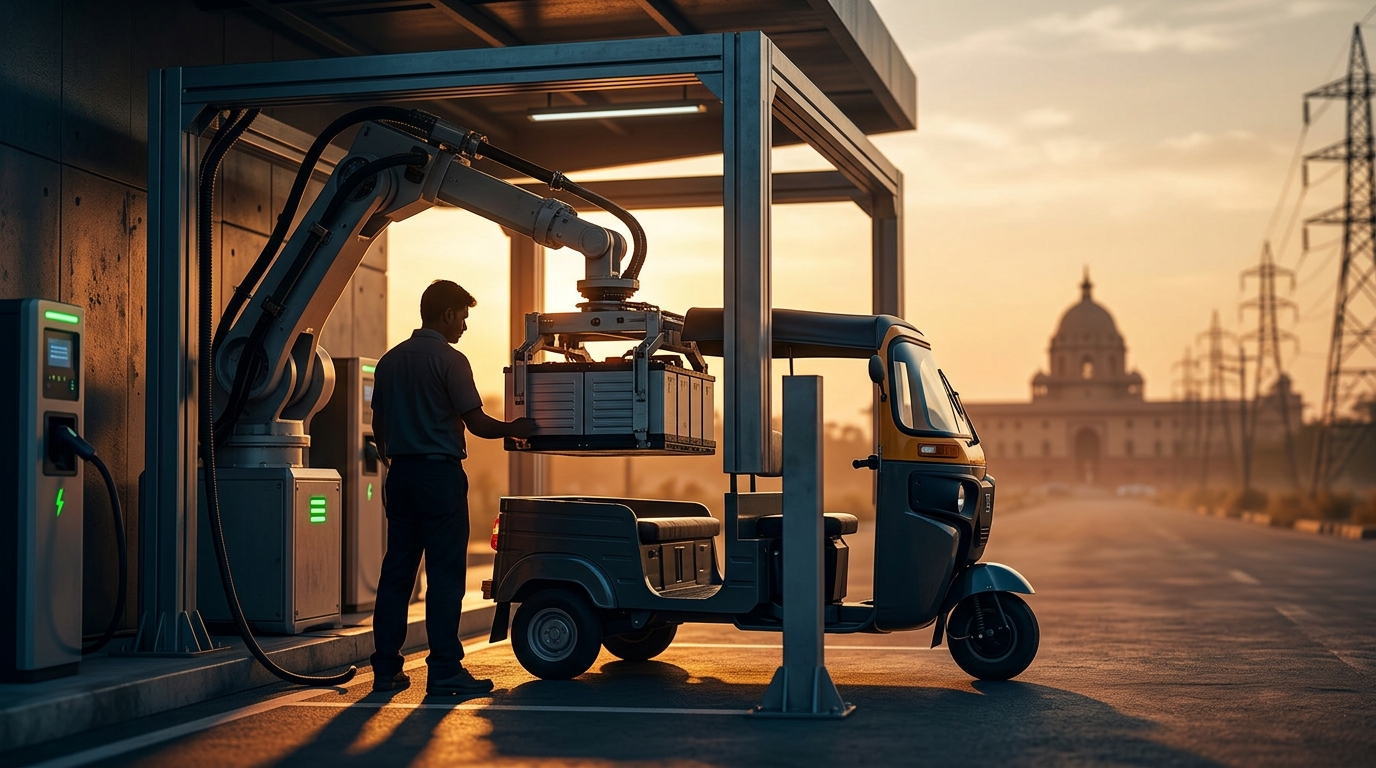
The Technology Development Board (TDB) under the Department of Science & Technology (DST) has approved financial assistance to InfinityX Innovations for setting up automated, IoT‑enabled battery‑swapping stations that can replace an EV battery in under 40 seconds. The move aims to accelerate electric‑vehicle adoption, especially for commercial fleets and gig‑economy deliveries, while promoting indigenous, self‑reliant clean‑mobility technology.
Technology Development Board backs automated battery‑swapping ecosystem The TDB of the DST has signed an agreement with Bengaluru‑based InfinityX Innovations Private Limited to develop and scale automated battery swapping stations for EVs . Key Developments Financial assistance granted to InfinityX for commercialising an IoT -enabled swapping infrastructure. Targeted battery‑swap time of less than 40 seconds , addressing the charging‑time barrier for commercial fleets and last‑mile delivery services. Modular battery architecture designed for interoperability across multiple vehicle platforms, supporting the gig economy and fleet operators. Establishment of a dedicated manufacturing unit in Bengaluru to produce next‑generation battery packs and swapping stations. Goal to create a standardized, indigenous swapping network, reducing dependence on imported technologies. Important Facts The agreement was announced on 24 March 2026 by Shri Rajesh Kumar Pathak, Secretary, TDB . InfinityX’s solution promises high thermal stability and reliability under diverse Indian climatic conditions. The project aligns with the government’s broader push for self‑reliant clean‑mobility technologies. UPSC Relevance Understanding this initiative helps aspirants grasp several GS themes: the role of public‑sector funding agencies ( TDB ) in technology commercialization; the strategic importance of electric‑vehicle adoption in meeting Paris Agreement targets; and the emphasis on indigenous innovation as part of the Atmanirbhar Bharat agenda. Way Forward Scale up pilot swapping stations in high‑density commercial corridors and tier‑2/3 cities. Formulate national standards for battery form‑factor and communication protocols to ensure interoperability. Encourage public‑private partnerships to expand the swapping network, especially in logistics hubs. Integrate renewable energy sources at swapping stations to enhance sustainability. Monitor performance metrics such as swap time, safety incidents, and cost‑effectiveness to guide policy refinements. By fostering rapid, reliable battery swapping, the initiative aims to make EVs as convenient as conventional fuel vehicles, thereby accelerating India’s transition to a low‑carbon transport ecosystem.
Login to bookmark articles
Login to mark articles as complete
Overview
TDB‑DST backs automated battery swapping to fast‑track EV adoption and reduce import dependence
Key Facts
24 March 2026 – TDB (under DST) signed an agreement with InfinityX Innovations Pvt Ltd.
InfinityX, a Bengaluru‑based startup, will develop IoT‑enabled automated battery‑swapping stations.
Targeted battery‑swap time is less than 40 seconds, aimed at commercial fleets and last‑mile delivery.
Financial assistance is being provided to commercialise the swapping infrastructure and set up a manufacturing unit in Bengaluru.
The project seeks to create a standardized, indigenous swapping network, cutting reliance on imported technologies.
Modular battery architecture will ensure interoperability across multiple EV platforms, supporting the gig‑economy.
The initiative aligns with India’s Atmanirbhar Bharat and Paris Agreement commitments for clean mobility.
Background & Context
India’s EV push faces a charging‑time bottleneck, especially for commercial fleets. Battery‑swapping offers a rapid, infrastructure‑light solution, complementing charging stations and aiding climate‑targeted transport decarbonisation. Public‑sector funding through TDB exemplifies the government’s strategy of catalysing indigenous clean‑tech startups under the Atmanirbhar agenda.
UPSC Syllabus Connections
Essay•Economy, Development and InequalityGS3•Developments in science and technology and their applicationsEssay•Science, Technology and SocietyPrelims_GS•Environmental Issues and Climate Change
Mains Answer Angle
GS‑3 (Science & Technology) – Discuss the role of public‑sector funding agencies like TDB in accelerating indigenous clean‑mobility technologies and evaluate battery‑swapping as a policy instrument for EV adoption.