Loading page, please wait…
HomeCurrent AffairsEditorialsGovt SchemesLearning ResourcesUPSC SyllabusPricingAboutBest UPSC AIUPSC AI ToolAI for UPSCUPSC ChatGPT

© 2026 Vaidra. All rights reserved.

PrivacyTerms
Vaidra Logo
Vaidra

Top 4 items + smart groups

UPSC GPT
New
Current Affairs
Daily Solutions
Daily Puzzle
Mains Evaluator

Version 2.0.0 • Built with ❤️ for UPSC aspirants

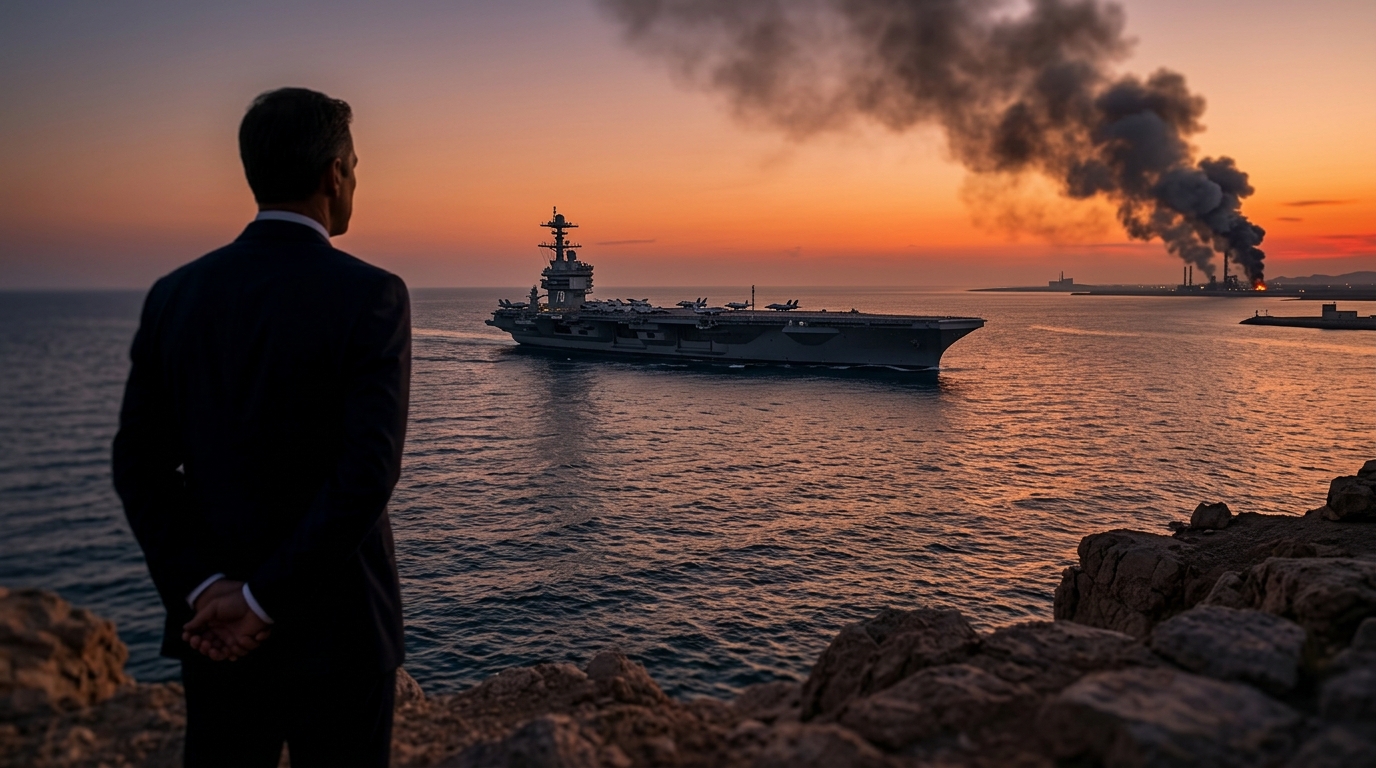
Trump Says US Not Rushing to End Iran War; Carrier Arrives as Tehran Faces Blast Since Ceasefire

Trump Says US Not Rushing to End Iran War; Carrier Arrives as Tehran Faces Blast Since Ceasefire
On 24 April 2026, President Donald Trump warned Iran that the US is not rushing to end the war but that "the clock is ticking," as a third US carrier entered West Asia. Iranian media reported the first blasts over Tehran since a ceasefire took effect two weeks earlier, highlighting the fragility of the truce and its relevance to UPSC topics on foreign policy, defence, and international relations.
Overview On Thursday, 24 April 2026 , President Donald Trump warned that the Iran must act quickly, even as the United States shows no hurry to conclude the ongoing conflict. The deployment of a third carrier in West Asia underscores Washington’s continued military presence. Meanwhile, Iranian media reported explosions over Tehran , marking the first such incident since a fragile ceasefire took effect two weeks ago. Key Developments A third US carrier entered the theatre, reinforcing the existing naval task force. President Donald Trump stated that while the US is not in a rush to end the war, “the clock is ticking” for Iran. Iranian state media reported blasts over Tehran , the first since the ceasefire began. The ceasefire, announced two weeks prior, remains tenuous, with both sides accusing each other of violations. Important Facts The United States currently operates a carrier strike group in the Arabian Sea, now augmented by an additional carrier, enhancing air‑power reach over the Persian Gulf. The ceasefire was brokered by a coalition of regional powers, aiming to prevent a full‑scale escalation. Iran’s domestic narrative frames the blasts as a response to perceived US aggression, while US officials cite them as evidence of Iran’s non‑compliance. UPSC Relevance Understanding this development is crucial for several UPSC dimensions: GS 2 – Polity & International Relations: The role of the US President in shaping foreign policy, the strategic calculus of Iran, and the dynamics of ceasefire negotiations. GS 3 – Defence & Security: The strategic importance of carrier deployments in power projection and deterrence. GS 4 – Ethics & Integrity: The ethical considerations of war‑time communication, propaganda, and the impact of civilian casualties in capital cities. Way Forward For policymakers, the immediate priority is to sustain the ceasefire while opening diplomatic channels to address Iran’s security concerns. Confidence‑building measures, such as humanitarian aid and limited verification mechanisms, could reduce mistrust. Simultaneously, the US must balance its show of force with diplomatic outreach to avoid further escalation. Aspirants should monitor subsequent statements from both capitals, track any UN Security Council interventions, and analyse how regional alliances (e.g., GCC, Russia, China) respond to the evolving situation.
  1. Home
  2. Prepare
  3. Current Affairs
  4. Trump Says US Not Rushing to End Iran War; Carrier Arrives as Tehran Faces Blast Since Ceasefire
Login to bookmark articles
Login to mark articles as complete

Overview

gs.gs276% UPSC Relevance

US carrier buildup and Trump’s warning signal heightened US‑Iran tensions post‑ceasefire

Key Facts

  1. On 24 April 2026, President Donald Trump warned Iran that “the clock is ticking” while stating the US is not rushing to end the war.
  2. A third US aircraft carrier entered the West Asian theatre, augmenting the existing carrier strike group in the Arabian Sea.
  3. The ceasefire between the US‑led coalition and Iran was brokered on 10 April 2026 and remains fragile, with both sides accusing each other of violations.
  4. Iranian state media reported the first explosions over Tehran since the ceasefire, heightening domestic and international tensions.
  5. The carrier strike group enhances US power‑projection capability over the Persian Gulf, a strategic chokepoint for global oil supplies.
  6. The ceasefire was mediated by a coalition of regional powers including GCC states, Russia and China, reflecting multilateral diplomatic involvement.

Background & Context

The deployment of a third US carrier underscores Washington’s naval deterrence doctrine and signals strategic pressure on Tehran, while the fragile ceasefire, brokered by regional and extra‑regional actors, illustrates the complex interplay of power politics and diplomatic mediation in West Asia. For UPSC, this episode links to GS 2 (India’s foreign policy, US‑Iran relations, ceasefire negotiations) and GS 3 (defence strategy, carrier strike groups, maritime security).

Mains Answer Angle

GS 2 – Analyse how US presidential signalling and naval power projection influence Iran’s strategic calculus and the durability of the 10‑April ceasefire; GS 3 – Evaluate the role of aircraft carriers in modern power projection and regional stability.

Full Article

<h3>Overview</h3> <p>On <strong>Thursday, 24 April 2026</strong>, <span class="key-term" data-definition="President of the United States — the chief executive and chief diplomat of the United States; his statements shape US foreign policy (GS2: Polity)">President Donald Trump</span> warned that the <span class="key-term" data-definition="Islamic Republic of Iran — a major Middle‑Eastern state often at odds with the United States over regional security and nuclear issues (GS2: Polity)">Iran</span> must act quickly, even as the United States shows no hurry to conclude the ongoing conflict. The deployment of a third <span class="key-term" data-definition="Aircraft carrier — a large warship that serves as a floating airbase, central to US power projection and naval strategy (GS3: Defence)">carrier</span> in <span class="key-term" data-definition="West Asia — the geopolitical region comprising the Middle East, including Iran, Saudi Arabia, Iraq and surrounding states (GS2: Polity)">West Asia</span> underscores Washington’s continued military presence. Meanwhile, Iranian media reported explosions over <span class="key-term" data-definition="Tehran — the capital city of Iran and the hub of its political and administrative apparatus (GS2: Polity)">Tehran</span>, marking the first such incident since a fragile <span class="key-term" data-definition="Ceasefire — a temporary suspension of hostilities agreed by warring parties, often used to de‑escalate conflicts (GS3: International Relations)">ceasefire</span> took effect two weeks ago.</p> <h3>Key Developments</h3> <ul> <li>A third US <span class="key-term" data-definition="Aircraft carrier — a large warship that serves as a floating airbase, central to US power projection and naval strategy (GS3: Defence)">carrier</span> entered the theatre, reinforcing the existing naval task force.</li> <li><span class="key-term" data-definition="President of the United States — the chief executive and chief diplomat of the United States; his statements shape US foreign policy (GS2: Polity)">President Donald Trump</span> stated that while the US is not in a rush to end the war, “the clock is ticking” for Iran.</li> <li>Iranian state media reported blasts over <span class="key-term" data-definition="Tehran — the capital city of Iran and the hub of its political and administrative apparatus (GS2: Polity)">Tehran</span>, the first since the <span class="key-term" data-definition="Ceasefire — a temporary suspension of hostilities agreed by warring parties, often used to de‑escalate conflicts (GS3: International Relations)">ceasefire</span> began.</li> <li>The ceasefire, announced two weeks prior, remains tenuous, with both sides accusing each other of violations.</li> </ul> <h3>Important Facts</h3> <p>The United States currently operates a carrier strike group in the Arabian Sea, now augmented by an additional carrier, enhancing air‑power reach over the Persian Gulf. The ceasefire was brokered by a coalition of regional powers, aiming to prevent a full‑scale escalation. Iran’s domestic narrative frames the blasts as a response to perceived US aggression, while US officials cite them as evidence of Iran’s non‑compliance.</p> <h3>UPSC Relevance</h3> <p>Understanding this development is crucial for several UPSC dimensions:</p> <ul> <li><strong>GS 2 – Polity & International Relations:</strong> The role of the US President in shaping foreign policy, the strategic calculus of Iran, and the dynamics of ceasefire negotiations.</li> <li><strong>GS 3 – Defence & Security:</strong> The strategic importance of <span class="key-term" data-definition="Aircraft carrier — a large warship that serves as a floating airbase, central to US power projection and naval strategy (GS3: Defence)">carrier</span> deployments in power projection and deterrence.</li> <li><strong>GS 4 – Ethics & Integrity:</strong> The ethical considerations of war‑time communication, propaganda, and the impact of civilian casualties in capital cities.</li> </ul> <h3>Way Forward</h3> <p>For policymakers, the immediate priority is to sustain the ceasefire while opening diplomatic channels to address Iran’s security concerns. Confidence‑building measures, such as humanitarian aid and limited verification mechanisms, could reduce mistrust. Simultaneously, the US must balance its show of force with diplomatic outreach to avoid further escalation. Aspirants should monitor subsequent statements from both capitals, track any UN Security Council interventions, and analyse how regional alliances (e.g., GCC, Russia, China) respond to the evolving situation.</p>
Read Original on hindu

Analysis

Practice Questions

GS2
Easy
Prelims MCQ

US strategic signalling and carrier deployments

1 marks
4 keywords
GS2
Medium
Mains Short Answer

Ceasefire durability and power projection

10 marks
5 keywords
GS2
Hard
Mains Essay

Multilateral diplomacy and conflict resolution

25 marks
7 keywords
Related:Daily•Weekly

Loading related articles...

Loading related articles...

Tip: Click articles above to read more from the same date, or use the back button to see all articles.

Quick Reference

Key Insight

US carrier buildup and Trump’s warning signal heightened US‑Iran tensions post‑ceasefire

Key Facts

  1. On 24 April 2026, President Donald Trump warned Iran that “the clock is ticking” while stating the US is not rushing to end the war.
  2. A third US aircraft carrier entered the West Asian theatre, augmenting the existing carrier strike group in the Arabian Sea.
  3. The ceasefire between the US‑led coalition and Iran was brokered on 10 April 2026 and remains fragile, with both sides accusing each other of violations.
  4. Iranian state media reported the first explosions over Tehran since the ceasefire, heightening domestic and international tensions.
  5. The carrier strike group enhances US power‑projection capability over the Persian Gulf, a strategic chokepoint for global oil supplies.
  6. The ceasefire was mediated by a coalition of regional powers including GCC states, Russia and China, reflecting multilateral diplomatic involvement.

Background

The deployment of a third US carrier underscores Washington’s naval deterrence doctrine and signals strategic pressure on Tehran, while the fragile ceasefire, brokered by regional and extra‑regional actors, illustrates the complex interplay of power politics and diplomatic mediation in West Asia. For UPSC, this episode links to GS 2 (India’s foreign policy, US‑Iran relations, ceasefire negotiations) and GS 3 (defence strategy, carrier strike groups, maritime security).

Mains Angle

GS 2 – Analyse how US presidential signalling and naval power projection influence Iran’s strategic calculus and the durability of the 10‑April ceasefire; GS 3 – Evaluate the role of aircraft carriers in modern power projection and regional stability.

Explore:Current Affairs·Editorial Analysis·Govt Schemes·Study Materials·Previous Year Questions·UPSC GPT

Related Topics

  • 📖Glossary TermUN
Trump Says US Not Rushing to End Iran War;... | UPSC Current Affairs