<h2>Overview</h2>
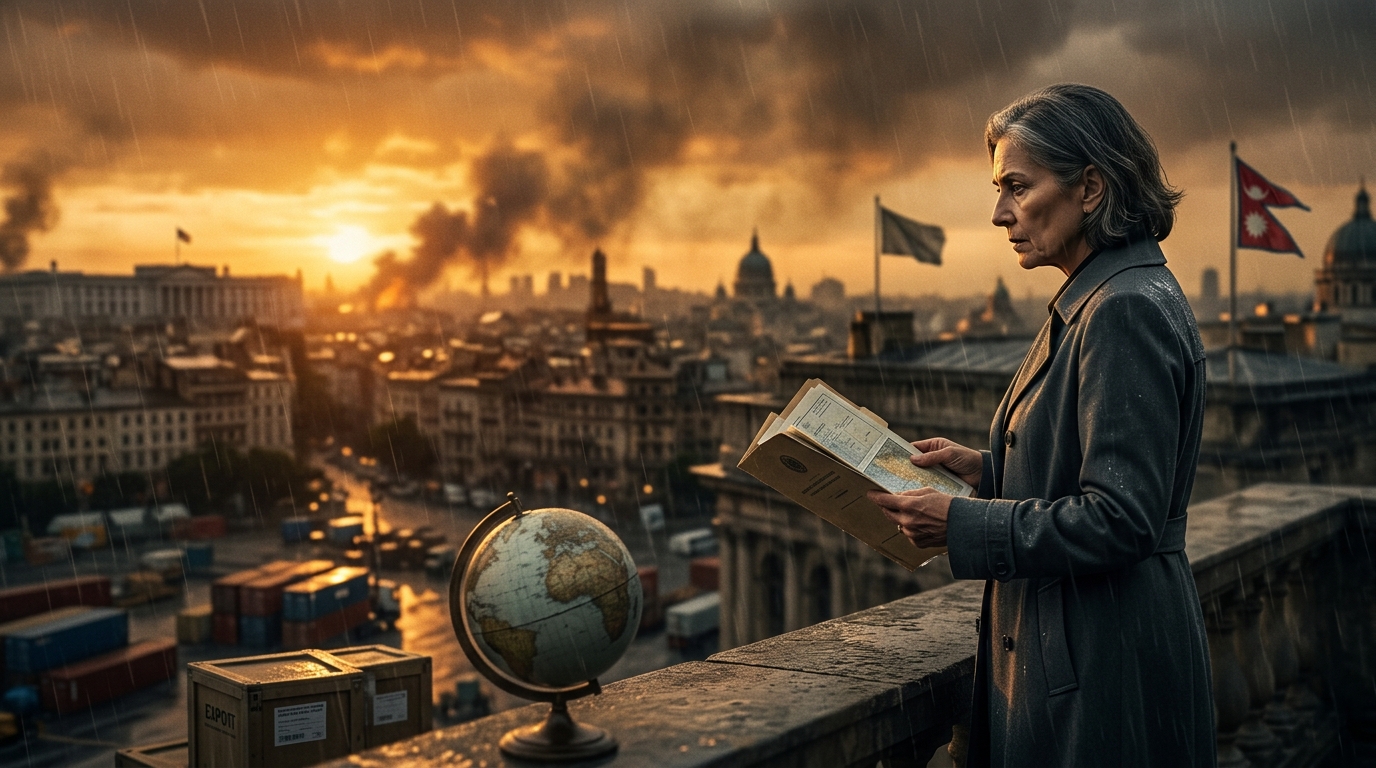
<p>On <strong>28 February 2026</strong> the United States and Israel carried out coordinated air strikes on Iranian territory, killing <strong>Supreme Leader Ayatollah Ali Khamenei</strong> and several senior officials. The attack ignited a full‑scale war across West Asia, drawing in regional allies, disrupting global oil flows, and spilling over into US‑India trade policy. At the same time, President <strong>Donald Trump</strong> faced fresh legal challenges to his unilateral tariff regime, while Nepal’s general‑election count shows the newcomer <span class="key-term" data-definition="Rastriya Swatantra Party — New political party in Nepal emerging after 2023 Gen‑Z revolt, challenging traditional parties (GS2: Polity)">RSP</span> on the brink of a landslide. The developments have direct relevance for UPSC aspirants across GS 2 (Polity) and GS 3 (Economy).</p>
<h3>Key Developments</h3>
<ul>
<li>US‑Israel strike kills Iran’s top leadership; Iran retaliates with drones and missiles against US bases in <span class="key-term" data-definition="Strait of Hormuz — narrow waterway between Oman and Iran through which about 20% of global oil passes; strategic chokepoint (GS3: Economy)">Strait of Hormuz</span> and regional allies.</li>
<li>Six American personnel die in Kuwait; US embassies in Kuwait and Saudi Arabia close.</li>
<li>Iranian Revolutionary Guard Corps (<span class="key-term" data-definition="Iranian Revolutionary Guard Corps — elite paramilitary force of Iran, involved in regional proxy wars and missile program (GS2: Polity)">IRGC</span>) blocks the strait and targets oil tankers, threatening a fifth of world oil shipments.</li>
<li>US Navy sinks Iranian frigate IRIS Dena near Sri Lanka, extending the conflict to the Indian Ocean.</li>
<li>Washington temporarily waives sanctions, allowing Indian refiners to import stranded Russian crude to stabilise global oil prices.</li>
<li>Trump re‑imposes a 10 % blanket tariff using <span class="key-term" data-definition="International Emergency Economic Powers Act — US law granting the President authority to regulate commerce after a national emergency (GS2: Polity)">IEEPA</span>‑derived powers, prompting lawsuits from two dozen states.</li>
<li>Nepal’s vote count shows <span class="key-term" data-definition="Rastriya Swatantra Party — New political party in Nepal emerging after 2023 Gen‑Z revolt, challenging traditional parties (GS2: Polity)">RSP</span> leading in 110 of 161 constituencies, signalling a shift away from the Nepali Congress and CPN‑UML.</li>
</ul>
<h3>Important Facts</h3>
<p>• US maintains eight persistent bases and 11 other sites in West Asia (CRS 2024).<br>
• Iran’s missile range caps at <strong>2,000 km</strong>, putting most US installations within reach.<br>
• The <span class="key-term" data-definition="Joint Comprehensive Plan of Action (JCPOA) — 2015 nuclear agreement between Iran and P5+1 limiting Iran's uranium enrichment in exchange for sanctions relief (GS2: Polity, GS3: Economy)">JCPOA</span> was abandoned in 2018; Tehran has since enriched uranium to 60 %.
</p>
<h3>UPSC Relevance</h3>
<p>• <strong>Geopolitics & International Relations (GS 2)</strong>: The US‑Israel strike illustrates power projection, regime‑change rhetoric, and the strategic importance of the <span class="key-term" data-definition="Strait of Hormuz — narrow waterway between Oman and Iran through which about 20% of global oil passes; strategic chokepoint (GS3: Economy)">Strait of Hormuz</span>. Understanding proxy dynamics (IRGC, Hezbollah) is essential for questions on South‑West Asian security.</p>
<p>• <strong>Energy Security (GS 3)</strong>: Disruption of oil flows and the US waiver for Russian crude highlight how geopolitical shocks affect global oil markets, a recurring UPSC theme.</p>
<p>• <strong>Trade Policy & Legal Framework (GS 2)</strong>: The use of <span class="key-term" data-definition="International Emergency Economic Powers Act — US law granting the President authority to regulate commerce after a national emergency (GS2: Polity)">IEEPA</span> and Section 122 of the 1974 Trade Act underscores the executive’s tariff powers and the role of the judiciary, useful for questions on trade law and federal‑state relations.</p>
<p>• <strong>South Asian Politics (GS 2)</strong>: Nepal’s electoral shift towards the <span class="key-term" data-definition="Rastriya Swatantra Party — New political party in Nepal emerging after 2023 Gen‑Z revolt, challenging traditional parties (GS2: Polity)">RSP</span> reflects youth‑driven political realignment, a case study for party systems and democratic transitions.</p>
<h3>Way Forward</h3>
<p>1. **Diplomatic de‑escalation** – US and Israel need to engage multilateral mechanisms (UN, GCC) to prevent a broader regional war and secure the <span class="key-term" data-definition="Strait of Hormuz — narrow waterway between Oman and Iran through which about 20% of global oil passes; strategic chokepoint (GS3: Economy)">Strait of Hormuz</span> for global energy stability.</p>
<p>2. **Legal clarity on tariffs** – Congress should assert its role under the Constitution to provide a clear statutory basis for trade measures, reducing litigation risk.</p>
<p>3. **Political consolidation in Nepal** – New parties must translate electoral momentum into governance reforms, addressing the chronic instability of 14 governments in 18 years.</p>
<p>4. **Strategic autonomy for India** – While benefitting from the temporary Russian‑crude waiver, India should diversify energy sources and strengthen domestic refining capacity to mitigate future supply shocks.</p>
Loading page, please wait…