Overview
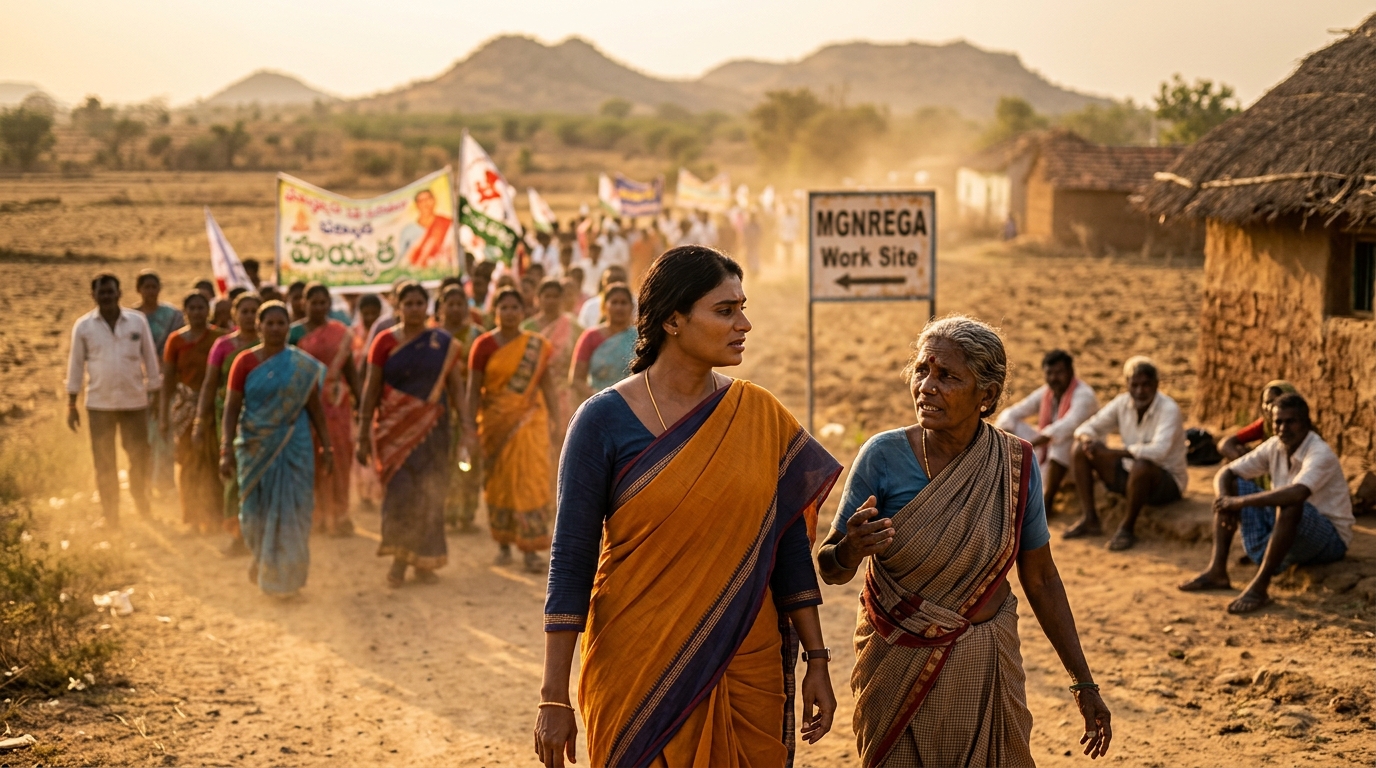
On February 05, 2026, Y.S. Sharmila, chief of the Andhra Pradesh Congress Committee (APCC), led her fourth yatra demanding the continuation of the Mahatma Gandhi National Rural Employment Guarantee Act (MGNREGA). The rally reached Punganur in the newly formed Annamayya district, where she warned that any dilution of the scheme would trigger massive migration from the backward Rayalaseema region.
Key Developments
- Development 1: Sharmila’s yatra underscored that several villages in Rayalaseema have witnessed tangible development due to MGNREGA, emphasizing its role in poverty alleviation.
- Development 2: She alleged that Prime Minister Narendra Modi has altered the original scheme, renaming it and shifting work‑allocation authority from village panchayats to the Centre, which she claims benefits contractors.
- Development 3: Sharmila challenged the Centre’s claim of providing 125 work days per household, pointing out that since 2014 the average number of days actually delivered has been below 52 days.
Important Facts
- Fact 1: MGNREGA was originally launched from the Rayalaseema region and has directly impacted the lives of lakhs of poor families in Andhra Pradesh.
- Fact 2: Official data since 2014 indicates that the scheme has consistently fallen short of its statutory guarantee of 100 work days, delivering less than half of the promised days on average.
Exam Relevance
This episode is pertinent to GS Paper II (Governance, Social Justice and Welfare) and GS Paper III (Economic Development, Poverty, Rural Development). Candidates may be asked to evaluate the effectiveness of MGNREGA, discuss centre‑state relations in policy implementation, or analyse the impact of scheme modifications on migrant labour trends. The issue also intersects with optional subjects like Public Administration and Geography (human‑environment interaction).
Way Forward
For sustainable rural employment, it is essential to restore village‑level decision‑making, ensure transparent fund allocation, and monitor actual work‑day delivery against targets. Strengthening grievance redressal mechanisms and integrating skill‑development components could mitigate migration pressures from Rayalaseema and similar backward regions.