Loading page, please wait…
Strategic Importance of A&N Islands - UPSC Defence And Security
What is Strategic Importance of A&N Islands in UPSC Defence And Security?
Strategic Importance of A&N Islands is a key topic under Defence And Security for UPSC Civil Services Examination. Key points include: ANI adds 300,000 sq km to India's EEZ, with resource potential.. Strategically located astride the Malacca Strait, vital for global trade.. Serves as India's first line of defence in the East against maritime threats.. Understanding this topic is essential for both UPSC Prelims and Mains preparation.
Why is Strategic Importance of A&N Islands important for UPSC exam?
Strategic Importance of A&N Islands is a Medium-level topic in UPSC Defence And Security. It is tested in both Prelims (factual MCQs) and Mains (analytical answer writing). Previous year UPSC questions have frequently covered aspects of Strategic Importance of A&N Islands, making it essential for comprehensive IAS preparation.
How to prepare Strategic Importance of A&N Islands for UPSC?
To prepare Strategic Importance of A&N Islands for UPSC: (1) Study the comprehensive notes covering all key concepts on Vaidra. (2) Practice previous year questions on this topic. (3) Connect it with current affairs using daily updates. (4) Revise using key takeaways and mind maps available for Defence And Security. (5) Write practice answers linking Strategic Importance of A&N Islands to related GS Paper topics.
Key takeaways of Strategic Importance of A&N Islands for UPSC
- ANI adds 300,000 sq km to India's EEZ, with resource potential.
- Strategically located astride the Malacca Strait, vital for global trade.
- Serves as India's first line of defence in the East against maritime threats.
- Port Blair has potential as a regional hub for maritime security cooperation.
- Andaman Nicobar Command (ANC) is India's first joint operational command, established in 2001.
- Renewed government focus on ANI for infrastructure and security reflects India's Indo-Pacific strategy.

Strategic Importance of A&N Islands
Medium⏱️ 8 min read
defence and security
📖 Introduction
Renewed Focus on Andaman & Nicobar Islands
The Indian government is intensifying its efforts to develop the Andaman and Nicobar Islands (ANI).
This renewed focus highlights their critical strategic significance within the broader Indo-Pacific region.
Recent initiatives aim to significantly enhance both civilian and military infrastructure on the islands.
Experts note that this development is long overdue, reflecting a historical gap in India's strategic maritime vision since independence.
Geographic and Economic Importance
The Andaman and Nicobar Islands are situated approximately 700 nautical miles southeast of the Indian mainland.
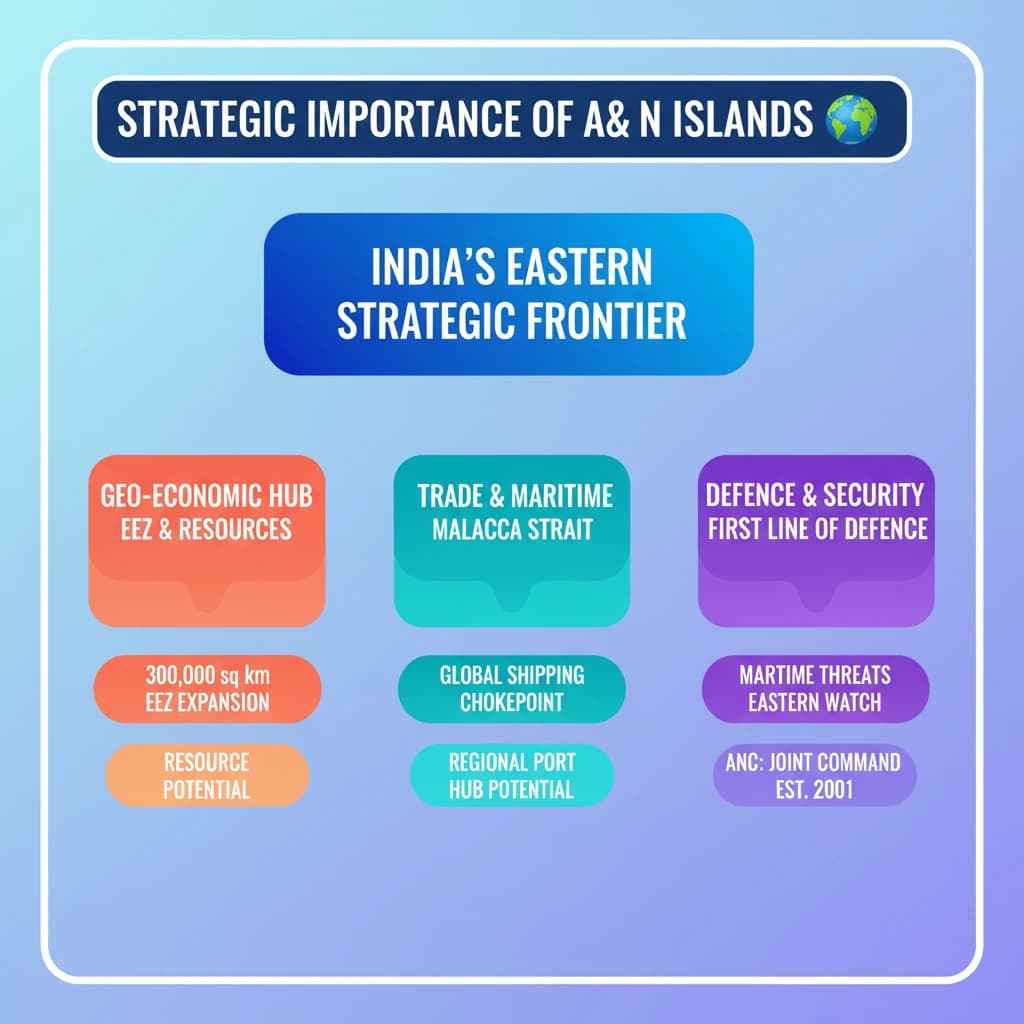
Their presence expands India’s Exclusive Economic Zone (EEZ) by a substantial 300,000 sq km.
This vast maritime area holds significant potential for undiscovered undersea hydrocarbon and mineral deposits.
Strategic Location and Maritime Choke Point
The islands are strategically positioned astride the Malacca Strait, a vital global maritime passage.
This location makes ANI an indispensable asset for India's capability to monitor and project power across the Indo-Pacific region.
The Malacca Strait is a crucial maritime choke point, through which over 90,000 merchant ships transit annually.
These vessels collectively transport approximately 30% of the world’s traded goods, underscoring the strait's global economic importance.
Maritime Boundaries and UNCLOS
The Andaman and Nicobar Islands share maritime boundaries with several neighboring countries:
- Myanmar
- Thailand
- Indonesia
- Bangladesh
This extensive shared boundary grants India substantial ocean space under the provisions of the United Nations Convention on the Law of the Sea (UNCLOS).
UNCLOS allows India rights over its Exclusive Economic Zone and continental shelf, enhancing its maritime influence.
First Line of Defence and Regional Hub
The islands serve as India’s first line of defence against any potential threats from the East aimed at undermining its maritime security.
This defensive capability is particularly crucial given China's growing influence and strategic activities in the Indo-Pacific region.
Port Blair, the capital, has the potential to become a significant regional hub for naval cooperation.
Such a hub could facilitate collaborative efforts in areas like disaster relief, medical aid, counter-piracy, search and rescue missions, and other vital maritime security initiatives.
💡 Key Takeaways
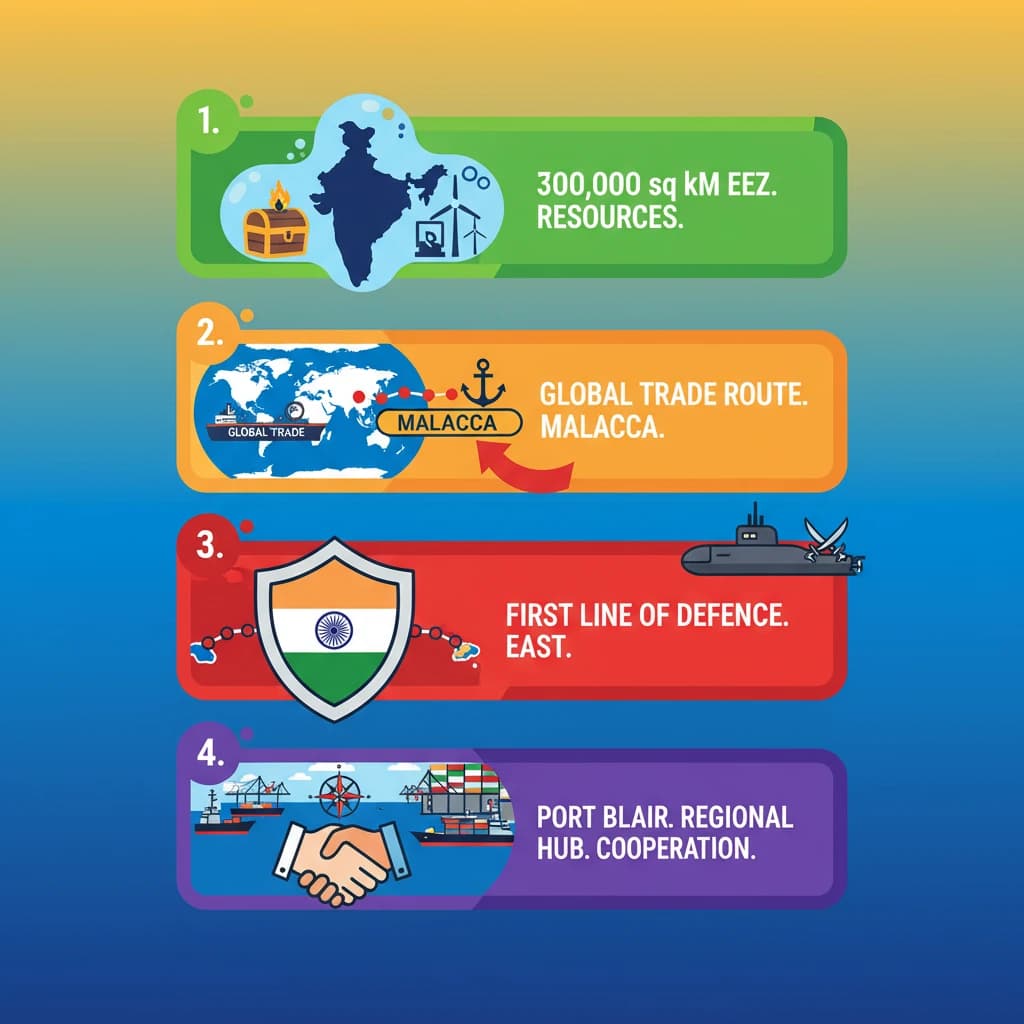
- •ANI adds 300,000 sq km to India's EEZ, with resource potential.
- •Strategically located astride the Malacca Strait, vital for global trade.
- •Serves as India's first line of defence in the East against maritime threats.
- •Port Blair has potential as a regional hub for maritime security cooperation.
- •Andaman Nicobar Command (ANC) is India's first joint operational command, established in 2001.
- •Renewed government focus on ANI for infrastructure and security reflects India's Indo-Pacific strategy.
🧠 Memory Techniques
95% Verified Content