Loading page, please wait…
How did Cooperatives Evolve in India? - UPSC Economy
What is How did Cooperatives Evolve in India? in UPSC Economy?
How did Cooperatives Evolve in India? is a key topic under Economy for UPSC Civil Services Examination. Key points include: Cooperatives are member-owned, democratically controlled enterprises fulfilling common needs.. India has one of the largest cooperative networks globally, with significant contributions to agriculture and credit.. Pre-independence evolution saw key acts (1904, 1912) and the Maclagan Committee, with cooperation becoming a provincial subject in 1919.. Understanding this topic is essential for both UPSC Prelims and Mains preparation.
Why is How did Cooperatives Evolve in India? important for UPSC exam?
How did Cooperatives Evolve in India? is a Medium-level topic in UPSC Economy. It is tested in both Prelims (factual MCQs) and Mains (analytical answer writing). Previous year UPSC questions have frequently covered aspects of How did Cooperatives Evolve in India?, making it essential for comprehensive IAS preparation.
How to prepare How did Cooperatives Evolve in India? for UPSC?
To prepare How did Cooperatives Evolve in India? for UPSC: (1) Study the comprehensive notes covering all key concepts on Vaidra. (2) Practice previous year questions on this topic. (3) Connect it with current affairs using daily updates. (4) Revise using key takeaways and mind maps available for Economy. (5) Write practice answers linking How did Cooperatives Evolve in India? to related GS Paper topics.
Key takeaways of How did Cooperatives Evolve in India? for UPSC
- Cooperatives are member-owned, democratically controlled enterprises fulfilling common needs.
- India has one of the largest cooperative networks globally, with significant contributions to agriculture and credit.
- Pre-independence evolution saw key acts (1904, 1912) and the Maclagan Committee, with cooperation becoming a provincial subject in 1919.
- Gandhian philosophy championed cooperatives for decentralization and empowerment.
- Post-independence, the First Five-Year Plan promoted cooperatives for community development.
- The 97th Constitutional Amendment Act, 2011, made forming cooperatives a fundamental right and added Part IX-B.
- The Union Ministry of Cooperation (2021) was established to strengthen the sector.
- Cooperatives are crucial for rural development, financial inclusion, and inclusive growth in modern India.

How did Cooperatives Evolve in India?
Medium⏱️ 10 min read
economy
📖 Introduction
Introduction to Cooperatives in India
Cooperatives are unique, people-centred enterprises. They are owned, controlled, and run by and for their members to realize their common economic, social, and cultural needs and aspirations.
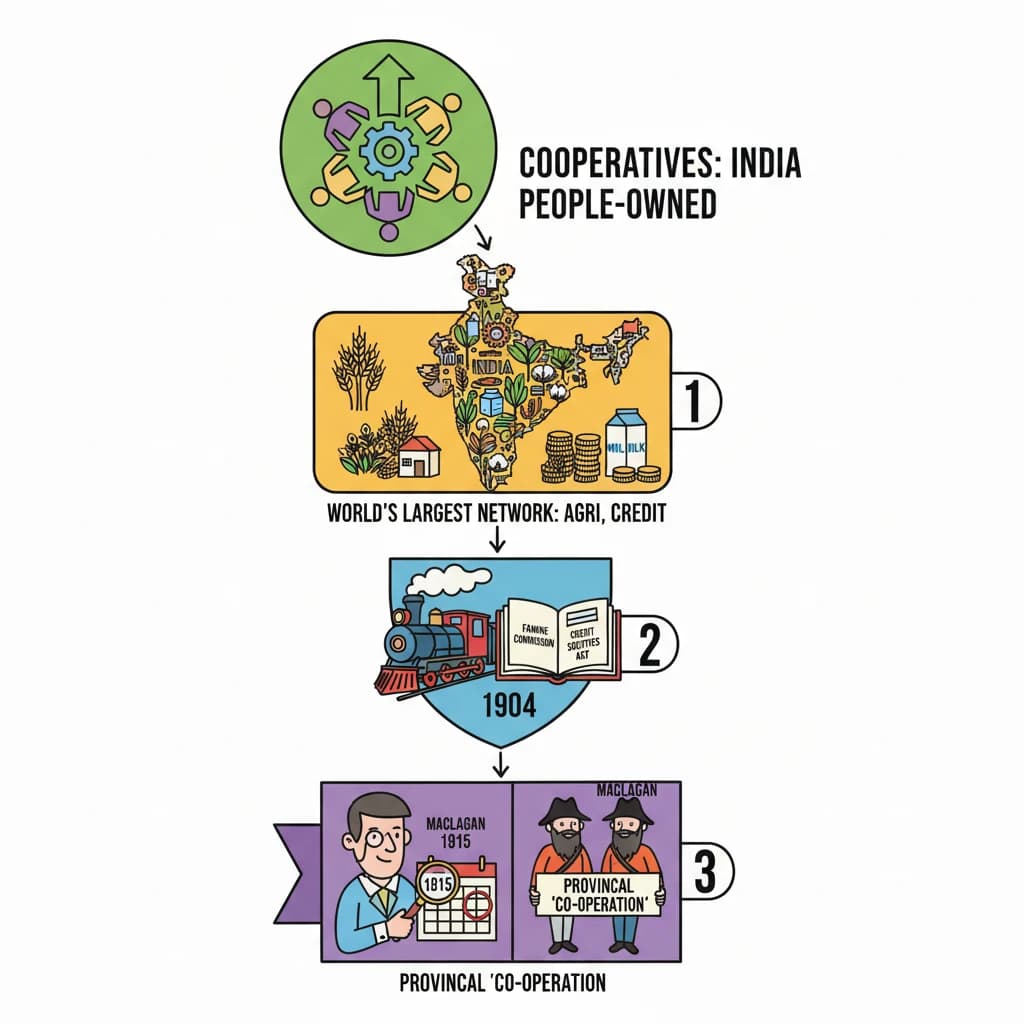
India boasts one of the world's largest cooperative networks, with over 800,000 cooperatives spread across diverse sectors like agriculture, credit, dairy, housing, and fisheries.
The cooperative sector makes significant contributions to the Indian economy, including:
- 20% in agricultural loans
- 35% in fertilizer distribution
- 31% in sugar production
- 13% in wheat purchase
- 20% in paddy purchase
Cooperatives in the Pre-Independence Era
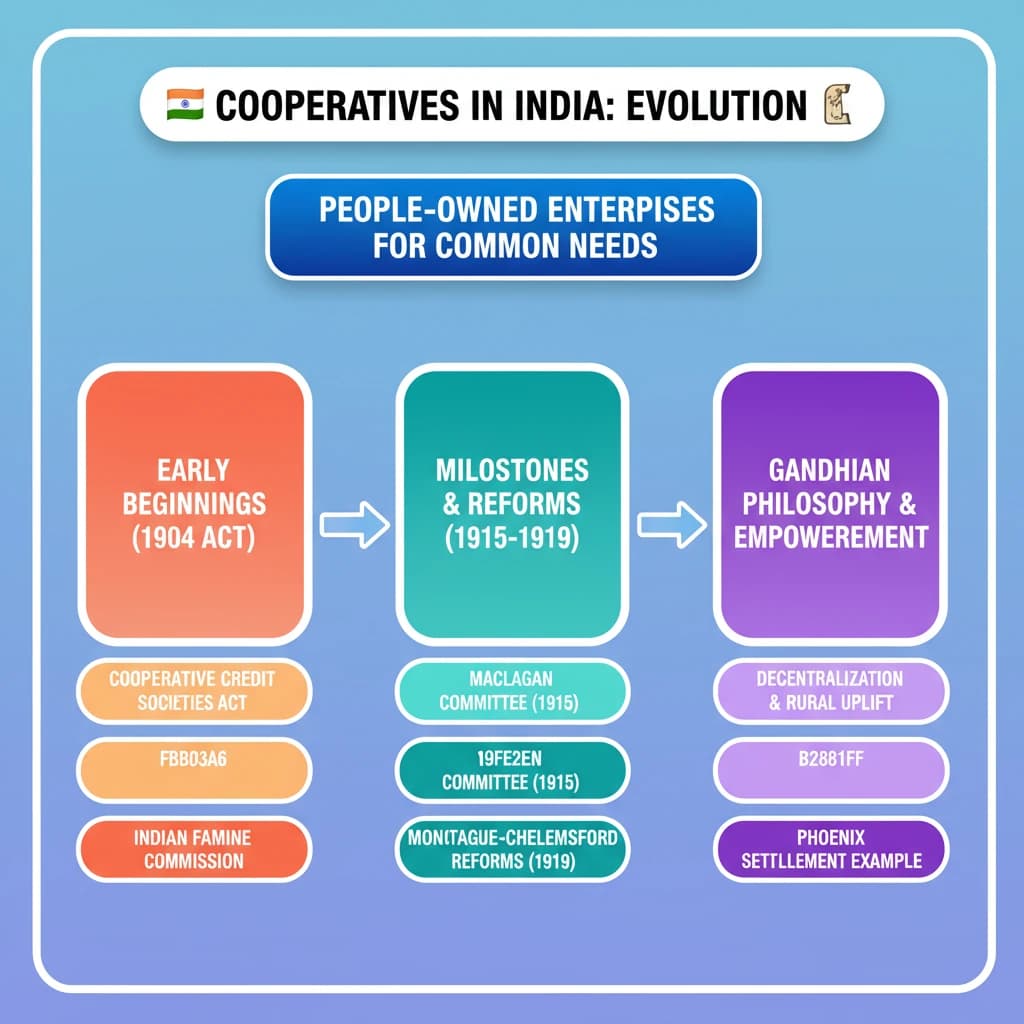
The foundation for the cooperative movement in India was laid in the early 20th century, primarily to address agrarian distress and rural indebtedness.
Indian Famine Commission (1901): Its recommendations led to the enactment of the first cooperative law.
Cooperative Credit Societies Act, 1904: This was the first significant legislation, focusing on providing credit to farmers and artisans.
Cooperative Societies Act, 1912: An amendment to the 1904 Act, expanding its scope beyond credit to include non-credit cooperatives.
Maclagan Committee (1915): Headed by Sir Edward Maclagan, this committee was appointed to study and report on the economic and financial soundness of the cooperative movement.
The Montague-Chelmsford Reforms of 1919 brought a significant change by making co-operation a provincial subject. This decentralization gave further impetus to the movement, allowing provinces to tailor laws to local needs.
During the Poor Economic Depression of 1929, various committees were appointed in provinces like Madras, Bombay, Travancore, Mysore, Gwalior, and Punjab to examine possibilities for restructuring cooperative societies.
Gandhian Socialist Philosophy played a crucial role. Mahatma Gandhi believed cooperation was necessary for the creation of a socialistic society and complete decentralisation of power.
He was of the opinion that cooperation was one of the important means to empower people. His practical applications include the ‘Phoenix Settlement’ and ‘Tolstoy Farm’ in South Africa, established on cooperative principles.
Cooperatives in Post-Independence India
Post-independence, cooperatives were seen as integral to nation-building and comprehensive rural development.
First Five-Year Plan (1951-56): This plan strongly highlighted the promotion of cooperatives for comprehensive community development across the country.
Multi-State Co-operative Societies Act, 2002: This act provided the legal framework for the formation and functioning of cooperatives operating across multiple states.
Multi-State Co-operative Societies (Amendment) Act, 2022: This amendment introduced the Co-operative Election Authority to oversee board elections in multi-state co-operative societies, ensuring transparency.
97th Constitutional Amendment Act of 2011: This landmark amendment significantly strengthened the cooperative movement by:
- Establishing the right to form cooperative societies as a fundamental right (Article 19(1)(c)).
- Introducing a new Directive Principle of State Policy (DPSP) on Cooperative Societies (Article 43-B).
- Adding a new Part IX-B to the Constitution, titled “The Co-operative Societies” (Articles 243-ZH to 243-ZT).
- Empowering Parliament to enact laws governing Multi-State Cooperative Societies (MSCS) and delegating authority to state legislatures for other cooperative societies.
Establishment of Union Ministry of Cooperation (2021): This new ministry was created to provide a separate administrative, legal, and policy framework for strengthening the cooperative movement in India, previously overseen by the Ministry of Agriculture.
The evolution of cooperatives showcases a blend of legislative action, committee recommendations, and constitutional reforms, reflecting their growing importance in India's socio-economic fabric. Questions often focus on the 97th Amendment and the role of the Ministry of Cooperation.
💡 Key Takeaways
- •Cooperatives are member-owned, democratically controlled enterprises fulfilling common needs.
- •India has one of the largest cooperative networks globally, with significant contributions to agriculture and credit.
- •Pre-independence evolution saw key acts (1904, 1912) and the Maclagan Committee, with cooperation becoming a provincial subject in 1919.
- •Gandhian philosophy championed cooperatives for decentralization and empowerment.
- •Post-independence, the First Five-Year Plan promoted cooperatives for community development.
- •The 97th Constitutional Amendment Act, 2011, made forming cooperatives a fundamental right and added Part IX-B.
- •The Union Ministry of Cooperation (2021) was established to strengthen the sector.
- •Cooperatives are crucial for rural development, financial inclusion, and inclusive growth in modern India.
🧠 Memory Techniques
95% Verified Content
📚 Reference Sources
•The Constitution of India (97th Amendment Act, 2011)
•Ministry of Cooperation, Government of India official website
•NCERT Economics Textbooks (relevant chapters on Indian Economy)