Loading page, please wait…
HomeCurrent AffairsEditorialsGovt SchemesLearning ResourcesUPSC SyllabusPricingAboutBest UPSC AIUPSC AI ToolAI for UPSCUPSC ChatGPT

© 2026 Vaidra. All rights reserved.

PrivacyTerms
Vaidra Logo
Vaidra

Top 4 items + smart groups

UPSC GPT
New
Current Affairs
Daily Solutions
Daily Puzzle
Mains Evaluator

Version 2.0.0 • Built with ❤️ for UPSC aspirants

India-U.S. Trade Talks Conclude in Washington; Interim Agreement Framework Set

India-U.S. Trade Talks Conclude in Washington; Interim Agreement Framework Set
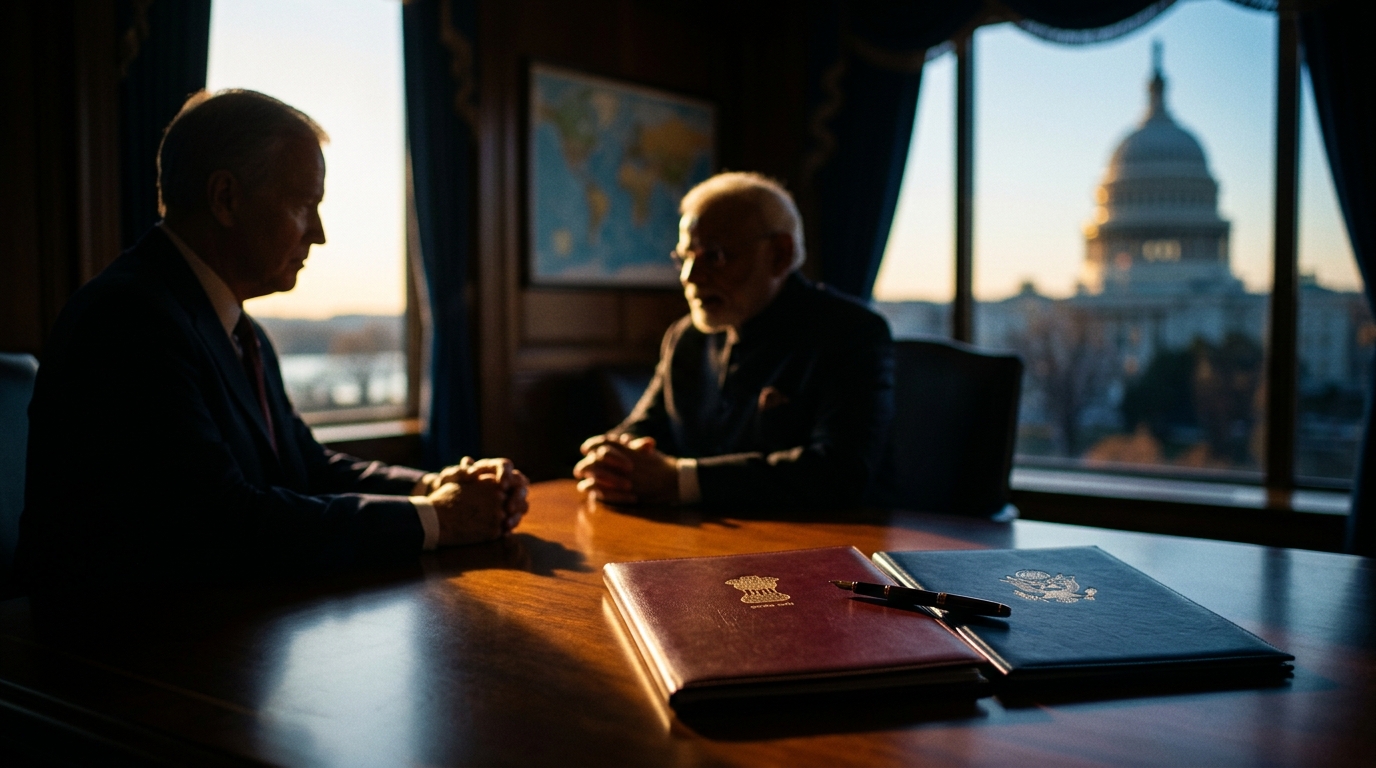
India and the United States concluded constructive trade talks in Washington (20‑23 April 2026), reaffirming a framework for an Interim Agreement on reciprocal tariffs first outlined on 7 February 2026. The progress signals a strengthening of bilateral economic ties, with implications for India's trade policy and foreign‑policy objectives.
Overview Negotiating teams of India and the U.S. concluded a series of bilateral trade negotiations in Washington from 20‑23 April 2026 . Both sides described the talks as “constructive” and “forward‑looking”, signalling a positive trajectory towards a deeper trade partnership. Key Developments Final‑day statements highlighted progress on a framework for an Interim Agreement . The framework, first announced in a joint statement on 7 February 2026 , focuses on reciprocal tariffs and mutually beneficial trade flows. Both delegations agreed to set up a technical working group to iron out sector‑specific tariff schedules within the next six months. Important Facts Negotiations were held in Washington, the capital of the United States, underscoring the strategic importance both capitals attach to the dialogue. The talks covered sectors such as information technology services, pharmaceuticals, and agricultural commodities. No final numbers on tariff reductions were disclosed, but the language suggests a move towards lower duties for a broader range of goods. UPSC Relevance The development touches upon several UPSC syllabus areas: International Economic Relations (GS3) : Understanding how bilateral trade agreements shape India's export‑import balance and foreign exchange earnings. Foreign Policy & Diplomacy (GS2) : The talks reflect India's strategic engagement with a major power, influencing geopolitical alignments. Trade Policy Instruments (GS3) : Concepts like reciprocal tariffs and interim agreements are essential for answering questions on trade liberalisation. Economic Reforms (GS3) : Progress in trade talks can complement domestic reforms aimed at boosting manufacturing and services. Way Forward While the talks have set a constructive tone, the next steps will involve detailed tariff negotiations, stakeholder consultations, and parliamentary briefings. Successful completion of the Interim Agreement could pave the way for a comprehensive trade pact, potentially enhancing market access for Indian exporters and attracting U.S. investment in key sectors.
  1. Home
  2. Prepare
  3. Current Affairs
  4. India-U.S. Trade Talks Conclude in Washington; Interim Agreement Framework Set
Login to bookmark articles
Login to mark articles as complete

Overview

gs.gs276% UPSC Relevance

India‑U.S. interim tariff framework set, signalling deeper strategic trade partnership.

Key Facts

  1. India and the United States held bilateral trade talks in Washington from 20‑23 April 2026.
  2. The talks built on a joint statement dated 7 February 2026 that announced an Interim Agreement framework for reciprocal tariff reductions.
  3. Both sides agreed to set up a technical working group to finalise sector‑specific tariff schedules within the next six months.
  4. Key sectors discussed included information technology services, pharmaceuticals, and agricultural commodities.
  5. No specific tariff reduction percentages were disclosed, but the language signals a move towards lower duties across a broader range of goods.

Background & Context

Bilateral trade negotiations are a core instrument of India's foreign economic policy, influencing export‑import balances, foreign exchange earnings, and strategic ties with major powers. The India‑U.S. talks reflect a shift from ad‑hoc market access to a structured, reciprocal tariff regime, aligning with India's broader economic reforms and diversification of trade partners.

Mains Answer Angle

GS2 (Foreign Policy) – Analyse how the India‑U.S. interim trade framework could reshape India's strategic partnership with the United States and impact its trade diversification agenda. GS3 (Economy) – Evaluate the potential macro‑economic benefits of reciprocal tariff reductions for key sectors.

Full Article

<h2>Overview</h2> <p>Negotiating teams of <span class="key-term" data-definition="India — South Asian nation, world's largest democracy, key player in global trade negotiations (GS1: Polity, GS3: Economy)">India</span> and the <span class="key-term" data-definition="United States (U.S.) — Federal republic and major global economic power, partner in bilateral trade talks (GS3: Economy)">U.S.</span> concluded a series of <span class="key-term" data-definition="bilateral trade negotiations — discussions between two countries to set terms of trade, crucial for foreign policy and economic strategy (GS2: Polity, GS3: Economy)">bilateral trade negotiations</span> in Washington from <strong>20‑23 April 2026</strong>. Both sides described the talks as “constructive” and “forward‑looking”, signalling a positive trajectory towards a deeper trade partnership.</p> <h3>Key Developments</h3> <ul> <li>Final‑day statements highlighted progress on a framework for an <span class="key-term" data-definition="Interim Agreement — provisional trade pact outlining reciprocal tariff reductions and cooperation, often a stepping stone to a comprehensive deal (GS3: Economy)">Interim Agreement</span>.</li> <li>The framework, first announced in a joint statement on <strong>7 February 2026</strong>, focuses on <span class="key-term" data-definition="reciprocal tariffs — mutually agreed customs duties where each side reduces rates on the other's goods, facilitating trade (GS3: Economy)">reciprocal tariffs</span> and mutually beneficial trade flows.</li> <li>Both delegations agreed to set up a technical working group to iron out sector‑specific tariff schedules within the next six months.</li> </ul> <h3>Important Facts</h3> <ul> <li>Negotiations were held in Washington, the capital of the United States, underscoring the strategic importance both capitals attach to the dialogue.</li> <li>The talks covered sectors such as information technology services, pharmaceuticals, and agricultural commodities.</li> <li>No final numbers on tariff reductions were disclosed, but the language suggests a move towards lower duties for a broader range of goods.</li> </ul> <h3>UPSC Relevance</h3> <p>The development touches upon several UPSC syllabus areas:</p> <ul> <li><strong>International Economic Relations (GS3)</strong>: Understanding how bilateral trade agreements shape India's export‑import balance and foreign exchange earnings.</li> <li><strong>Foreign Policy &amp; Diplomacy (GS2)</strong>: The talks reflect India's strategic engagement with a major power, influencing geopolitical alignments.</li> <li><strong>Trade Policy Instruments (GS3)</strong>: Concepts like <em>reciprocal tariffs</em> and interim agreements are essential for answering questions on trade liberalisation.</li> <li><strong>Economic Reforms (GS3)</strong>: Progress in trade talks can complement domestic reforms aimed at boosting manufacturing and services.</li> </ul> <h3>Way Forward</h3> <p>While the talks have set a constructive tone, the next steps will involve detailed tariff negotiations, stakeholder consultations, and parliamentary briefings. Successful completion of the <span class="key-term" data-definition="Interim Agreement — provisional trade pact outlining reciprocal tariff reductions and cooperation, often a stepping stone to a comprehensive deal (GS3: Economy)">Interim Agreement</span> could pave the way for a comprehensive trade pact, potentially enhancing market access for Indian exporters and attracting U.S. investment in key sectors.</p>
Read Original on hindu

Analysis

Practice Questions

Prelims
Easy
Prelims MCQ

India‑U.S. trade negotiations

1 marks
5 keywords
GS3
Medium
Mains Short Answer

Trade policy instruments

10 marks
5 keywords
GS2
Hard
Mains Essay

Strategic partnership and economic reforms

25 marks
8 keywords
Related:Daily•Weekly

Loading related articles...

Loading related articles...

Tip: Click articles above to read more from the same date, or use the back button to see all articles.

Quick Reference

Key Insight

India‑U.S. interim tariff framework set, signalling deeper strategic trade partnership.

Key Facts

  1. India and the United States held bilateral trade talks in Washington from 20‑23 April 2026.
  2. The talks built on a joint statement dated 7 February 2026 that announced an Interim Agreement framework for reciprocal tariff reductions.
  3. Both sides agreed to set up a technical working group to finalise sector‑specific tariff schedules within the next six months.
  4. Key sectors discussed included information technology services, pharmaceuticals, and agricultural commodities.
  5. No specific tariff reduction percentages were disclosed, but the language signals a move towards lower duties across a broader range of goods.

Background

Bilateral trade negotiations are a core instrument of India's foreign economic policy, influencing export‑import balances, foreign exchange earnings, and strategic ties with major powers. The India‑U.S. talks reflect a shift from ad‑hoc market access to a structured, reciprocal tariff regime, aligning with India's broader economic reforms and diversification of trade partners.

Mains Angle

GS2 (Foreign Policy) – Analyse how the India‑U.S. interim trade framework could reshape India's strategic partnership with the United States and impact its trade diversification agenda. GS3 (Economy) – Evaluate the potential macro‑economic benefits of reciprocal tariff reductions for key sectors.

Explore:Current Affairs·Editorial Analysis·Govt Schemes·Study Materials·Previous Year Questions·UPSC GPT
India-U.S. Trade Talks Conclude in Washing... | UPSC Current Affairs

Related Topics

  • 📰Current AffairsIndian Delegation Visits Washington (20‑23 Apr 2026) to Finalise Interim Trade Deal with the United States
  • 📰Current AffairsIndia-U.S. Trade Talks Conclude in Washington; Interim Agreement Framework Set
  • 📚Subject TopicArchaeological Survey of India (ASI)
  • 📚Subject Topic19th NAM Summit and India-Uganda Relations
  • 📚Subject TopicHow did Cooperatives Evolve in India?
  • 📖Glossary TermElection Commission of India