Loading page, please wait…
Make in India Celebrates 10 Years - UPSC Economy
What is Make in India Celebrates 10 Years in UPSC Economy?
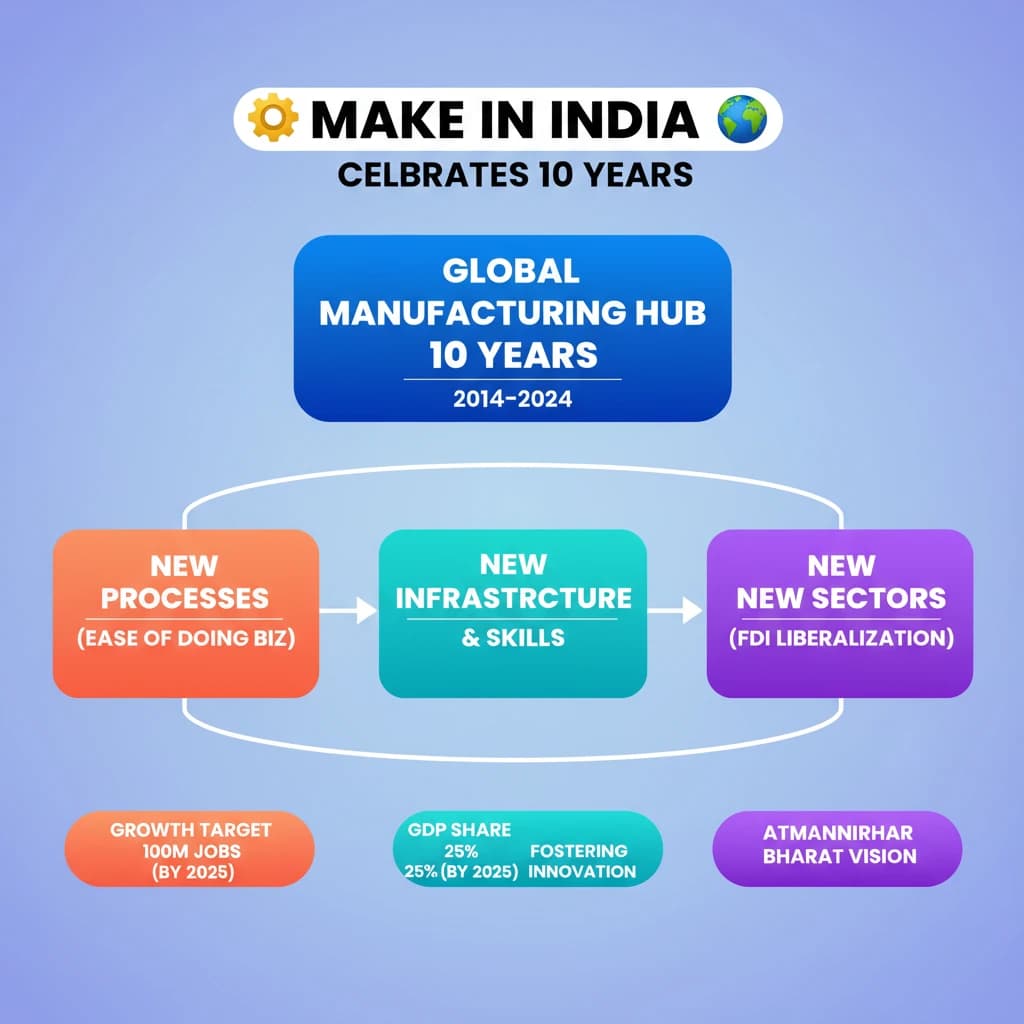
Make in India Celebrates 10 Years is a key topic under Economy for UPSC Civil Services Examination. Key points include: Launched on 25th September 2014, completing 10 years, aiming to make India a global manufacturing hub.. Key objectives: Increase manufacturing growth (12-14%), create 100M jobs (by 2025), and boost manufacturing's GDP share to 25% (by 2025).. Built on four foundational pillars: New Processes (Ease of Doing Business), New Infrastructure, New Sectors (FDI liberalization), and a New Mindset.. Understanding this topic is essential for both UPSC Prelims and Mains preparation.
Why is Make in India Celebrates 10 Years important for UPSC exam?
Make in India Celebrates 10 Years is a Medium-level topic in UPSC Economy. It is tested in both Prelims (factual MCQs) and Mains (analytical answer writing). Previous year UPSC questions have frequently covered aspects of Make in India Celebrates 10 Years, making it essential for comprehensive IAS preparation.
How to prepare Make in India Celebrates 10 Years for UPSC?
To prepare Make in India Celebrates 10 Years for UPSC: (1) Study the comprehensive notes covering all key concepts on Vaidra. (2) Practice previous year questions on this topic. (3) Connect it with current affairs using daily updates. (4) Revise using key takeaways and mind maps available for Economy. (5) Write practice answers linking Make in India Celebrates 10 Years to related GS Paper topics.
Key takeaways of Make in India Celebrates 10 Years for UPSC
- Launched on 25th September 2014, completing 10 years, aiming to make India a global manufacturing hub.
- Key objectives: Increase manufacturing growth (12-14%), create 100M jobs (by 2025), and boost manufacturing's GDP share to 25% (by 2025).
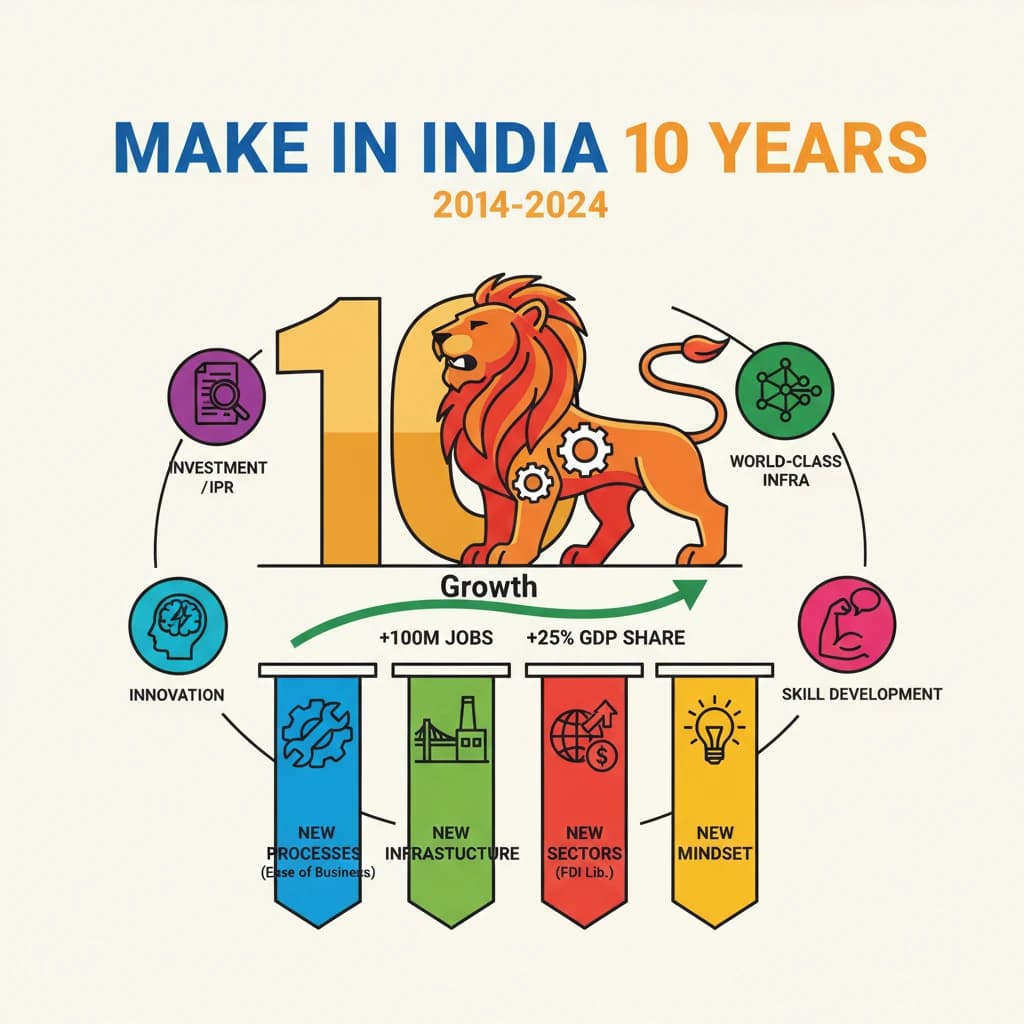
- Built on four foundational pillars: New Processes (Ease of Doing Business), New Infrastructure, New Sectors (FDI liberalization), and a New Mindset.
- Focuses on facilitating investment, fostering innovation, enhancing skill development, protecting IPR, and building world-class infrastructure.
- Integral to India's 'Atmanirbhar Bharat' vision and crucial for sustained economic growth and employment generation.
Make in India Celebrates 10 Years
Medium⏱️ 8 min read
economy
📖 Introduction
Introduction: Celebrating a Decade of Make in India
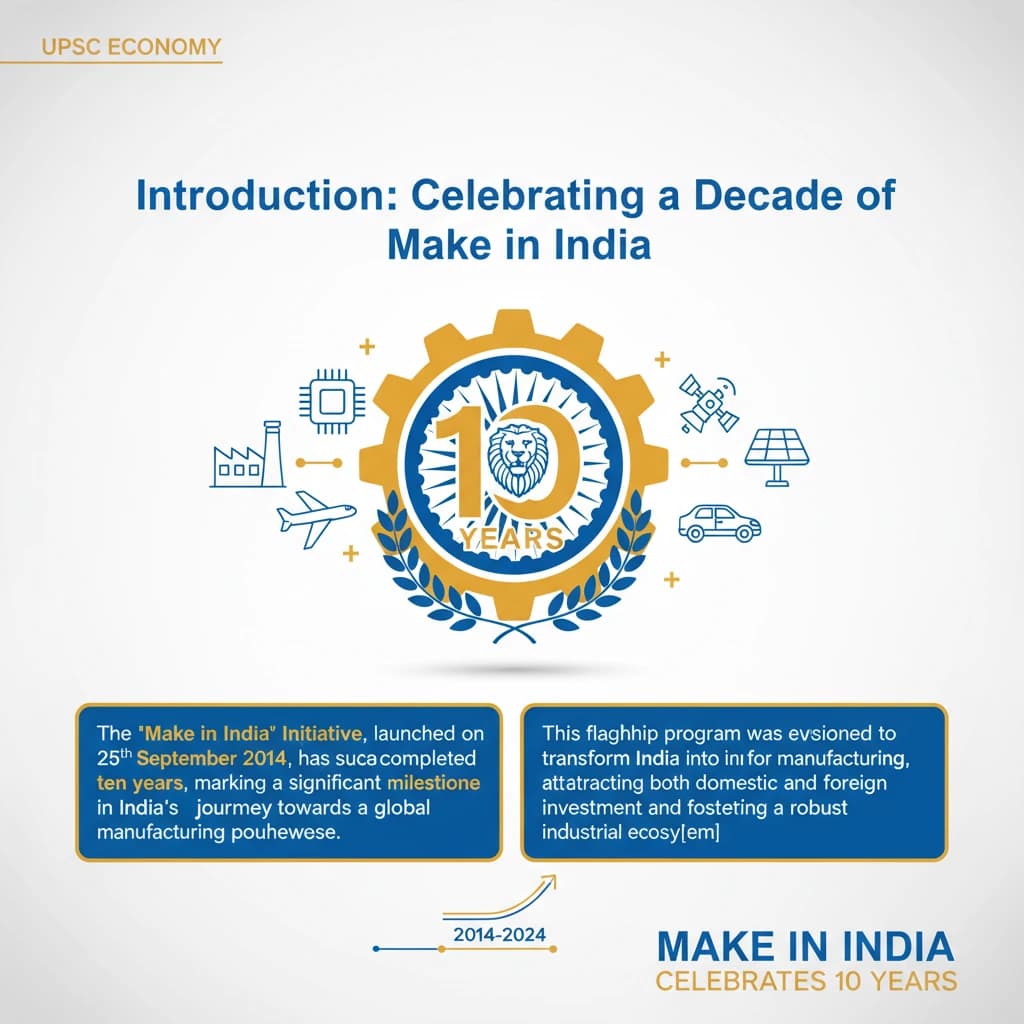
The 'Make in India' Initiative, launched on 25th September 2014, has successfully completed ten years, marking a significant milestone in India's journey towards becoming a global manufacturing powerhouse.
This flagship program was envisioned to transform India into a hub for manufacturing, attracting both domestic and foreign investment and fostering a robust industrial ecosystem.
Core Mandate of the Initiative
The 'Make in India' campaign was established with a multi-faceted approach aimed at invigorating the country's manufacturing sector.
Key areas of focus included facilitating investment, fostering innovation, enhancing skill development, protecting intellectual property (IP), and building best-in-class manufacturing infrastructure.
Ambitious Objectives Set
The initiative laid down clear, quantifiable targets to measure its success and impact on the Indian economy.
- Increase the growth rate of the manufacturing sector to 12-14% per annum.
- Create 100 million additional manufacturing jobs by 2022 (subsequently revised to 2025).
- Increase the manufacturing sector's contribution to GDP to 25% by 2025.
Four Pillars of Make in India
The strategy of 'Make in India' is built upon four foundational pillars designed to create a conducive environment for manufacturing growth.
New Processes: Enhancing Ease of Doing Business
Recognizing that a streamlined regulatory environment is crucial, this pillar focuses on improving the ease of doing business.
Measures have been implemented to simplify procedures and create a more favorable business environment for both startups and established enterprises.
New Infrastructure: Building World-Class Capabilities
The government prioritized the development of robust physical infrastructure to support industrial growth.
This includes establishing industrial corridors and developing smart cities to provide state-of-the-art facilities and connectivity.
Furthermore, efforts were made to enhance innovation and research through streamlined registration systems and improved intellectual property rights (IPR) infrastructure.
New Sectors: Opening Avenues for Investment
A significant aspect of the initiative was the strategic opening up of various sectors to attract greater Foreign Direct Investment (FDI).
Sectors where FDI was liberalized include Defence Production, Insurance, Medical Devices, Construction, and Railway infrastructure, among others.
New Mindset: Fostering Entrepreneurship and Partnership
While not explicitly mentioned as a 'pillar' in the source, the spirit of 'Make in India' inherently promotes a new mindset of entrepreneurship and collaboration between government and industry.
When discussing Make in India in UPSC Mains (GS3), remember to elaborate on these four pillars as they form the strategic backbone of the initiative. Mentioning the 'New Mindset' aspect can add depth to your answer.
💡 Key Takeaways
- •Launched on 25th September 2014, completing 10 years, aiming to make India a global manufacturing hub.
- •Key objectives: Increase manufacturing growth (12-14%), create 100M jobs (by 2025), and boost manufacturing's GDP share to 25% (by 2025).
- •Built on four foundational pillars: New Processes (Ease of Doing Business), New Infrastructure, New Sectors (FDI liberalization), and a New Mindset.
- •Focuses on facilitating investment, fostering innovation, enhancing skill development, protecting IPR, and building world-class infrastructure.
- •Integral to India's 'Atmanirbhar Bharat' vision and crucial for sustained economic growth and employment generation.
🧠 Memory Techniques
95% Verified Content
📚 Reference Sources
•Official Make in India website (Department for Promotion of Industry and Internal Trade - DPIIT, Ministry of Commerce & Industry, Government of India)