Loading page, please wait…
What are Strategic Petroleum Reserves? - UPSC Economy
What is What are Strategic Petroleum Reserves? in UPSC Economy?
What are Strategic Petroleum Reserves? is a key topic under Economy for UPSC Civil Services Examination. Key points include: Strategic Petroleum Reserves (SPRs) are emergency crude oil stockpiles for supply disruptions.. India currently has 5.33 MT capacity across three sites (Visakhapatnam, Mangaluru, Padur).. Phase II expansion will add 6.5 MT capacity (Chandikhol, additional Padur), totaling 11.83 MT.. Understanding this topic is essential for both UPSC Prelims and Mains preparation.
Why is What are Strategic Petroleum Reserves? important for UPSC exam?
What are Strategic Petroleum Reserves? is a Medium-level topic in UPSC Economy. It is tested in both Prelims (factual MCQs) and Mains (analytical answer writing). Previous year UPSC questions have frequently covered aspects of What are Strategic Petroleum Reserves?, making it essential for comprehensive IAS preparation.
How to prepare What are Strategic Petroleum Reserves? for UPSC?
To prepare What are Strategic Petroleum Reserves? for UPSC: (1) Study the comprehensive notes covering all key concepts on Vaidra. (2) Practice previous year questions on this topic. (3) Connect it with current affairs using daily updates. (4) Revise using key takeaways and mind maps available for Economy. (5) Write practice answers linking What are Strategic Petroleum Reserves? to related GS Paper topics.
Key takeaways of What are Strategic Petroleum Reserves? for UPSC
- Strategic Petroleum Reserves (SPRs) are emergency crude oil stockpiles for supply disruptions.
- India currently has 5.33 MT capacity across three sites (Visakhapatnam, Mangaluru, Padur).
- Phase II expansion will add 6.5 MT capacity (Chandikhol, additional Padur), totaling 11.83 MT.
- SPRs are crucial for India's energy security, mitigating import dependence and price volatility.
- The concept originated from the 1973 oil crisis, leading to the formation of the IEA.
- Managed by ISPRL under the Ministry of Petroleum & Natural Gas.
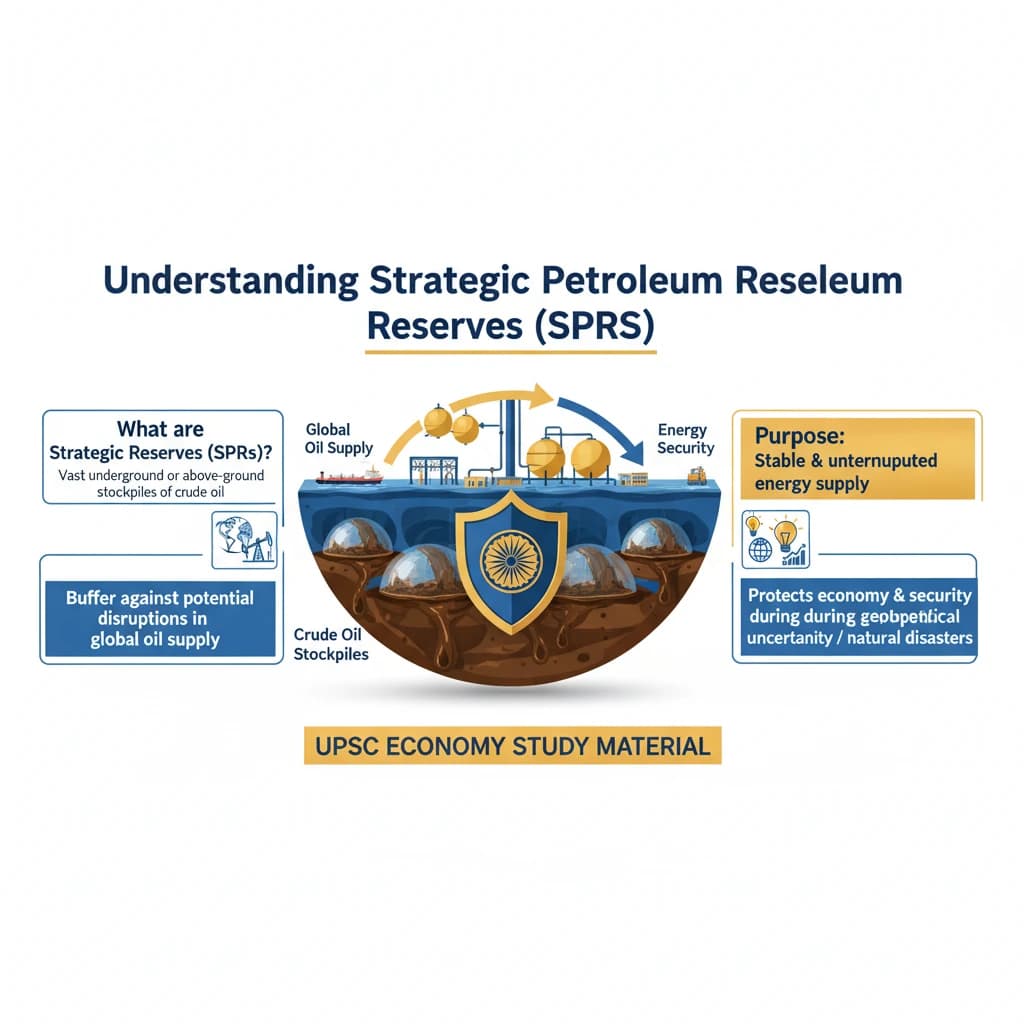
What are Strategic Petroleum Reserves?
Medium⏱️ 8 min read
economy
📖 Introduction
Understanding Strategic Petroleum Reserves (SPRs)
Strategic Petroleum Reserves (SPRs) are vast underground or above-ground stockpiles of crude oil maintained by various countries. Their primary purpose is to provide a buffer against potential disruptions in global oil supply.
These reserves are crucial for ensuring a stable and uninterrupted supply of energy. They protect a nation's economy and security during periods of geopolitical uncertainty, natural disasters, or unexpected supply chain failures.
Key Purpose: SPRs safeguard national energy security by mitigating the impact of sudden oil supply shocks.
India's Strategic Petroleum Reserve Capacity
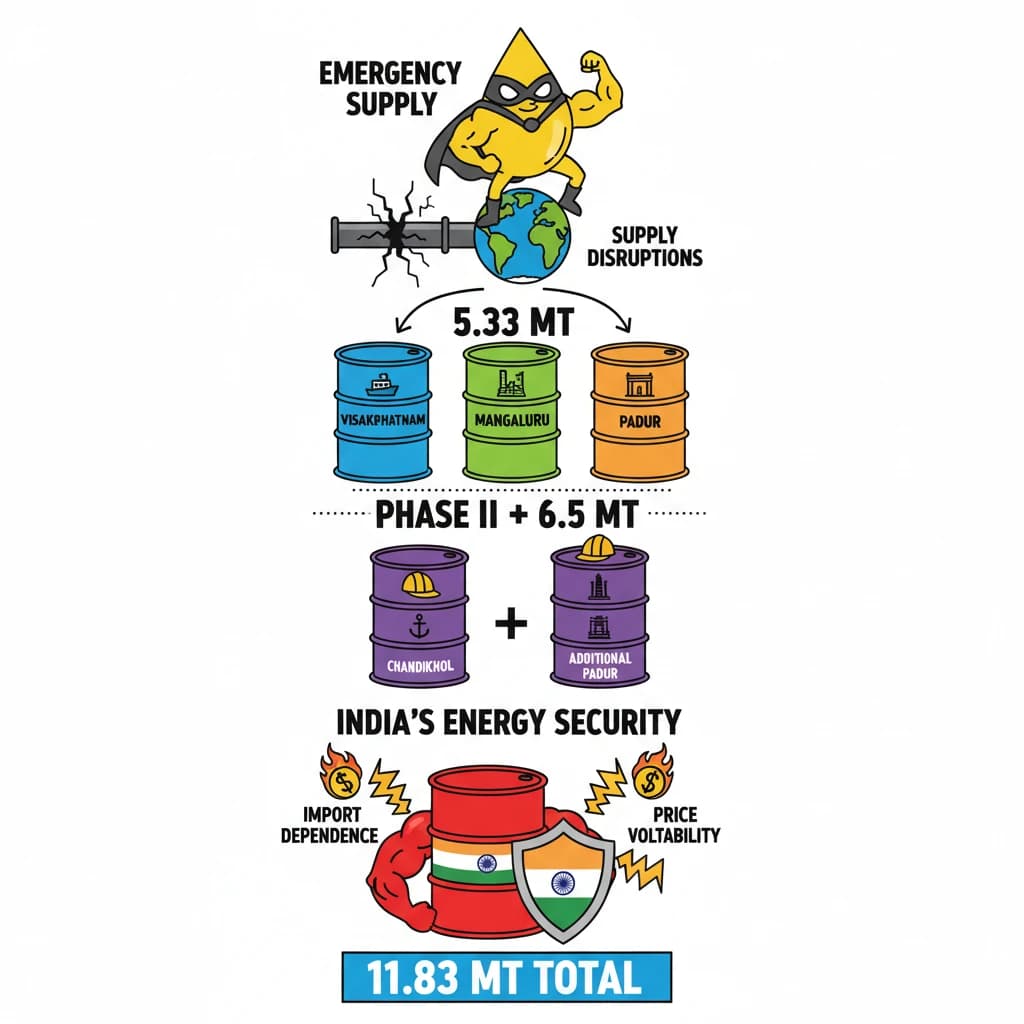
India, being a major oil importer, places significant emphasis on its strategic reserves. Currently, India's strategic crude oil reserve capacity stands at 5.33 million tonnes (MT).
Current Capacity: 5.33 million tonnes of crude oil.
This capacity is strategically located across three sites in southern India, managed by Indian Strategic Petroleum Reserves Limited (ISPRL).
Phase II Expansion of SPRs
To further bolster its energy security, India is embarking on the second phase of its strategic petroleum reserves programme. This expansion aims to significantly increase the country's storage capabilities.
Under Phase II, additional strategic reserves are planned. These new facilities will have a combined capacity to hold an extra 6.5 million tonnes (MT) of crude oil.
UPSC Insight: Questions on India's energy security, import dependence, and infrastructure projects like SPRs are common in GS Paper III (Economy and Infrastructure). Understanding both current capacity and future expansion is vital.
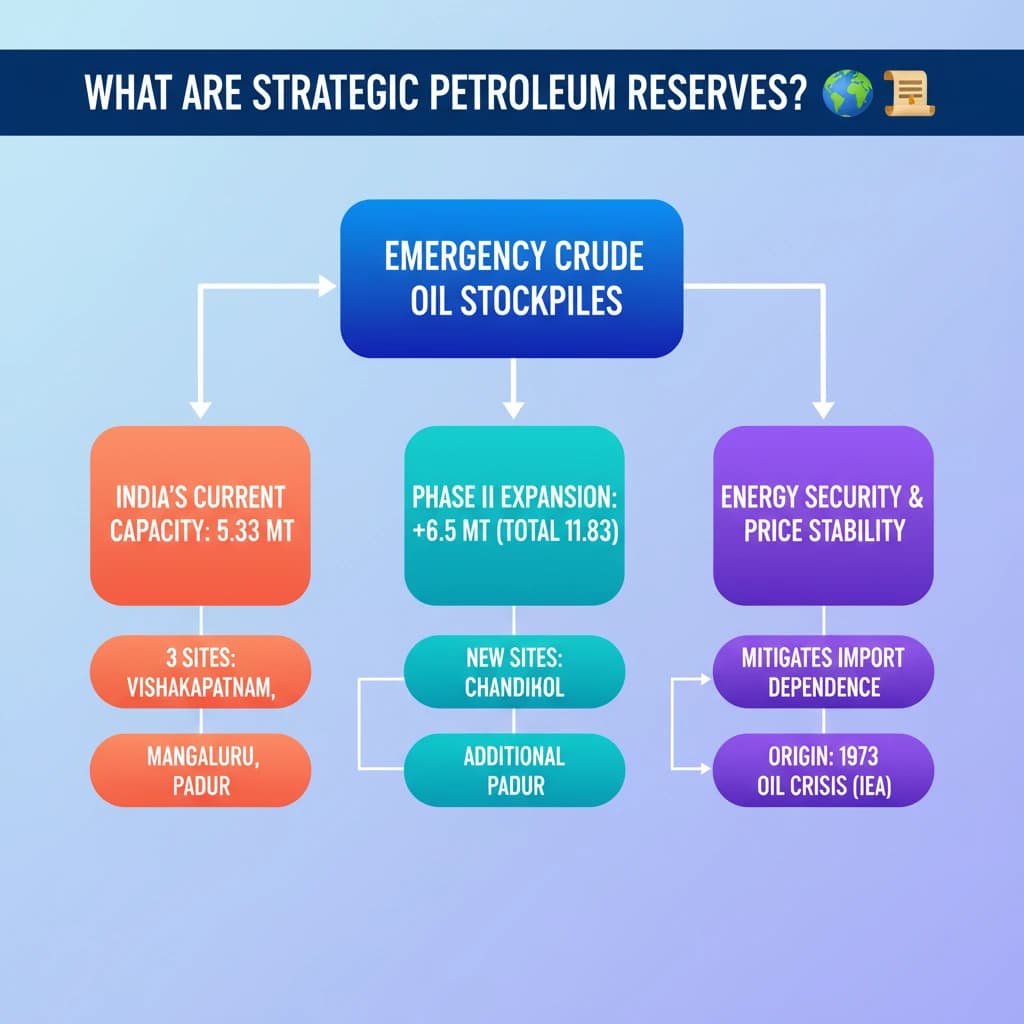
💡 Key Takeaways
- •Strategic Petroleum Reserves (SPRs) are emergency crude oil stockpiles for supply disruptions.
- •India currently has 5.33 MT capacity across three sites (Visakhapatnam, Mangaluru, Padur).
- •Phase II expansion will add 6.5 MT capacity (Chandikhol, additional Padur), totaling 11.83 MT.
- •SPRs are crucial for India's energy security, mitigating import dependence and price volatility.
- •The concept originated from the 1973 oil crisis, leading to the formation of the IEA.
- •Managed by ISPRL under the Ministry of Petroleum & Natural Gas.
🧠 Memory Techniques
98% Verified Content
📚 Reference Sources
•Indian Strategic Petroleum Reserves Limited (ISPRL) official website
•International Energy Agency (IEA) reports
•NITI Aayog publications on Energy Security