Loading page, please wait…
Black Carbon Emissions and PMUY - UPSC Environment And Ecology
What is Black Carbon Emissions and PMUY in UPSC Environment And Ecology?
Black Carbon Emissions and PMUY is a key topic under Environment And Ecology for UPSC Civil Services Examination. Key points include: India committed to achieving net-zero emissions by 2070 at UNFCCC COP26 in Glasgow.. Renewable energy capacity surpassed 180 GW by 2023, targeting 500 GW by 2030.. Pradhan Mantri Ujjwala Yojana (PMUY) significantly mitigates black carbon emissions by promoting clean cooking fuel.. Understanding this topic is essential for both UPSC Prelims and Mains preparation.
Why is Black Carbon Emissions and PMUY important for UPSC exam?
Black Carbon Emissions and PMUY is a Medium-level topic in UPSC Environment And Ecology. It is tested in both Prelims (factual MCQs) and Mains (analytical answer writing). Previous year UPSC questions have frequently covered aspects of Black Carbon Emissions and PMUY, making it essential for comprehensive IAS preparation.
How to prepare Black Carbon Emissions and PMUY for UPSC?
To prepare Black Carbon Emissions and PMUY for UPSC: (1) Study the comprehensive notes covering all key concepts on Vaidra. (2) Practice previous year questions on this topic. (3) Connect it with current affairs using daily updates. (4) Revise using key takeaways and mind maps available for Environment And Ecology. (5) Write practice answers linking Black Carbon Emissions and PMUY to related GS Paper topics.
Key takeaways of Black Carbon Emissions and PMUY for UPSC
- India committed to achieving net-zero emissions by 2070 at UNFCCC COP26 in Glasgow.
- Renewable energy capacity surpassed 180 GW by 2023, targeting 500 GW by 2030.
- Pradhan Mantri Ujjwala Yojana (PMUY) significantly mitigates black carbon emissions by promoting clean cooking fuel.
- Black carbon is a potent short-lived climate pollutant (SLCP) from incomplete combustion.
- PMUY is a key example of how social welfare schemes contribute to environmental and climate goals.

Black Carbon Emissions and PMUY
Medium⏱️ 8 min read
environment and ecology
📖 Introduction
Context: India's Climate Commitments at COP26
During the UNFCCC COP26 climate talks held in Glasgow in November 2021, India made a significant pledge. The nation committed to achieving net-zero emissions by the year 2070.
This ambitious target positions India as a crucial player in the global pursuit of carbon neutrality. It underscores the country's dedication to combating climate change on an international platform.
India's Renewable Energy Progress
According to the Ministry of New and Renewable Energy, India has made substantial progress in its renewable energy sector. By 2023, the country's installed renewable energy capacity surpassed 180 GW.
India is actively pursuing an even more ambitious target: to reach 500 GW of renewable energy capacity by 2030. This rapid expansion is central to its climate mitigation strategy.
Understanding Black Carbon Emissions
Black carbon is a component of fine particulate matter (PM2.5) that results from the incomplete combustion of fossil fuels, biofuels, and biomass. It is a powerful short-lived climate pollutant (SLCP).
Unlike carbon dioxide, black carbon remains in the atmosphere for only a few days to weeks. However, its impact on warming is significant due to its strong light-absorbing properties.
Pradhan Mantri Ujjwala Yojana (PMUY) and its Role
The Pradhan Mantri Ujjwala Yojana (PMUY) is a flagship scheme launched by the Government of India. Its primary objective is to provide clean cooking fuel, specifically LPG (Liquefied Petroleum Gas), to women from economically weaker sections.
PMUY can play a significant role in India's journey towards net-zero emissions. By replacing traditional biomass fuels (like wood, cow dung, crop residue) with LPG, it directly contributes to mitigating black carbon emissions.
Understanding the link between social welfare schemes like PMUY and environmental goals like net-zero emissions is crucial for UPSC Mains GS-III (Environment) and GS-II (Government Policies and Interventions).
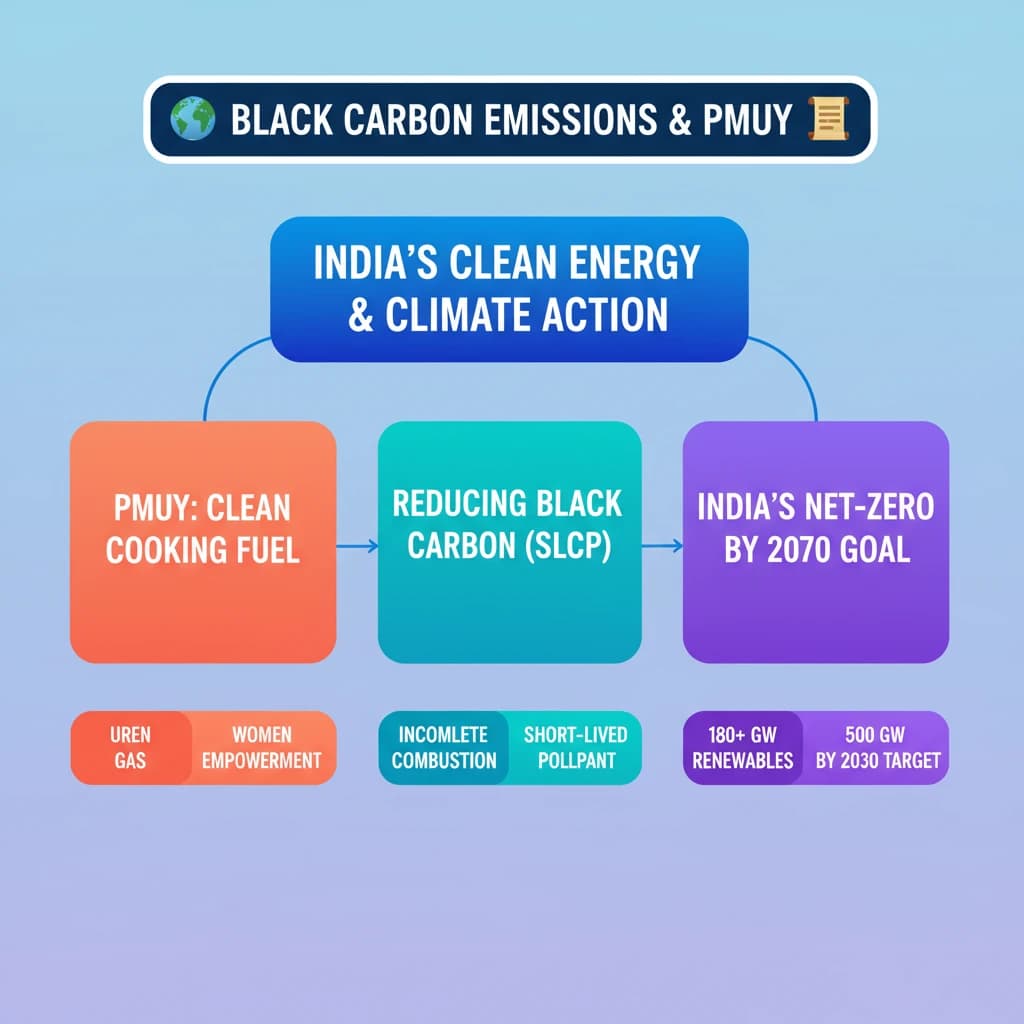
💡 Key Takeaways
- •India committed to achieving net-zero emissions by 2070 at UNFCCC COP26 in Glasgow.
- •Renewable energy capacity surpassed 180 GW by 2023, targeting 500 GW by 2030.
- •Pradhan Mantri Ujjwala Yojana (PMUY) significantly mitigates black carbon emissions by promoting clean cooking fuel.
- •Black carbon is a potent short-lived climate pollutant (SLCP) from incomplete combustion.
- •PMUY is a key example of how social welfare schemes contribute to environmental and climate goals.
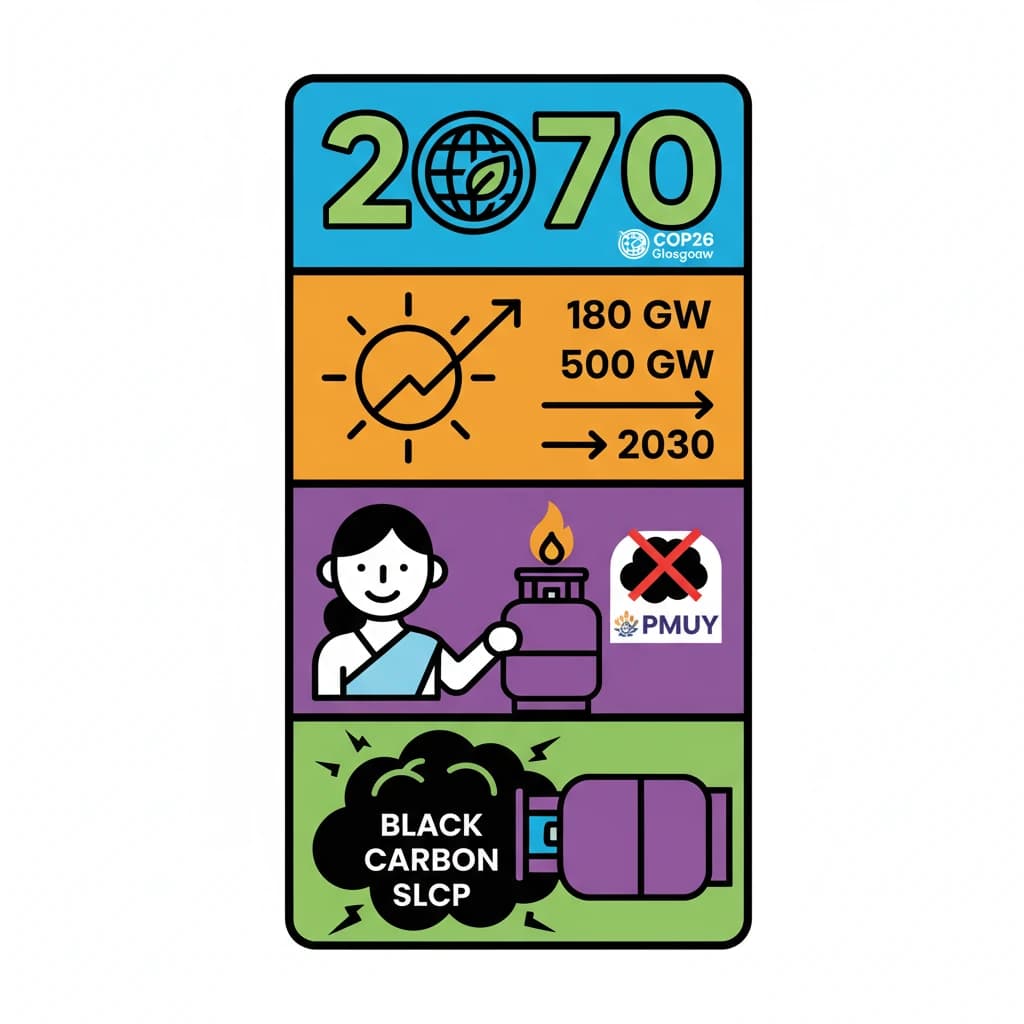
🧠 Memory Techniques
95% Verified Content
📚 Reference Sources
•UNFCCC (United Nations Framework Convention on Climate Change) COP26 outcomes
•Press Information Bureau (PIB), Government of India - Pradhan Mantri Ujjwala Yojana
•NITI Aayog reports on India's energy transition