Loading page, please wait…
Marine Heatwaves in Arctic Ocean - UPSC Environment And Ecology
What is Marine Heatwaves in Arctic Ocean in UPSC Environment And Ecology?
Marine Heatwaves in Arctic Ocean is a key topic under Environment And Ecology for UPSC Civil Services Examination. Key points include: Arctic Marine Heatwaves (MHWs) are extreme events of prolonged high Sea Surface Temperatures, linked to greenhouse gases and abrupt sea-ice melt.. Since 2007, 13 MHW events have occurred in the Arctic, coinciding with record declines in sea ice.. MHWs cause devastating impacts on marine life, including fish kills, kelp forest destruction, and widespread coral bleaching.. Understanding this topic is essential for both UPSC Prelims and Mains preparation.
Why is Marine Heatwaves in Arctic Ocean important for UPSC exam?
Marine Heatwaves in Arctic Ocean is a Medium-level topic in UPSC Environment And Ecology. It is tested in both Prelims (factual MCQs) and Mains (analytical answer writing). Previous year UPSC questions have frequently covered aspects of Marine Heatwaves in Arctic Ocean, making it essential for comprehensive IAS preparation.
How to prepare Marine Heatwaves in Arctic Ocean for UPSC?
To prepare Marine Heatwaves in Arctic Ocean for UPSC: (1) Study the comprehensive notes covering all key concepts on Vaidra. (2) Practice previous year questions on this topic. (3) Connect it with current affairs using daily updates. (4) Revise using key takeaways and mind maps available for Environment And Ecology. (5) Write practice answers linking Marine Heatwaves in Arctic Ocean to related GS Paper topics.
Key takeaways of Marine Heatwaves in Arctic Ocean for UPSC
- Arctic Marine Heatwaves (MHWs) are extreme events of prolonged high Sea Surface Temperatures, linked to greenhouse gases and abrupt sea-ice melt.
- Since 2007, 13 MHW events have occurred in the Arctic, coinciding with record declines in sea ice.
- MHWs cause devastating impacts on marine life, including fish kills, kelp forest destruction, and widespread coral bleaching.
- Warmer ocean temperatures from MHWs intensify tropical cyclones, leading to more powerful storms, heavier rainfall, and increased coastal flooding.
- The Arctic experienced a regime shift post-2007, moving from thicker to thinner, less durable sea ice, accelerating ocean warming.
Marine Heatwaves in Arctic Ocean
Medium⏱️ 7 min read
environment and ecology
📖 Introduction
Context and Recent Findings
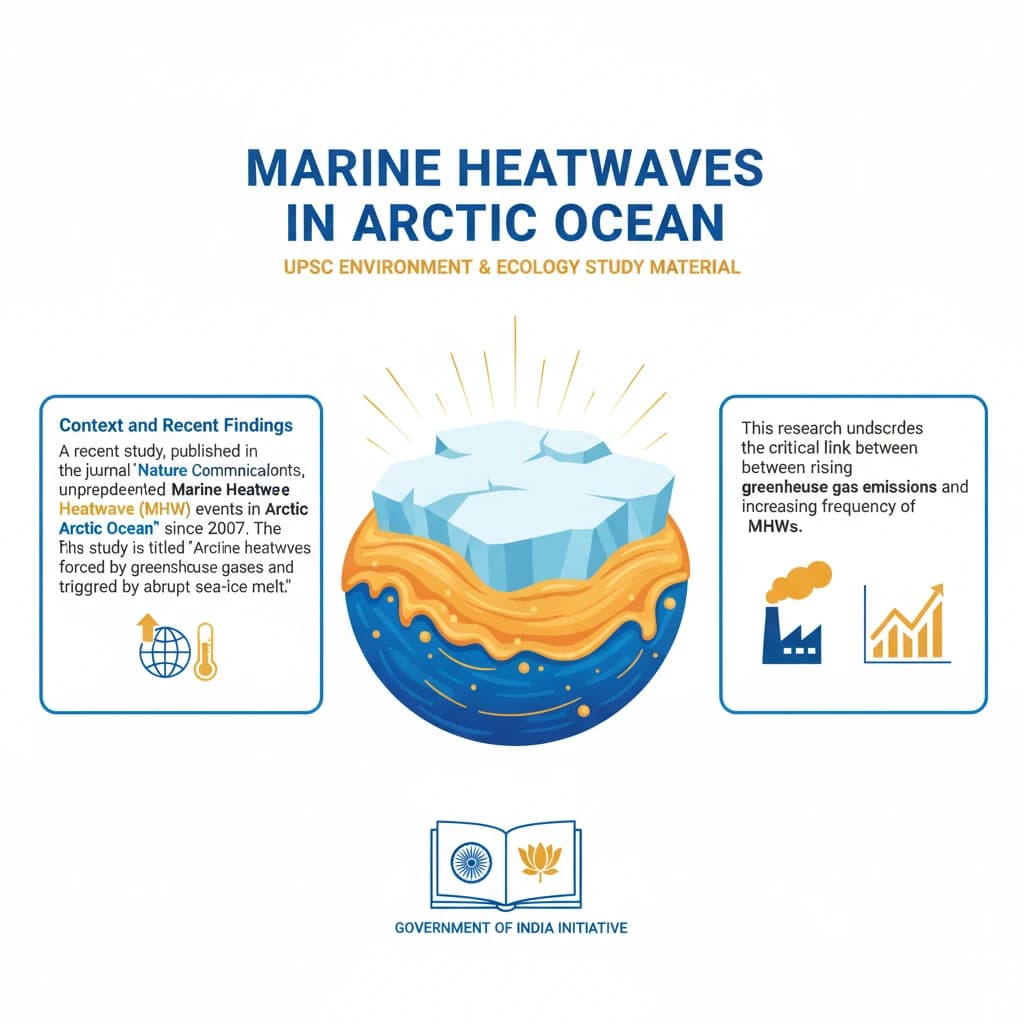
A recent study, published in the journal Nature Communications, highlights unprecedented Marine Heatwave (MHW) events in the Arctic Ocean since 2007. The study is titled 'Arctic marine heatwaves forced by greenhouse gases and triggered by abrupt sea-ice melt'.
This research underscores the critical link between rising greenhouse gas emissions and the increasing frequency of these extreme temperature events in the polar region.
What are Marine Heatwaves (MHWs)?
A Marine Heatwave (MHW) is an extreme weather event. It occurs when the surface temperature of a particular region of the sea rises to 3 or 4 degrees Celsius above the average temperature for at least five consecutive days.
According to the National Oceanic and Atmospheric Administration (NOAA), MHWs can persist for varying durations, ranging from weeks to months, or even extend over several years.
Characteristics of Arctic Marine Heatwaves
Between 2007 and 2021, the Arctic experienced 13 distinct MHW events. These were marked by prolonged periods of significantly high Sea Surface Temperatures (SST).
These events directly coincide with record-breaking declines in Arctic Sea Ice, indicating a strong correlation between the two phenomena.
The State of the Global Climate 2022 report confirmed severe and extreme marine heatwaves in the Laptev and Beaufort seas from spring to autumn in 2022.
Drivers of Arctic MHWs
Arctic MHWs primarily occur over marginal seas such as the Kara, Laptev, East Siberian, and Chukchi seas.
These regions possess characteristics conducive to MHW development, including shallow mixed-layer depths and a predominance of first-year ice cover.
First-year ice refers to sea ice that forms and grows during a single winter season and typically melts completely during the subsequent summer melt season.
An abrupt retreat of sea ice is a significant concern as it can directly trigger marine heatwave events, creating a feedback loop.
The thinner, less durable first-year ice melts more quickly, allowing increased solar radiation to warm the ocean surface, thereby fueling MHWs.
Impacts of Marine Heatwaves on Oceans and Marine Life
An increase of just 3 or 4 degrees Celsius in average ocean temperatures can have catastrophic consequences for marine life and ecosystems.
- Fish Kills: MHWs off the Western Australian coast in 2010 and 2011 led to devastating fish kills, causing sudden and widespread mortality of aquatic animals.
- Ecosystem Alteration: These heatwaves destroyed vital kelp forests, fundamentally altering the coastal ecosystem. Kelps, which thrive in cooler waters, provide crucial habitat and food for numerous marine species.
Impacts: Coral Bleaching
High ocean temperatures, such as those experienced in the tropical Atlantic and Caribbean in 2005, can trigger massive coral bleaching events.
Coral bleaching occurs when corals, sensitive to temperature changes, expel the symbiotic algae known as zooxanthellae living in their tissues. This expulsion causes them to lose their color and turn white, often leading to their death.
Impacts on Humans and Coastal Areas
Higher ocean temperatures associated with MHWs contribute to the intensification of extreme weather events like hurricanes and tropical cyclones.
Warmer temperatures accelerate the rate of evaporation and increase the transfer of heat from oceans to the atmosphere. This fuels storms with more water vapour and heat.
Consequently, when these storms make landfall, they bring more powerful winds, heavier rainfall, and extensive flooding, leading to heightened devastation for human populations and infrastructure.
Understanding the link between MHWs and intensified storms is crucial for questions on disaster management and climate change impacts in UPSC Mains GS-III.
💡 Key Takeaways
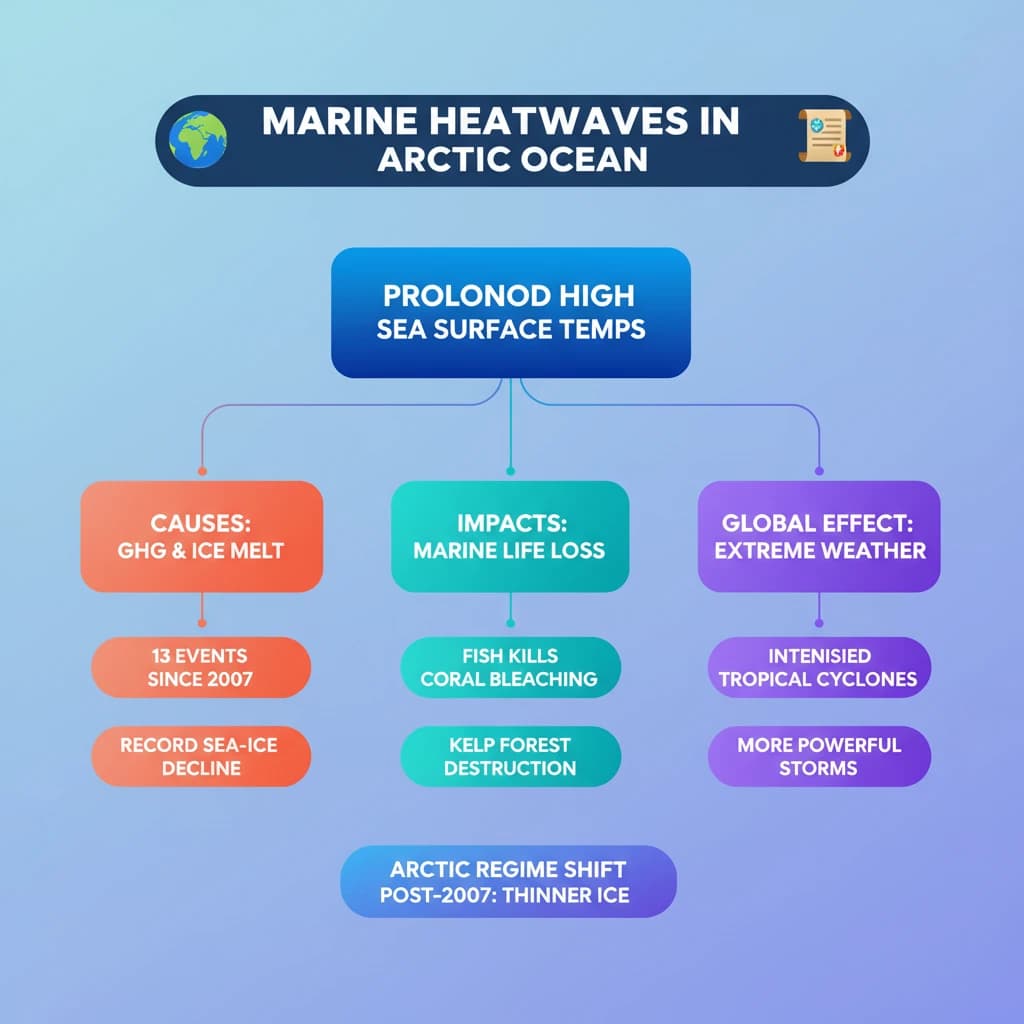
- •Arctic Marine Heatwaves (MHWs) are extreme events of prolonged high Sea Surface Temperatures, linked to greenhouse gases and abrupt sea-ice melt.
- •Since 2007, 13 MHW events have occurred in the Arctic, coinciding with record declines in sea ice.
- •MHWs cause devastating impacts on marine life, including fish kills, kelp forest destruction, and widespread coral bleaching.
- •Warmer ocean temperatures from MHWs intensify tropical cyclones, leading to more powerful storms, heavier rainfall, and increased coastal flooding.
- •The Arctic experienced a regime shift post-2007, moving from thicker to thinner, less durable sea ice, accelerating ocean warming.
🧠 Memory Techniques
95% Verified Content
📚 Reference Sources
•State of the Global Climate 2022 report
•National Oceanic and Atmospheric Administration (NOAA)