Loading page, please wait…
National Conference on Promotion of Seaweed Cultivation - UPSC Environment And Ecology
What is National Conference on Promotion of Seaweed Cultivation in UPSC Environment And Ecology?
National Conference on Promotion of Seaweed Cultivation is a key topic under Environment And Ecology for UPSC Civil Services Examination. Key points include: National Conference in Kutch aimed to promote pan-India seaweed cultivation to diversify marine production and enhance fish farmer income.. Seaweeds are macroscopic marine algae, 'Medical Food of 21st Century', found in intertidal, shallow, and deep waters, forming kelp forests.. India has ~844 seaweed species; cultivated for agar, alginates, and liquid fertilizers (e.g., Gelidiella, Gracilaria, Sargassum).. Understanding this topic is essential for both UPSC Prelims and Mains preparation.
Why is National Conference on Promotion of Seaweed Cultivation important for UPSC exam?
National Conference on Promotion of Seaweed Cultivation is a Medium-level topic in UPSC Environment And Ecology. It is tested in both Prelims (factual MCQs) and Mains (analytical answer writing). Previous year UPSC questions have frequently covered aspects of National Conference on Promotion of Seaweed Cultivation, making it essential for comprehensive IAS preparation.
How to prepare National Conference on Promotion of Seaweed Cultivation for UPSC?
To prepare National Conference on Promotion of Seaweed Cultivation for UPSC: (1) Study the comprehensive notes covering all key concepts on Vaidra. (2) Practice previous year questions on this topic. (3) Connect it with current affairs using daily updates. (4) Revise using key takeaways and mind maps available for Environment And Ecology. (5) Write practice answers linking National Conference on Promotion of Seaweed Cultivation to related GS Paper topics.
Key takeaways of National Conference on Promotion of Seaweed Cultivation for UPSC
- National Conference in Kutch aimed to promote pan-India seaweed cultivation to diversify marine production and enhance fish farmer income.
- Seaweeds are macroscopic marine algae, 'Medical Food of 21st Century', found in intertidal, shallow, and deep waters, forming kelp forests.
- India has ~844 seaweed species; cultivated for agar, alginates, and liquid fertilizers (e.g., Gelidiella, Gracilaria, Sargassum).
- Major seaweed beds are along Tamil Nadu, Gujarat coasts, Lakshadweep, and Andaman & Nicobar Islands.
- Biodiversity conventions (CBD, Cartagena, Nagoya, GBF) provide the international framework for sustainable use of resources like seaweeds.
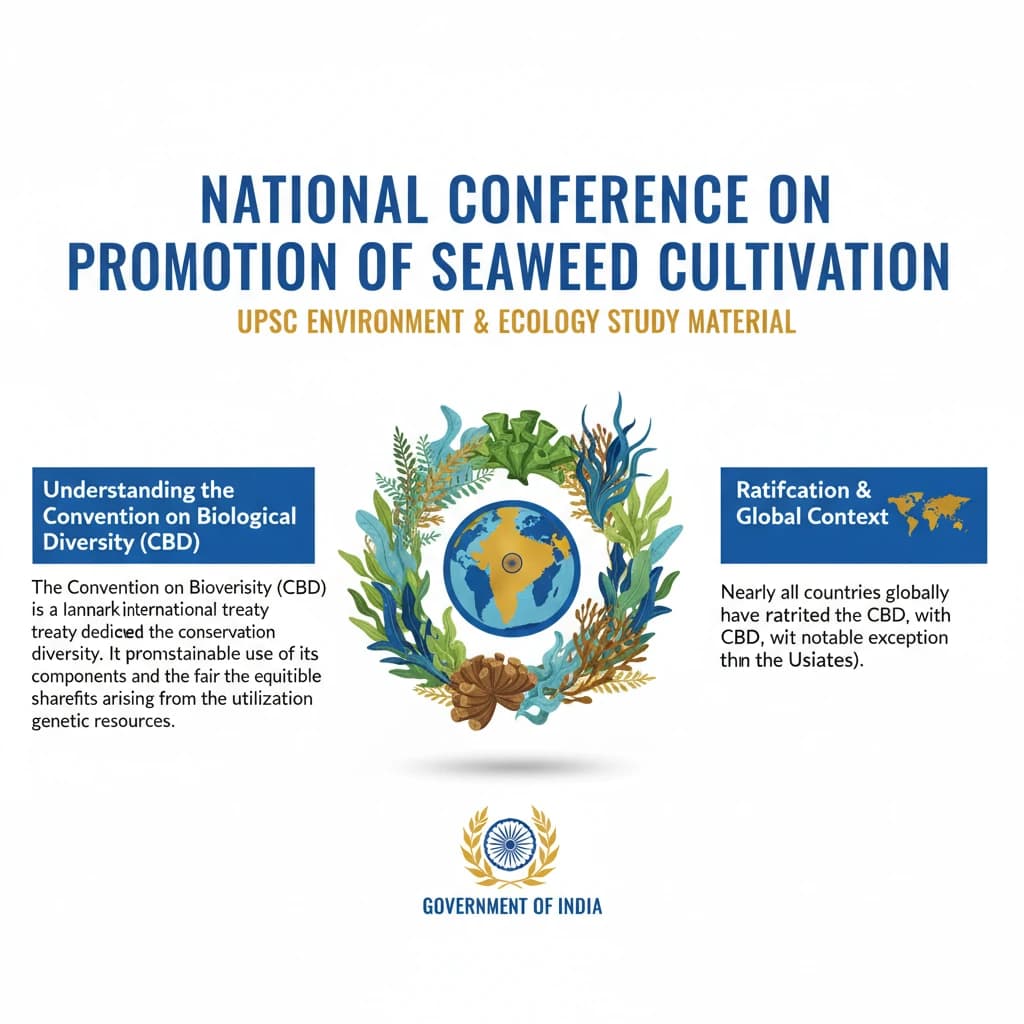
National Conference on Promotion of Seaweed Cultivation
Medium⏱️ 8 min read
environment and ecology
📖 Introduction
Understanding the Convention on Biological Diversity (CBD)
The Convention on Biological Diversity (CBD) is a landmark international treaty dedicated to the conservation of biological diversity. It promotes the sustainable use of its components and the fair and equitable sharing of benefits arising from the utilization of genetic resources.
Nearly all countries globally have ratified the CBD, with the notable exception of the United States, which has signed but not ratified it. India demonstrated its commitment by enacting the Biological Diversity Act, 2002, to implement the CBD's provisions.
The CBD Secretariat is based in Montreal, Canada, and operates under the umbrella of the United Nations Environment Programme (UNEP). Member countries, known as Parties, convene at regular intervals for meetings called the Conference of Parties (COP).
Key Protocols and Frameworks under CBD
In 2000, a supplementary agreement to the CBD, the Cartagena Protocol on Biosafety, was adopted. This protocol aims to safeguard biological diversity from potential risks posed by living modified organisms (LMOs), which are products of modern biotechnology.
The Nagoya Protocol on Access to Genetic Resources and the Fair and Equitable Sharing of Benefits Arising from their Utilization (ABS) was adopted in 2010 during COP10 in Nagoya, Japan. It extends beyond genetic resources to include traditional knowledge (TK) associated with these resources and the benefits derived from their utilization.
Alongside the Nagoya Protocol, COP10 also introduced the Strategic Plan for Biodiversity 2011-2020. This ten-year framework outlined 20 ambitious yet achievable targets, collectively known as the Aichi Targets for Biodiversity, for global action to conserve biodiversity.
More recently, the Kunming-Montreal Global Biodiversity Framework (GBF) was adopted during the 15th Conference of Parties (COP15). This comprehensive framework sets four goals to be achieved by 2050 and twenty-three targets for 2030, guiding global efforts for biodiversity conservation.
UPSC often asks about the objectives and provisions of international environmental conventions like the CBD, Cartagena, and Nagoya Protocols. Understanding their timelines and key targets (e.g., Aichi Targets, GBF goals) is crucial for both Prelims and Mains.
National Conference on Promotion of Seaweed Cultivation
A National Conference on Promotion of Seaweed Cultivation was recently held in Koteshwar (Kori Creek), Kutch, Gujarat. The primary objective of this conference was to promote and implement seaweed cultivation on a pan-India basis.
The conference emphasized the importance of seaweed cultivation for diversifying marine production and significantly enhancing the income of fish farmers across the country. It aligns with broader goals of sustainable marine resource utilization.
Understanding Seaweeds: The 'Medical Food of the 21st Century'
Seaweeds are defined as macroscopic, multicellular marine algae. They exhibit a diverse range of colors, including red, green, and brown, contributing to the rich biodiversity of marine ecosystems. They are often referred to as the ‘Medical Food of the 21st Century’ due to their numerous health benefits and industrial applications.
Distribution: Seaweeds are predominantly found in the intertidal region, as well as in shallow and deep waters of the sea. They also thrive in specialized environments such as estuaries and backwaters. Large accumulations of seaweeds form dense underwater ecosystems known as kelp forests.
These kelp forests play a vital ecological role, acting as crucial underwater nurseries for a variety of marine life, including fish, snails, and sea urchins. This highlights their importance in maintaining marine biodiversity and supporting fisheries.
Seaweed Species and Cultivation in India
India's marine environment is rich in seaweed diversity, with approximately 844 reported seaweed species found in its coastal waters. This vast resource offers significant potential for sustainable harvesting and cultivation.
- Specific species like Gelidiella acerosa, Gracilaria spp., Sargassum spp., Turbinaria spp., and Cystoseira trinodis are actively cultivated.
- These cultivated seaweeds are primarily used for the production of valuable commercial products such as agar, alginates, and liquid seaweed fertilizer.
Major Seaweed Beds in India
Significant seaweed resources are concentrated along India's coastline. Abundant seaweed beds are found along the coasts of Tamil Nadu and Gujarat. Additionally, the waters around Lakshadweep and the Andaman & Nicobar Islands are rich in seaweed diversity.
Other notable seaweed beds are located around Mumbai, Ratnagiri, Goa, Karwar, Varkala, Vizhinjam. Important sites also include Pulicat in Tamil Nadu, Andhra Pradesh, and Chilka in Orissa, indicating a widespread distribution across different coastal states.
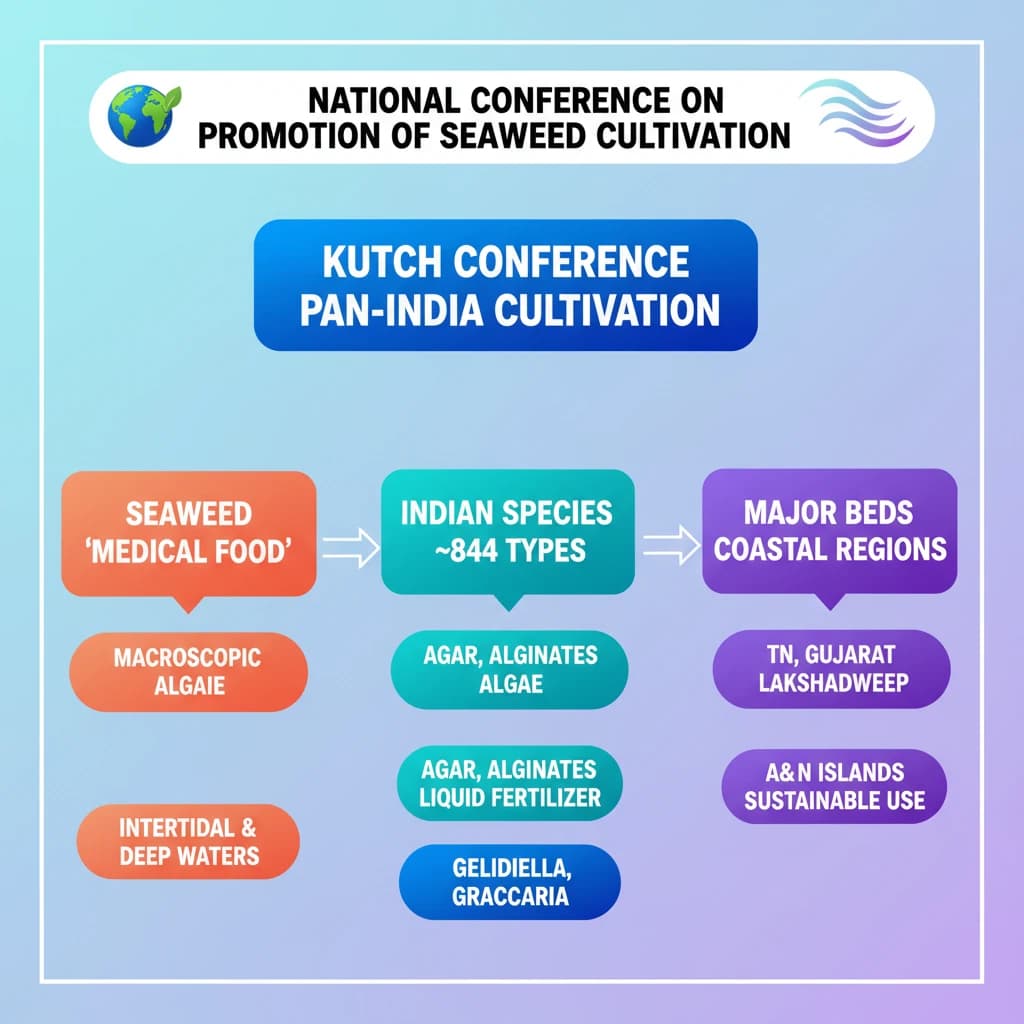
💡 Key Takeaways
- •National Conference in Kutch aimed to promote pan-India seaweed cultivation to diversify marine production and enhance fish farmer income.
- •Seaweeds are macroscopic marine algae, 'Medical Food of 21st Century', found in intertidal, shallow, and deep waters, forming kelp forests.
- •India has ~844 seaweed species; cultivated for agar, alginates, and liquid fertilizers (e.g., Gelidiella, Gracilaria, Sargassum).
- •Major seaweed beds are along Tamil Nadu, Gujarat coasts, Lakshadweep, and Andaman & Nicobar Islands.
- •Biodiversity conventions (CBD, Cartagena, Nagoya, GBF) provide the international framework for sustainable use of resources like seaweeds.
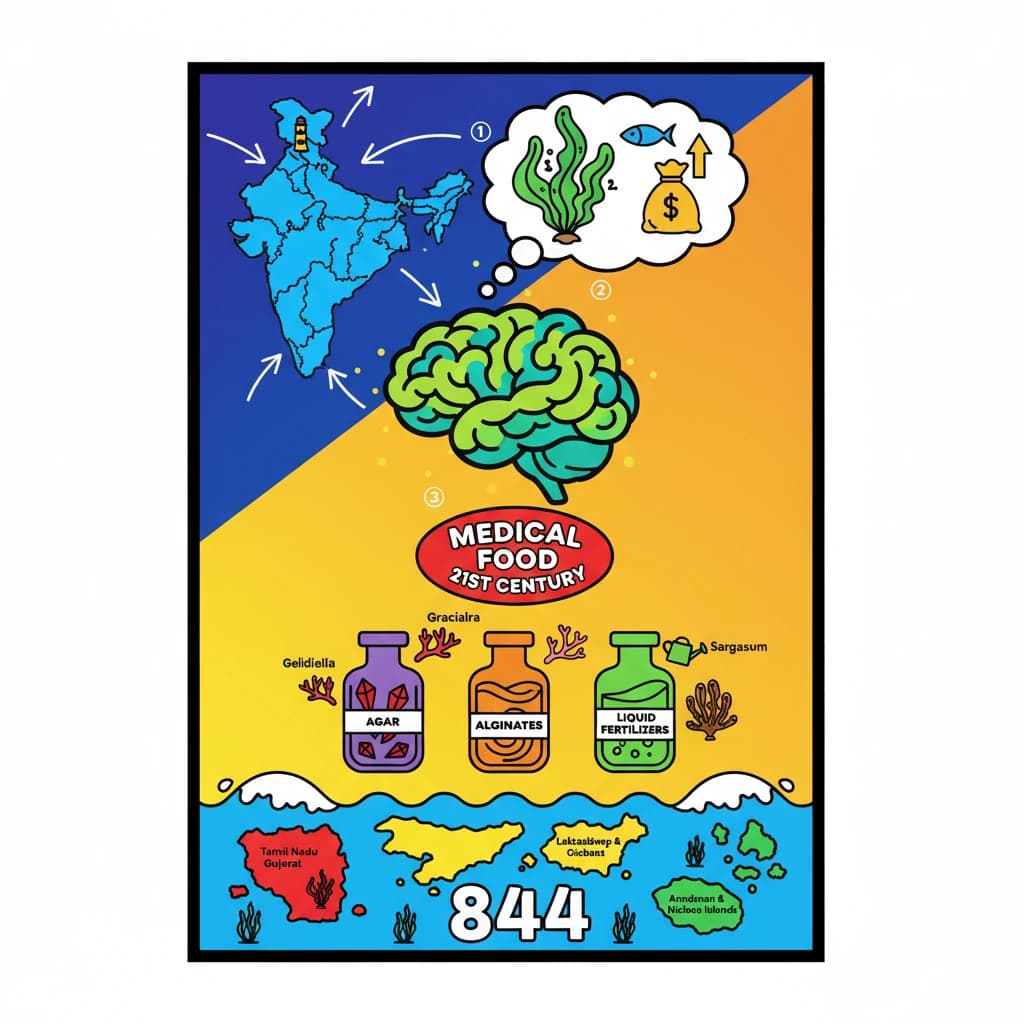
🧠 Memory Techniques
95% Verified Content