Loading page, please wait…
Artesian Well in Rajasthan and Tethys Sea - UPSC Geography
What is Artesian Well in Rajasthan and Tethys Sea in UPSC Geography?
Artesian Well in Rajasthan and Tethys Sea is a key topic under Geography for UPSC Civil Services Examination. Key points include: Artesian wells are naturally flowing wells where water rises under pressure from a confined aquifer without pumping.. A recent discovery in Jaisalmer, Rajasthan, is attributed to an artesian well, with water potentially millions of years old.. Experts link the Jaisalmer water's origin to the ancient Tethys Sea, rejecting the Saraswati river connection.. Understanding this topic is essential for both UPSC Prelims and Mains preparation.
Why is Artesian Well in Rajasthan and Tethys Sea important for UPSC exam?
Artesian Well in Rajasthan and Tethys Sea is a Medium-level topic in UPSC Geography. It is tested in both Prelims (factual MCQs) and Mains (analytical answer writing). Previous year UPSC questions have frequently covered aspects of Artesian Well in Rajasthan and Tethys Sea, making it essential for comprehensive IAS preparation.
How to prepare Artesian Well in Rajasthan and Tethys Sea for UPSC?
To prepare Artesian Well in Rajasthan and Tethys Sea for UPSC: (1) Study the comprehensive notes covering all key concepts on Vaidra. (2) Practice previous year questions on this topic. (3) Connect it with current affairs using daily updates. (4) Revise using key takeaways and mind maps available for Geography. (5) Write practice answers linking Artesian Well in Rajasthan and Tethys Sea to related GS Paper topics.
Key takeaways of Artesian Well in Rajasthan and Tethys Sea for UPSC
- Artesian wells are naturally flowing wells where water rises under pressure from a confined aquifer without pumping.
- A recent discovery in Jaisalmer, Rajasthan, is attributed to an artesian well, with water potentially millions of years old.
- Experts link the Jaisalmer water's origin to the ancient Tethys Sea, rejecting the Saraswati river connection.
- Artesian wells form when a well penetrates a permeable aquifer sandwiched between impermeable rock layers.
- They differ from tube wells, which require external power for water extraction.
- Such discoveries are crucial for water security in arid regions and highlight the importance of deep geological studies.
Artesian Well in Rajasthan and Tethys Sea
Medium⏱️ 10 min read
geography
📖 Introduction
Introduction: Artesian Well in Rajasthan
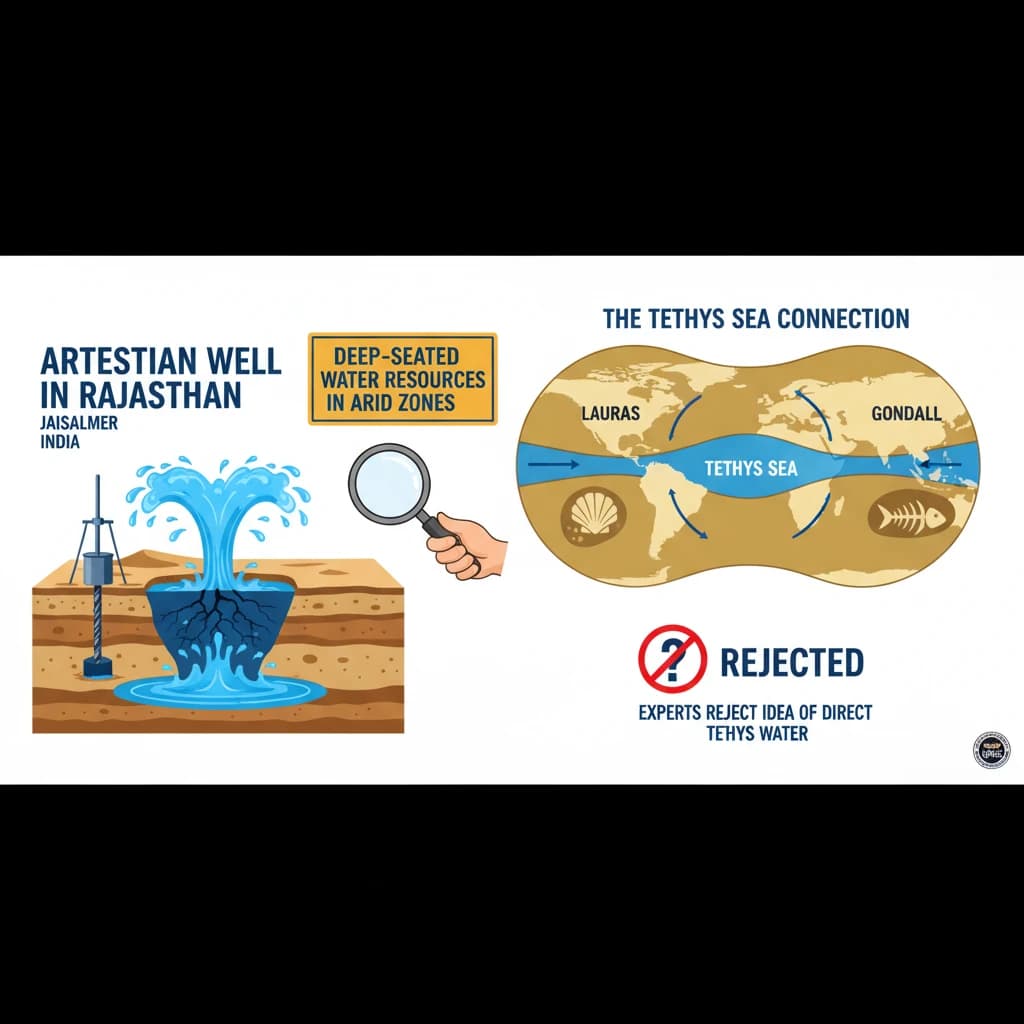
Recently, a significant amount of water began gushing out from underground in Jaisalmer, Rajasthan. This phenomenon has been attributed to the presence of an Artesian Well in the region.
The discovery has sparked interest regarding deep-seated water resources in India's arid zones.
The Tethys Sea Connection
Experts have rejected the idea that this gushing water is linked to the ancient Saraswati river.
Instead, they suggest the water may be millions of years old, originating from the ancient Tethys Sea, which existed in pre-Vedic times.
Understanding the distinction between historical rivers and ancient geological formations like the Tethys Sea is crucial for UPSC Geography.
What is an Artesian Well?
An artesian well is a unique type of well where water rises naturally to the surface under its own pressure.
Crucially, it does not require any external pumping to bring the water up.
This natural flow occurs when water is trapped within a confined aquifer, where it is subjected to significant hydrostatic pressure.
The water within such an aquifer is often described as “confined” because it is enclosed by layers of hardy, impermeable materials both above and below it.
Formation of Artesian Wells
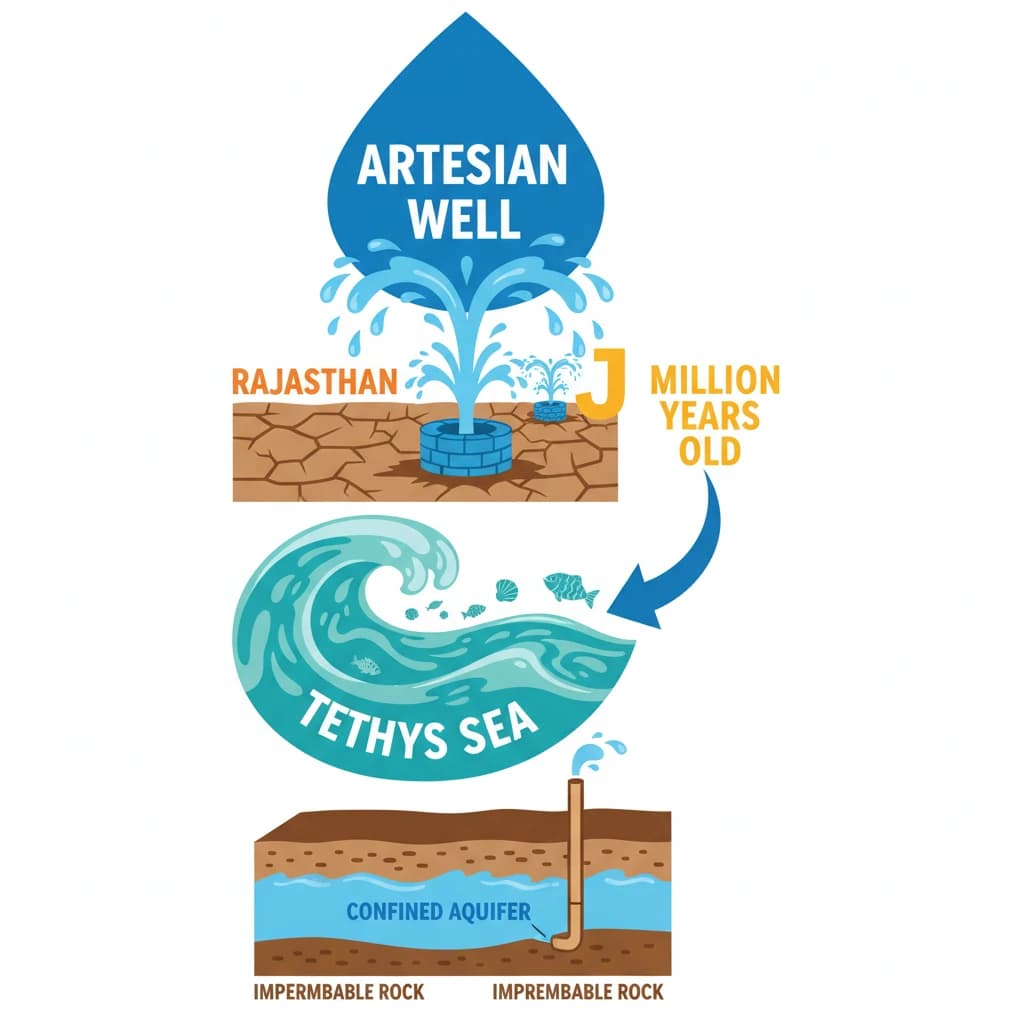
Artesian wells are formed when a bore or well penetrates a confined aquifer.
A confined aquifer is essentially a layer of permeable rock or sediment (like sandstone or limestone) that is capable of holding water.
This permeable layer is typically sandwiched between two layers of impermeable rock or sediment, such as clay or shale, which prevent the water from escaping vertically.
Global Locations of Famous Artesian Wells
- The Great Artesian Basin, located primarily in Australia, is one of the largest and most famous artesian systems globally.
- The Dakota aquifer in the United States is another prominent example of a significant confined aquifer.
- Various regions across Africa also feature notable artesian wells, providing vital water resources.
Artesian Wells vs. Tube Wells: A Comparison
Artesian water can naturally rise to the surface on its own due to inherent pressure.
It is typically found much deeper beneath the Earth’s surface compared to conventional groundwater sources.
In contrast, tube wells always require external power, such as electric pumps, to draw water to the surface.
Etymology: Origin of the Term 'Artesian'
The name Artesian has historical roots, derived from the town of Artois in France.
This region was historically known as the old Roman city of Artesium.
It was in Artois during the Middle Ages that some of the earliest and best-known flowing artesian wells were successfully drilled, lending the phenomenon its enduring name.
💡 Key Takeaways
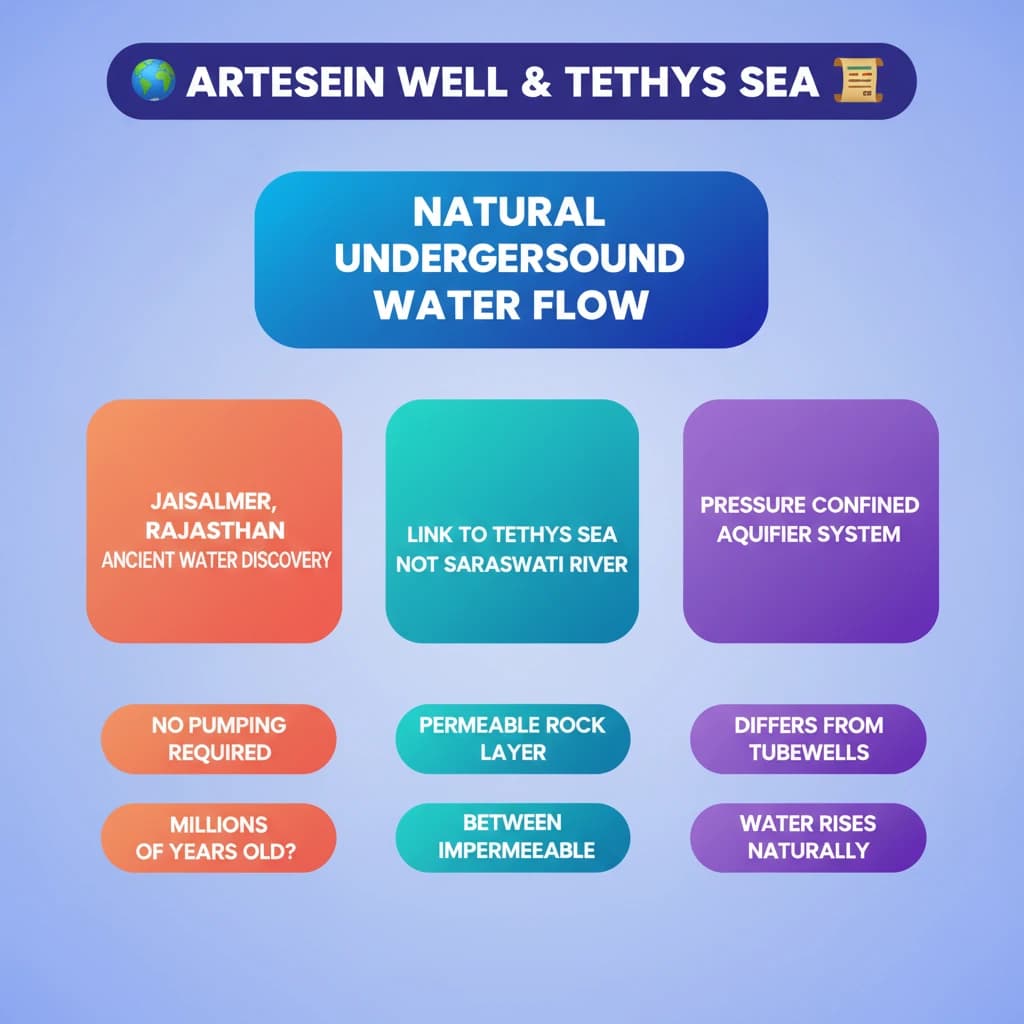
- •Artesian wells are naturally flowing wells where water rises under pressure from a confined aquifer without pumping.
- •A recent discovery in Jaisalmer, Rajasthan, is attributed to an artesian well, with water potentially millions of years old.
- •Experts link the Jaisalmer water's origin to the ancient Tethys Sea, rejecting the Saraswati river connection.
- •Artesian wells form when a well penetrates a permeable aquifer sandwiched between impermeable rock layers.
- •They differ from tube wells, which require external power for water extraction.
- •Such discoveries are crucial for water security in arid regions and highlight the importance of deep geological studies.
🧠 Memory Techniques
95% Verified Content
📚 Reference Sources
•NCERT Geography textbooks (Class XI - Fundamentals of Physical Geography)
•Geological Survey of India (GSI) reports on Rajasthan's hydrogeology
•Reputable news articles on the Jaisalmer discovery (e.g., The Hindu, Indian Express)