Loading page, please wait…
Cyclone Dana: Formation, Impact, and Significance for India - UPSC Geography
What is Cyclone Dana: Formation, Impact, and Significance for India in UPSC Geography?
Cyclone Dana: Formation, Impact, and Significance for India is a key topic under Geography for UPSC Civil Services Examination. Key points include: Cyclone Dana was the third cyclone in the North Indian Ocean in 2024, and the first of the post-monsoon season, named by Qatar.. It was predicted to be a severe cyclone making landfall on the Odisha coast, near Bhitarkanika National Park and Dhamra Port.. Intense convection, warm moist air influx, and a conducive Madden-Julian Oscillation (MJO) phase were key reasons for its heavy rainfall potential.. Understanding this topic is essential for both UPSC Prelims and Mains preparation.
Why is Cyclone Dana: Formation, Impact, and Significance for India important for UPSC exam?
Cyclone Dana: Formation, Impact, and Significance for India is a Medium-level topic in UPSC Geography. It is tested in both Prelims (factual MCQs) and Mains (analytical answer writing). Previous year UPSC questions have frequently covered aspects of Cyclone Dana: Formation, Impact, and Significance for India, making it essential for comprehensive IAS preparation.
How to prepare Cyclone Dana: Formation, Impact, and Significance for India for UPSC?
To prepare Cyclone Dana: Formation, Impact, and Significance for India for UPSC: (1) Study the comprehensive notes covering all key concepts on Vaidra. (2) Practice previous year questions on this topic. (3) Connect it with current affairs using daily updates. (4) Revise using key takeaways and mind maps available for Geography. (5) Write practice answers linking Cyclone Dana: Formation, Impact, and Significance for India to related GS Paper topics.
Key takeaways of Cyclone Dana: Formation, Impact, and Significance for India for UPSC
- Cyclone Dana was the third cyclone in the North Indian Ocean in 2024, and the first of the post-monsoon season, named by Qatar.
- It was predicted to be a severe cyclone making landfall on the Odisha coast, near Bhitarkanika National Park and Dhamra Port.
- Intense convection, warm moist air influx, and a conducive Madden-Julian Oscillation (MJO) phase were key reasons for its heavy rainfall potential.
- Landfall refers specifically to the eye of the cyclone crossing the coast, distinct from a direct hit by the eyewall.
- India's cyclone management has evolved significantly, leveraging advanced technology and institutional frameworks like NDMA to reduce casualties.
Cyclone Dana: Formation, Impact, and Significance for India
Medium⏱️ 7 min read
geography
📖 Introduction
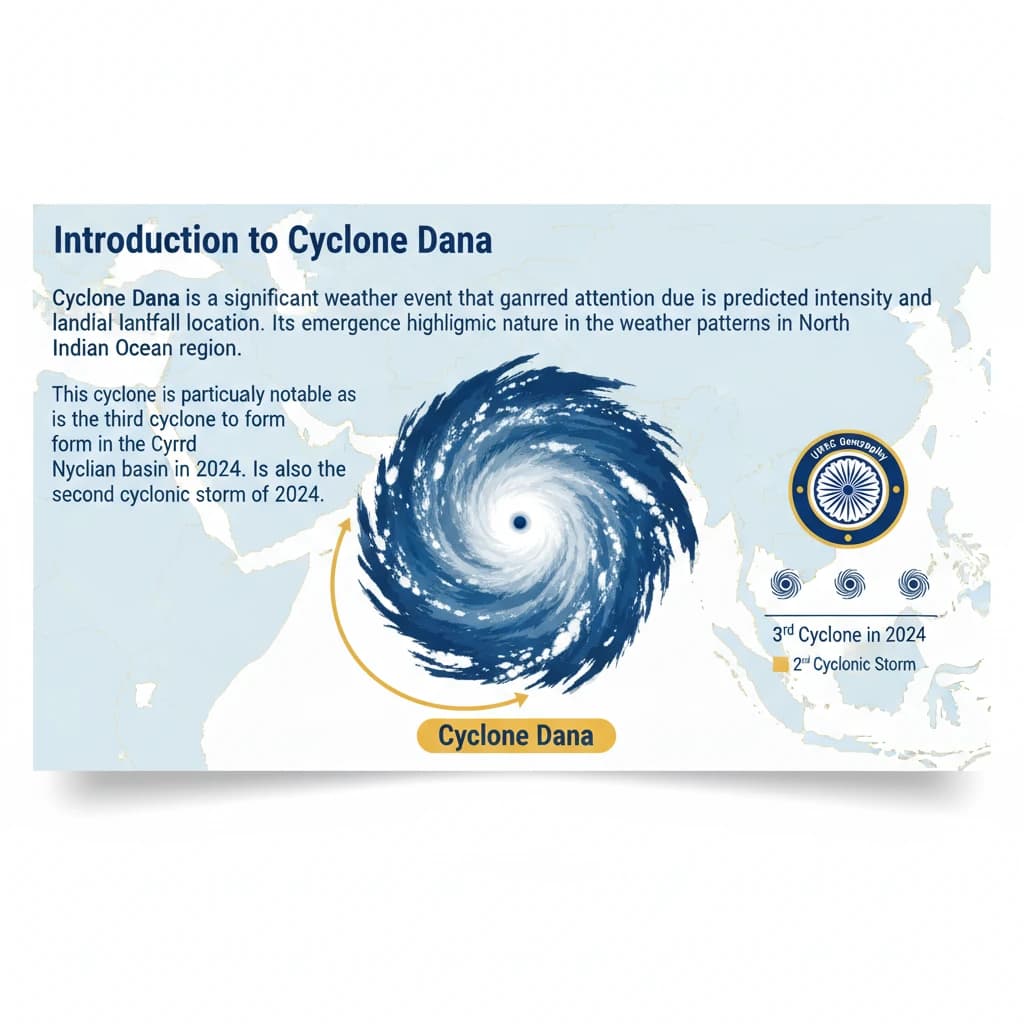
Introduction to Cyclone Dana
Cyclone Dana was a significant weather event in 2024, drawing attention due to its expected landfall along the Odisha coast. The India Meteorological Department (IMD) had forecasted it to make landfall as a severe cyclone.
Expected Landfall Area: Near Bhitarkanika National Park and Dhamra Port in Odisha.
Wind Speed Category: Classified as a severe cyclone, indicating wind speeds between 89 to 117 kmph.
Key Characteristics of Cyclone Dana
Cyclone Dana marked several important distinctions in the 2024 cyclone season. It was the third cyclone to develop in the North Indian Ocean region.
Notably, it was the second cyclone to make landfall along the Indian coast in 2024, following Cyclone Remal. It also held the distinction of being the first cyclone of the post-monsoon cyclone season.
Naming of Dana: Named by Qatar, as per the World Meteorological Organization (WMO) guidelines. In Arabic, "Dana" signifies "generosity" and also refers to "the most perfectly sized, valuable, and beautiful pearl."
Reasons for Intense Rainfall
The intensity of rainfall associated with Cyclone Dana was attributed to a combination of meteorological factors. These factors enhance the storm's ability to produce heavy precipitation.
- Intense Convection: The cyclone exhibited significant intense convection in its western sector. This convection extended up to the upper layers of the atmosphere, creating conditions for heavy rain.
- Warm Moist Air Influx: A continuous influx of warm, moist air into the cyclone's core further intensified convection. This supply of moisture fuels the storm, leading to more intense rainfall over a concentrated area.
Intense Convection Explained: This process begins when warm, moist air rises, cools, and expands. As it cools, moisture condenses into water droplets, forming clouds. Continued cooling and condensation lead to the formation of cumulonimbus clouds, characteristic of thunderstorms and heavy rainfall.
Madden-Julian Oscillation (MJO) Influence
The Madden-Julian Oscillation (MJO) played a crucial role in enhancing the rainfall associated with Cyclone Dana. Its current phase was conducive to convection.
MJO Structure: The MJO consists of two primary phases: an enhanced rainfall phase and a suppressed rainfall phase. This dipole structure propagates from west to east across the Tropics.
- During the enhanced phase, surface winds converge, causing air to rise and significantly increasing rainfall.
- Conversely, in the suppressed phase, winds converge at the top of the atmosphere, causing air to sink and reduced rainfall.
The enhanced phase results in more cloudiness and rainfall, while the suppressed phase brings more sunshine and dryness.
Understanding Cyclone Landfall
The term landfall is specific to tropical cyclones and describes a critical moment in their trajectory. It signifies the transition of the storm from ocean to land.
Definition of Landfall: Landfall occurs when the storm's center, specifically the eye of the cyclone, crosses the coast and moves onto land.
Distinction from Direct Hit: Landfall is different from a direct hit. A direct hit means the core of high winds, or the eyewall, comes onshore, but the actual center of the storm may still remain offshore.
💡 Key Takeaways
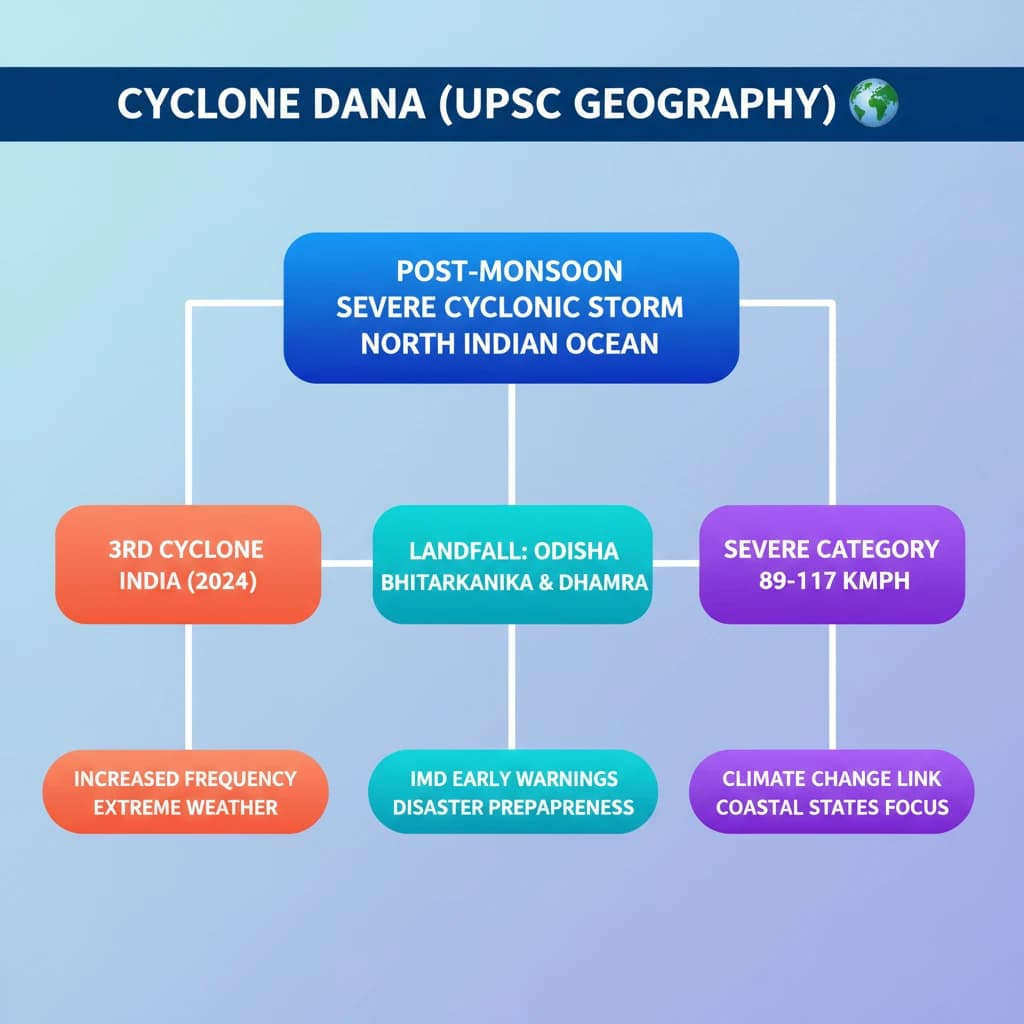
- •Cyclone Dana was the third cyclone in the North Indian Ocean in 2024, and the first of the post-monsoon season, named by Qatar.
- •It was predicted to be a severe cyclone making landfall on the Odisha coast, near Bhitarkanika National Park and Dhamra Port.
- •Intense convection, warm moist air influx, and a conducive Madden-Julian Oscillation (MJO) phase were key reasons for its heavy rainfall potential.
- •Landfall refers specifically to the eye of the cyclone crossing the coast, distinct from a direct hit by the eyewall.
- •India's cyclone management has evolved significantly, leveraging advanced technology and institutional frameworks like NDMA to reduce casualties.
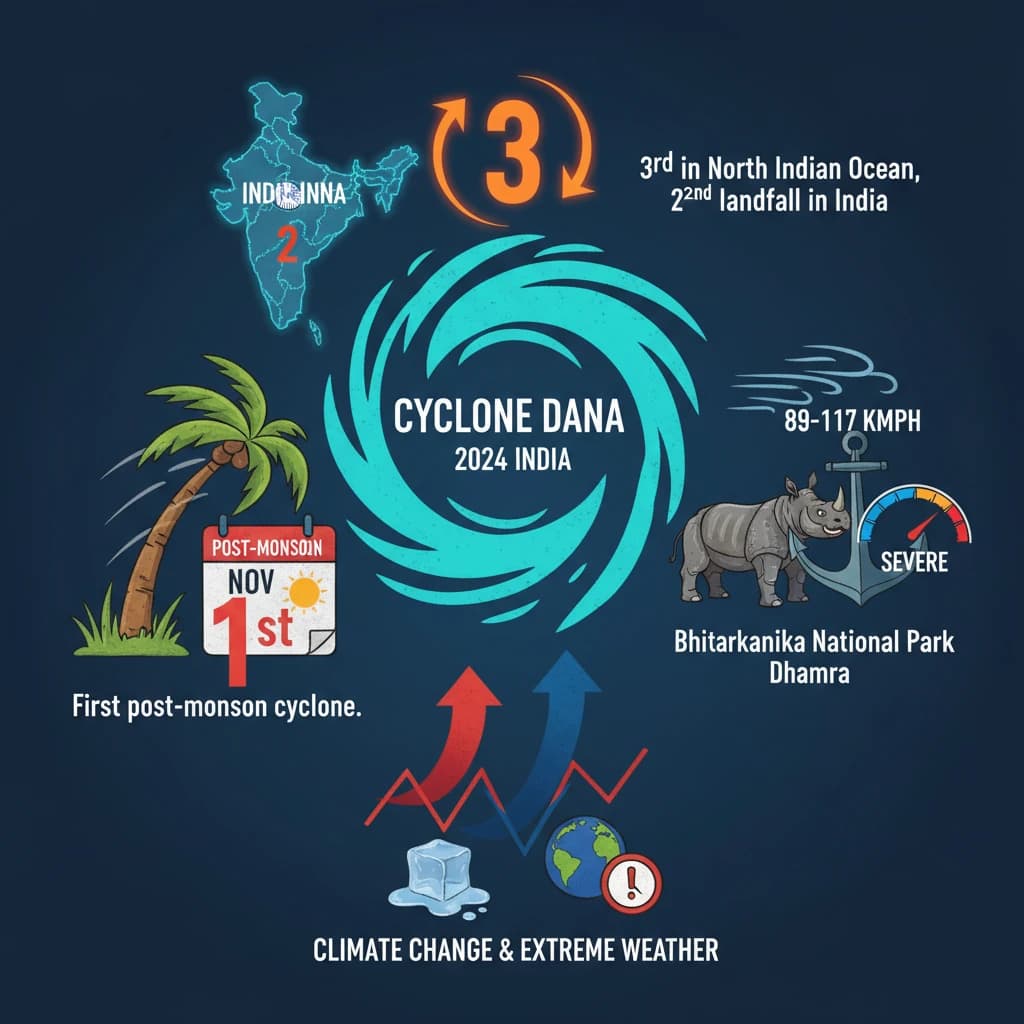
🧠 Memory Techniques
95% Verified Content
📚 Reference Sources
•World Meteorological Organization (WMO) guidelines on cyclone naming
•Drishti IAS Summary on Cyclone Dana
•National Disaster Management Authority (NDMA) publications