Loading page, please wait…
Water Management in Indian History - UPSC Geography
What is Water Management in Indian History in UPSC Geography?
Water Management in Indian History is a key topic under Geography for UPSC Civil Services Examination. Key points include: India has a rich history of diverse and sophisticated traditional water management systems.. These systems were highly adapted to local geography, climate, and community needs.. Examples range from Indus Valley Civilization reservoirs (Dholavira) to medieval canals (Western Yamuna Canal).. Understanding this topic is essential for both UPSC Prelims and Mains preparation.
Why is Water Management in Indian History important for UPSC exam?
Water Management in Indian History is a Medium-level topic in UPSC Geography. It is tested in both Prelims (factual MCQs) and Mains (analytical answer writing). Previous year UPSC questions have frequently covered aspects of Water Management in Indian History, making it essential for comprehensive IAS preparation.
How to prepare Water Management in Indian History for UPSC?
To prepare Water Management in Indian History for UPSC: (1) Study the comprehensive notes covering all key concepts on Vaidra. (2) Practice previous year questions on this topic. (3) Connect it with current affairs using daily updates. (4) Revise using key takeaways and mind maps available for Geography. (5) Write practice answers linking Water Management in Indian History to related GS Paper topics.
Key takeaways of Water Management in Indian History for UPSC
- India has a rich history of diverse and sophisticated traditional water management systems.
- These systems were highly adapted to local geography, climate, and community needs.
- Examples range from Indus Valley Civilization reservoirs (Dholavira) to medieval canals (Western Yamuna Canal).
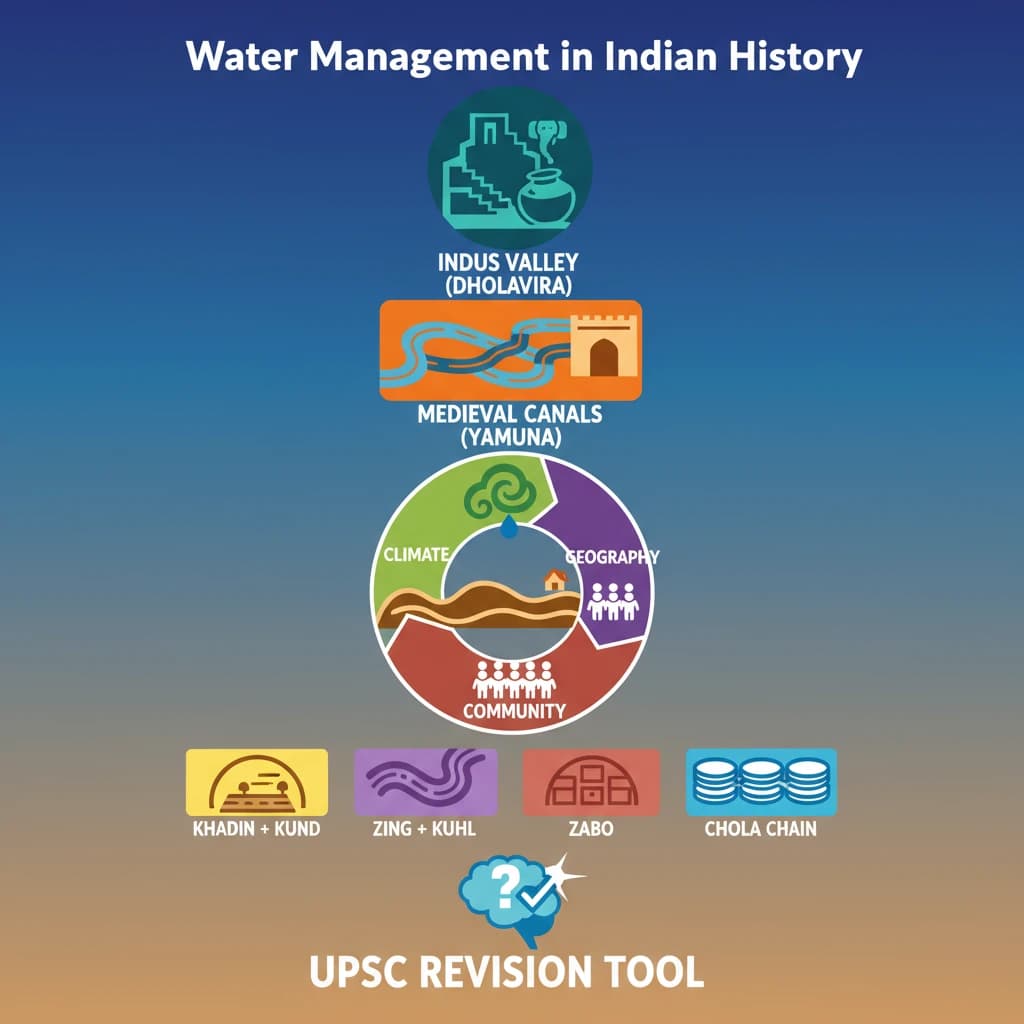
- Key systems include Khadins, Kunds, Zing, Kuhls, Zabo, and Chola chain tanks.
- Traditional methods offer valuable lessons for modern sustainable water resource management and climate resilience.
Water Management in Indian History
Medium⏱️ 10 min read
geography
📖 Introduction
Introduction to Traditional Water Management
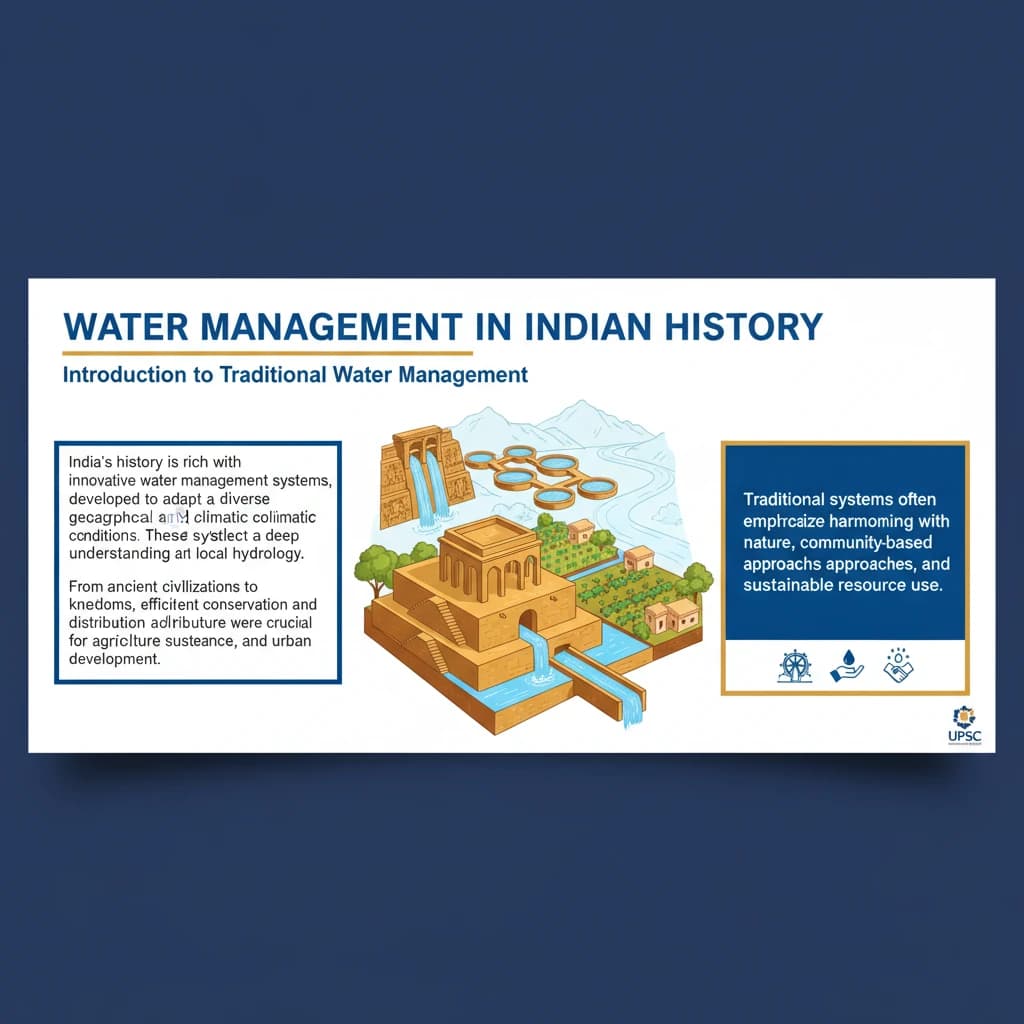
India's history is rich with innovative water management systems, developed to adapt to diverse geographical and climatic conditions. These systems reflect a deep understanding of local hydrology.
From ancient civilizations to medieval kingdoms, efficient water conservation and distribution were crucial for agriculture, sustenance, and urban development.
Traditional systems often emphasized community participation, sustainability, and minimal environmental impact, offering valuable lessons for modern challenges.
Key Traditional Water Harvesting Systems
Across different regions, unique methods evolved to collect, store, and utilize water. These systems were ingeniously designed to suit local terrain and water availability.
- Panam Keni: Cylindrical wells made from soaked toddy palm stems, considered sacred, found in Wayanad, Kerala.
- Khadin (Dhora): Long earthen embankments built across hill slopes in Jaisalmer, Rajasthan. They collect surface runoff for agriculture.
- Kund: A saucer-shaped catchment area with a central circular underground well. Traditionally lined with lime and ash, found across various regions.
- Zing: Small tanks in Ladakh that collect glacier meltwater, often turning into streams by afternoon.
- Kuhls: Surface water channels in Himachal Pradesh, carrying glacial waters to agricultural fields.
- Zabo System: An integrated system in Nagaland combining rainwater conservation with forestry, agriculture, and animal care, using pond-like structures on terraced hillsides.
- Jackwells: Pits surrounded by bunds made of hardwood logs, practiced by the Shompen tribe in the Great Nicobar Islands.
Water Management in Ancient India
The earliest evidence of sophisticated water management dates back to the Indus Valley Civilization, showcasing advanced urban planning.
- Dholavira: Featured large reservoirs to collect and store rainwater.
- Lothal and Inamgaon: Utilized small bunds to store water for irrigation and drinking purposes.
During the Mauryan Empire, water management became a state-regulated affair, vital for agricultural productivity and imperial administration.
The Arthashastra of Kautilya records extensive irrigation systems, including dams and bunds. These were managed under strict regulations, with taxes imposed based on water source and extraction method.
Innovations in Early Medieval India
The early medieval period witnessed further advancements and diversification of water management techniques, reflecting regional ingenuity.
- The Katayanas introduced brick and ring wells, improving access to groundwater.
- The Chola period in South India was renowned for its advanced chain tanks – interconnected tank systems ensuring efficient water distribution.
- The Rajputs constructed large reservoirs, such as the famous Bhopal Lake built under King Bhoja.
- In eastern India, the Pal and Sen dynasties were responsible for numerous tanks and lakes.
Medieval Period Advancements
The medieval era saw the construction of large-scale canal systems and tanks, often patronized by powerful rulers to boost agricultural output and support urban centers.
- Feroze Shah Tughlaq: Credited with building the Western Yamuna Canal.
- Emperor Shahjahan: Developed the significant Bari Doab or Hasli Canal.
- Vijayanagar Kingdom: Constructed impressive tanks like the Anantraj Sagar and the Korangal Dam.
- Sultan Zain Uddin: Established an extensive canal network in Kashmir.
Remember specific examples like Dholavira's reservoirs, Chola chain tanks, and Tughlaq's canals. These are frequently asked in UPSC Prelims and can enrich answers in Mains (GS-I History, GS-III Environment/Agriculture).
💡 Key Takeaways
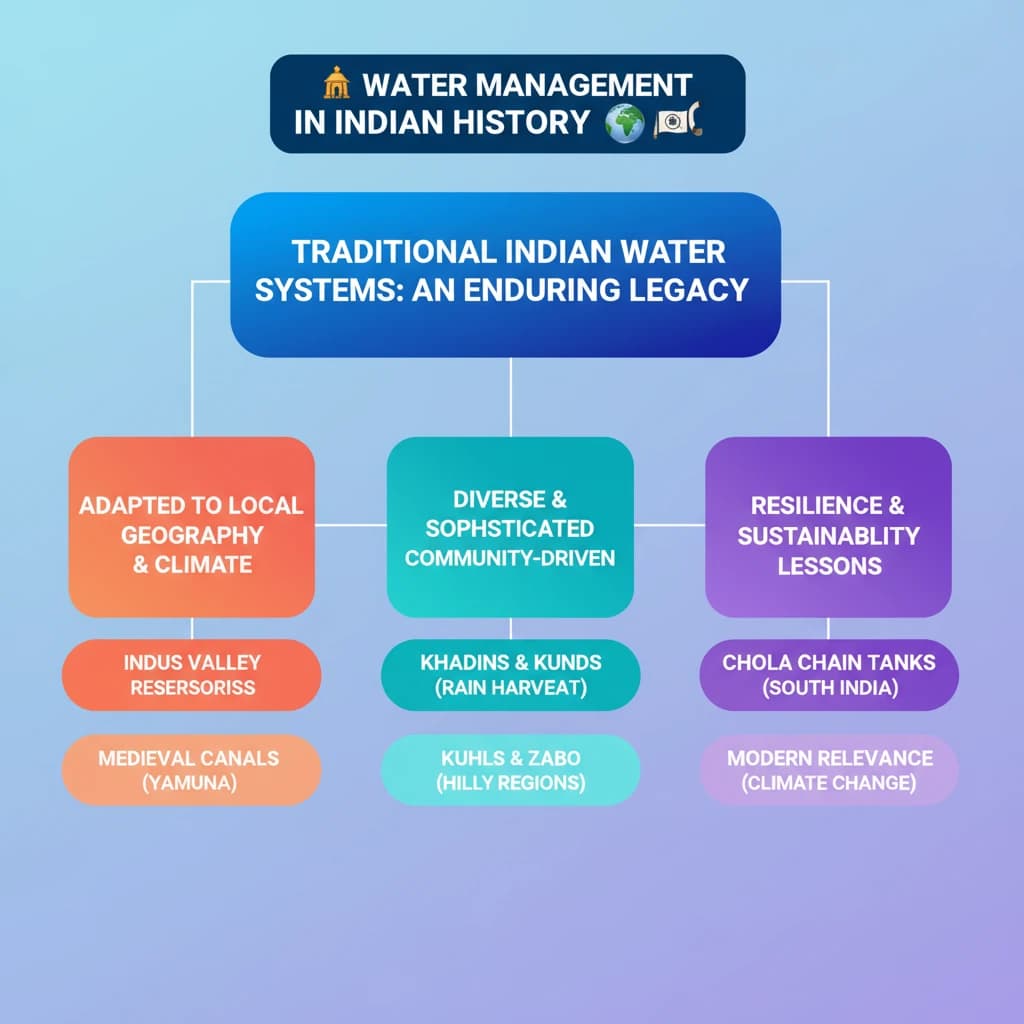
- •India has a rich history of diverse and sophisticated traditional water management systems.
- •These systems were highly adapted to local geography, climate, and community needs.
- •Examples range from Indus Valley Civilization reservoirs (Dholavira) to medieval canals (Western Yamuna Canal).
- •Key systems include Khadins, Kunds, Zing, Kuhls, Zabo, and Chola chain tanks.
- •Traditional methods offer valuable lessons for modern sustainable water resource management and climate resilience.
🧠 Memory Techniques
95% Verified Content
📚 Reference Sources
•NCERT History Textbooks (relevant chapters on ancient/medieval India)
•General knowledge on traditional water harvesting systems