Loading page, please wait…
What was the Role of Other Leaders in Integration of Princely States? - UPSC History
What is What was the Role of Other Leaders in Integration of Princely States? in UPSC History?
What was the Role of Other Leaders in Integration of Princely States? is a key topic under History for UPSC Civil Services Examination. Key points include: India gained significant territory and population through princely state integration despite Partition losses.. Lord Mountbatten used his influence as Governor-General to persuade reluctant rulers.. Jawaharlal Nehru adopted a firm stance, declaring non-acceding states as 'enemy states'.. Understanding this topic is essential for both UPSC Prelims and Mains preparation.
Why is What was the Role of Other Leaders in Integration of Princely States? important for UPSC exam?
What was the Role of Other Leaders in Integration of Princely States? is a Medium-level topic in UPSC History. It is tested in both Prelims (factual MCQs) and Mains (analytical answer writing). Previous year UPSC questions have frequently covered aspects of What was the Role of Other Leaders in Integration of Princely States?, making it essential for comprehensive IAS preparation.
How to prepare What was the Role of Other Leaders in Integration of Princely States? for UPSC?
To prepare What was the Role of Other Leaders in Integration of Princely States? for UPSC: (1) Study the comprehensive notes covering all key concepts on Vaidra. (2) Practice previous year questions on this topic. (3) Connect it with current affairs using daily updates. (4) Revise using key takeaways and mind maps available for History. (5) Write practice answers linking What was the Role of Other Leaders in Integration of Princely States? to related GS Paper topics.
Key takeaways of What was the Role of Other Leaders in Integration of Princely States? for UPSC
- India gained significant territory and population through princely state integration despite Partition losses.
- Lord Mountbatten used his influence as Governor-General to persuade reluctant rulers.
- Jawaharlal Nehru adopted a firm stance, declaring non-acceding states as 'enemy states'.
- C. Rajagopalachari provided a legal argument, stating British paramountcy's transfer to independent India.
- The Congress asserted that princely states were not sovereign and could not remain independent post-paramountcy.
- Integration was crucial for India's territorial integrity and national unity.
What was the Role of Other Leaders in Integration of Princely States?
Medium⏱️ 5 min read
history
📖 Introduction
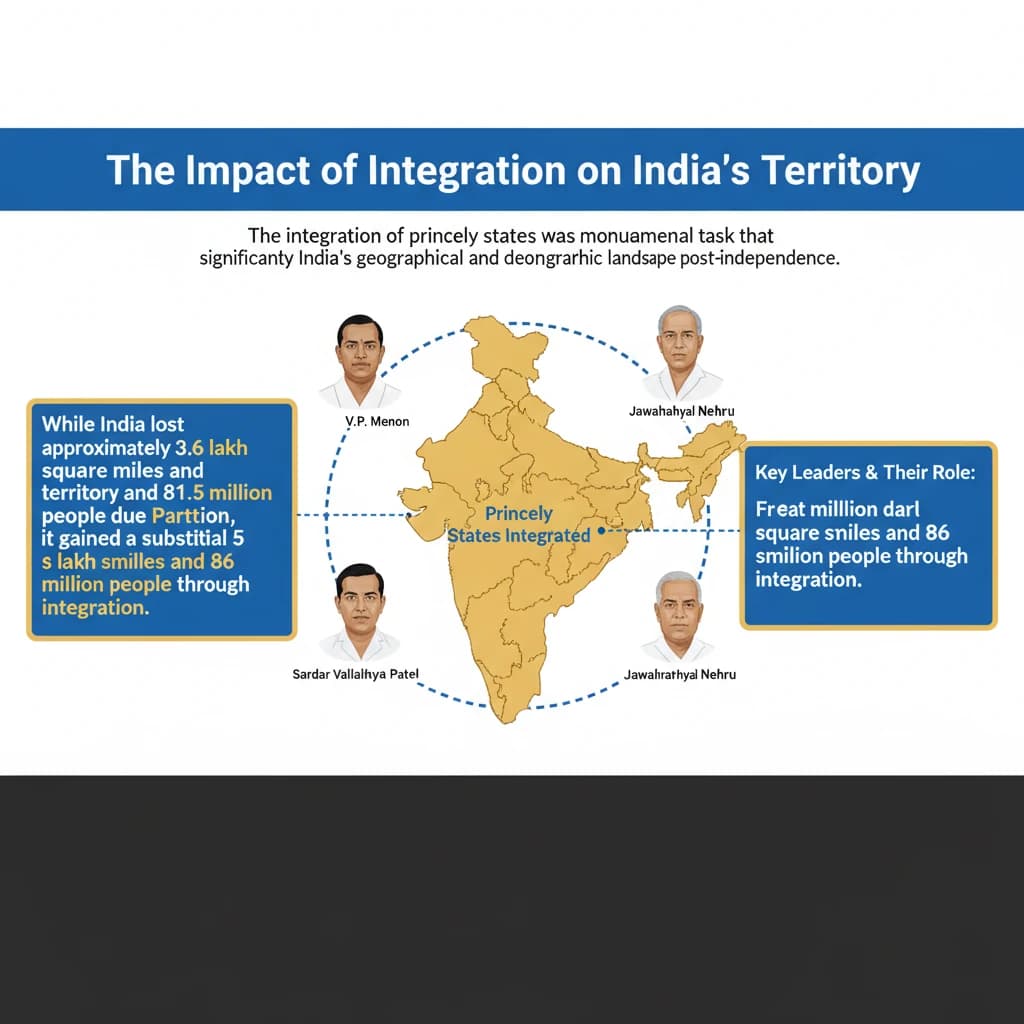
The Impact of Integration on India's Territory
The integration of princely states was a monumental task that significantly reshaped India's geographical and demographic landscape post-independence.
While India lost approximately 3.6 lakh square miles of territory and 81.5 million people due to Partition, it gained a substantial 5 lakh square miles and 86.5 million people through the successful integration of these states.
Lord Mountbatten's Role in Persuasion
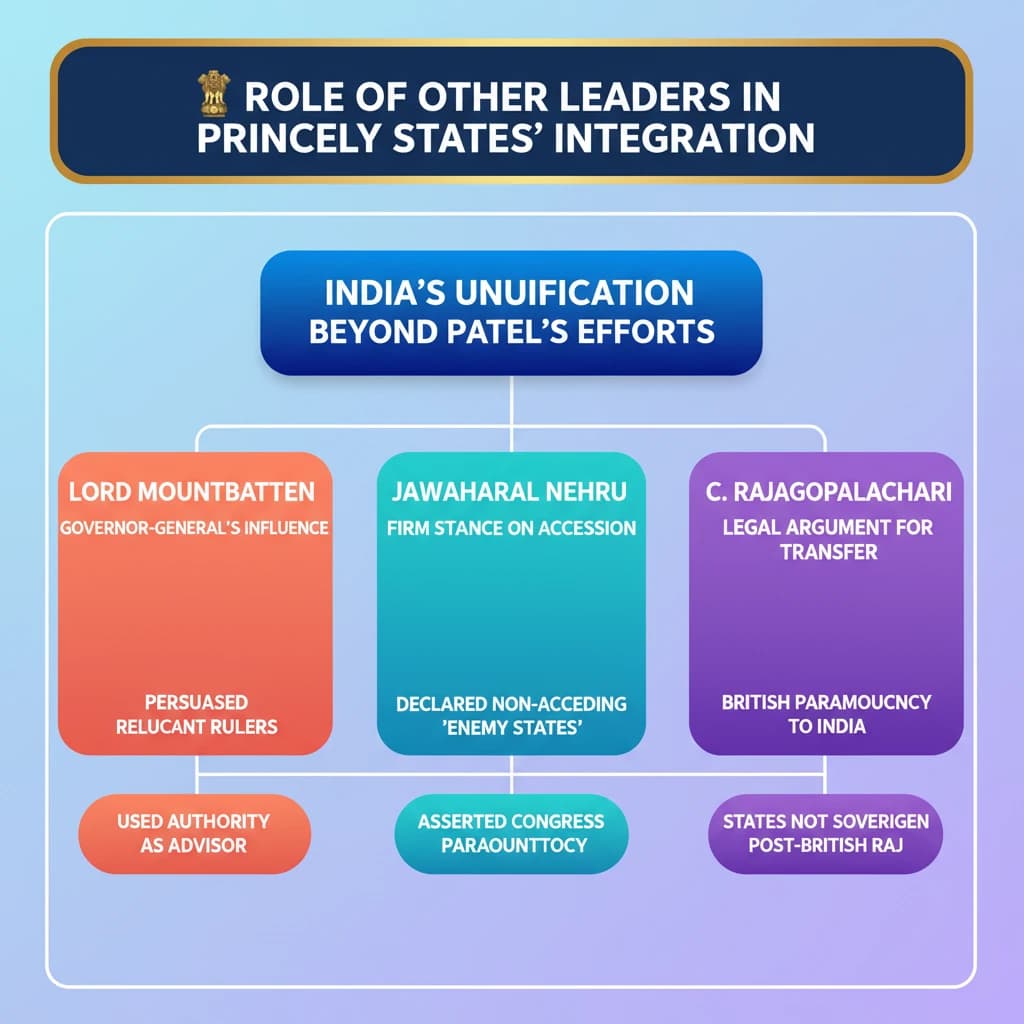
Lord Mountbatten, the last Viceroy and first Governor-General of independent India, played a pivotal role in the accession process. His influence was crucial in convincing many reluctant monarchs.
Mountbatten's position as the first Governor-General of India lent credibility to the agreements. Princely rulers believed he could guarantee that independent India would uphold the terms of accession.
Jawaharlal Nehru's Confrontational Approach
Jawaharlal Nehru, India's first Prime Minister, adopted a firmer stance towards the princely states. His approach was more assertive and less conciliatory than Mountbatten's.
In January 1947, Nehru unequivocally rejected the concept of the divine right of kings, signaling that traditional claims to sovereignty would not be recognized by the new Indian government.
By May 1947, Nehru declared that any princely state that refused to join the Constituent Assembly would be treated as an enemy state. This strong warning underscored the Union's determination.
C. Rajagopalachari's Legal Argument
C. Rajagopalachari, a prominent Congress leader, provided a crucial legal and political argument for the integration. He challenged the notion of princely states' independence.
He contended that British control over princely states was based on practical reality and historical dominance, rather than a formal treaty or agreement. Therefore, this control would naturally transfer to independent India as the legitimate successor to the British Raj.
The Congress Organisation's Stance
The Indian National Congress, as a unified political entity, consistently maintained a clear position on the future of princely states. It asserted that these states were not truly sovereign.
The Congress argued that the states could not unilaterally opt for independence once British paramountcy lapsed. Their future was inextricably linked with the Indian Union, reflecting the will of their people.
💡 Key Takeaways
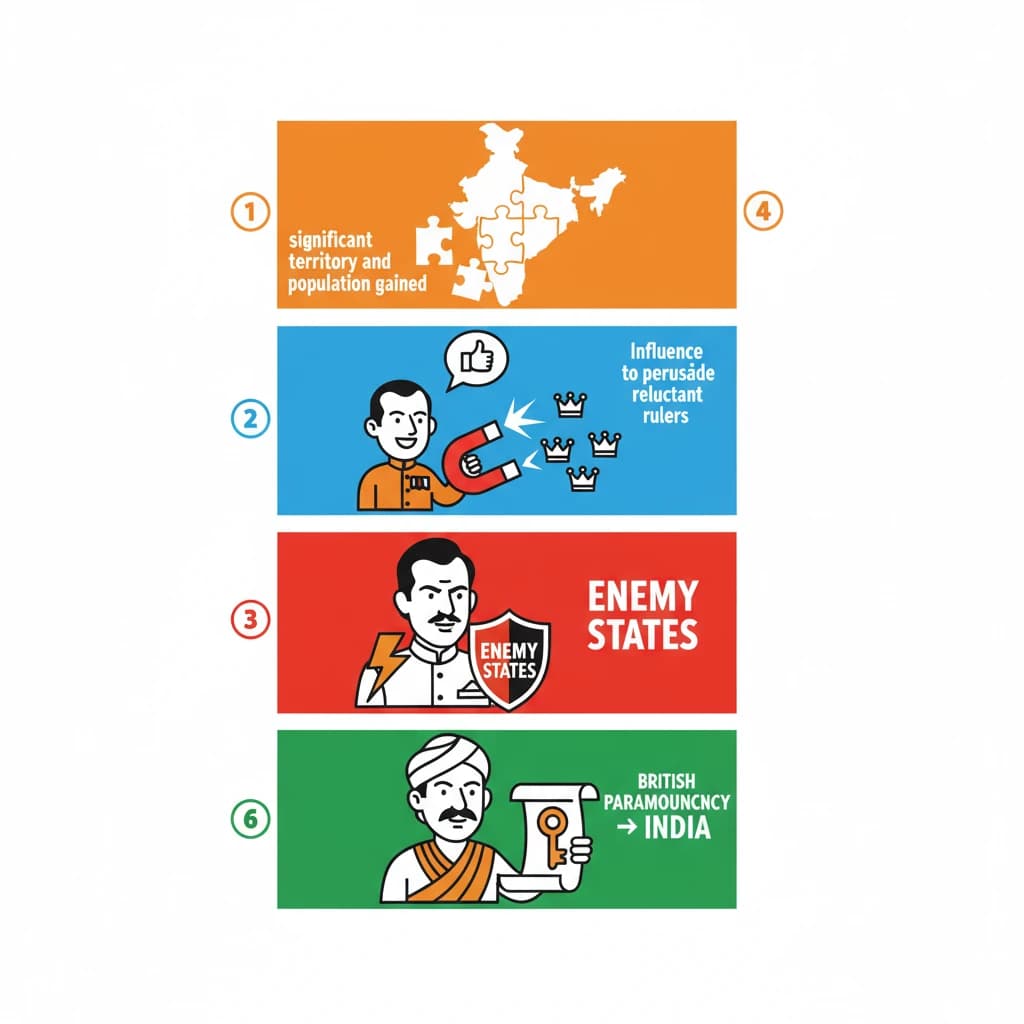
- •India gained significant territory and population through princely state integration despite Partition losses.
- •Lord Mountbatten used his influence as Governor-General to persuade reluctant rulers.
- •Jawaharlal Nehru adopted a firm stance, declaring non-acceding states as 'enemy states'.
- •C. Rajagopalachari provided a legal argument, stating British paramountcy's transfer to independent India.
- •The Congress asserted that princely states were not sovereign and could not remain independent post-paramountcy.
- •Integration was crucial for India's territorial integrity and national unity.
🧠 Memory Techniques
95% Verified Content