Loading page, please wait…
Shifting of Route of the Silk Road - UPSC International Relations
What is Shifting of Route of the Silk Road in UPSC International Relations?
Shifting of Route of the Silk Road is a key topic under International Relations for UPSC Civil Services Examination. Key points include: The Silk Road's main route shifted northward due to climate change, as per a recent study.. It was a vast network connecting Europe and Asia for over 1,500 years, named for China's silk trade.. Beyond silk, it transported spices, gold, and precious stones, passing through cities like Samarkand.. Understanding this topic is essential for both UPSC Prelims and Mains preparation.
Why is Shifting of Route of the Silk Road important for UPSC exam?
Shifting of Route of the Silk Road is a Medium-level topic in UPSC International Relations. It is tested in both Prelims (factual MCQs) and Mains (analytical answer writing). Previous year UPSC questions have frequently covered aspects of Shifting of Route of the Silk Road, making it essential for comprehensive IAS preparation.
How to prepare Shifting of Route of the Silk Road for UPSC?
To prepare Shifting of Route of the Silk Road for UPSC: (1) Study the comprehensive notes covering all key concepts on Vaidra. (2) Practice previous year questions on this topic. (3) Connect it with current affairs using daily updates. (4) Revise using key takeaways and mind maps available for International Relations. (5) Write practice answers linking Shifting of Route of the Silk Road to related GS Paper topics.
Key takeaways of Shifting of Route of the Silk Road for UPSC
- The Silk Road's main route shifted northward due to climate change, as per a recent study.
- It was a vast network connecting Europe and Asia for over 1,500 years, named for China's silk trade.
- Beyond silk, it transported spices, gold, and precious stones, passing through cities like Samarkand.
- Established in the 2nd century BCE by China's Han Dynasty; diplomat Zhang Qian is the 'Father of the Silk Road'.
- The Tarim Basin route was a key early segment, opened through Zhang Qian's expeditions.
- Historical route shifts underscore the long-term impact of climate on human societies and trade.
Shifting of Route of the Silk Road
Medium⏱️ 7 min read
international relations
📖 Introduction
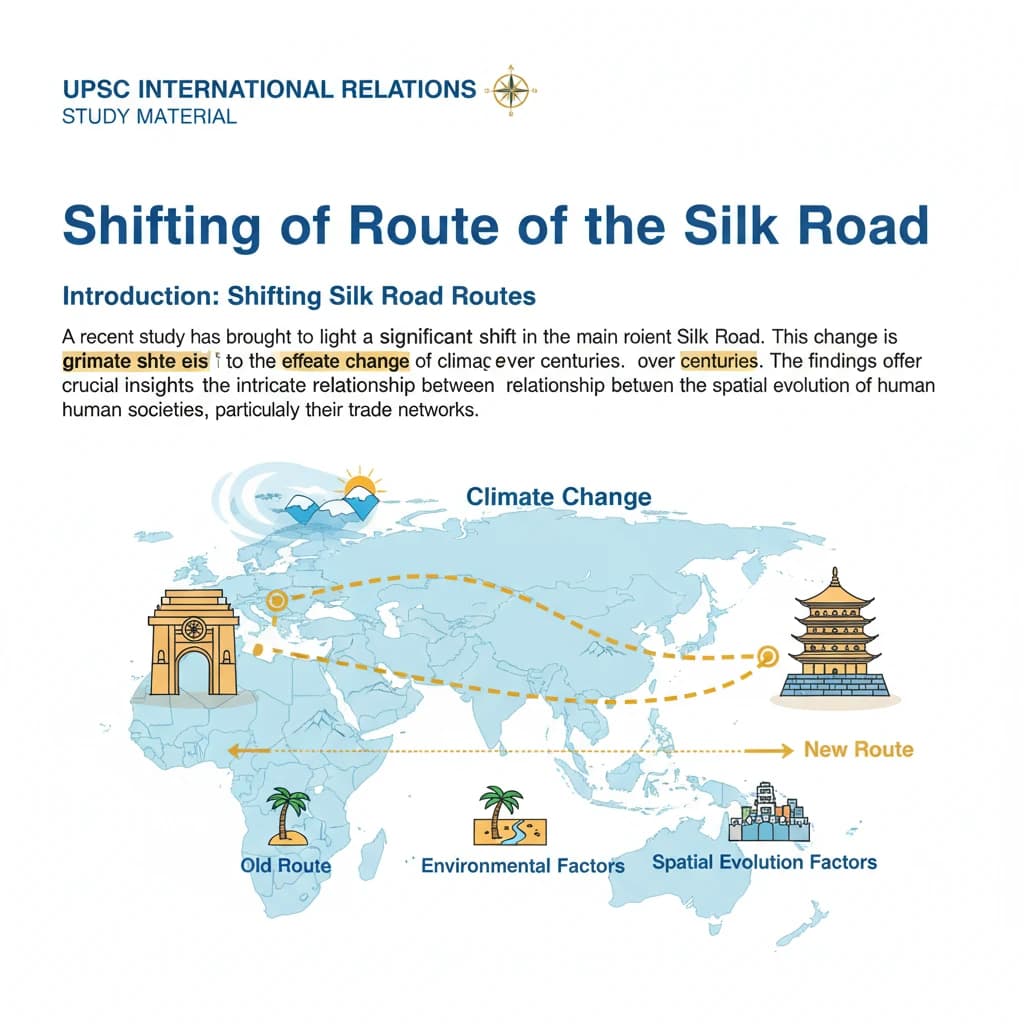
Introduction: Shifting Silk Road Routes
A recent study has brought to light a significant shift in the main route of the ancient Silk Road. This change is primarily attributed to the effects of climate change over centuries.
The findings offer crucial insights into the intricate relationship between environmental factors and the spatial evolution of human societies, particularly their trade networks.
Source: The study was conducted by Chinese scientists and published in the journal Science Bulletin.
What was the Silk Road?
The Silk Road was an extensive and complex network of ancient trade routes. It facilitated commercial, cultural, and technological exchange for over 1,500 years.
Geographically, it connected the Atlantic seaboard of Europe with the Pacific coast of Asia (China), forming a vital artery for ancient civilizations.
Nomenclature: The route earned its name from the highly profitable silk trade, which originated in China, located at its easternmost terminus.
Beyond Silk: Diverse Commodities and Key Hubs
While silk was a primary commodity, the Silk Road was instrumental in transporting a wide array of other valuable goods. These included spices, gold, and various precious stones.
The network traversed numerous significant cities and powerful kingdoms. Notable hubs along its path included Samarkand, Babylon, and Constantinople, each playing a crucial role in trade and cultural diffusion.
Historical Establishment of the Silk Road
The foundational establishment of the Silk Road began in the 2nd century BCE. This era saw Emperor Wu of the Chinese Han Dynasty initiate diplomatic outreach to the “Western Regions”.
Zhang Qian, a distinguished diplomat, was dispatched by Emperor Wu to these regions, encompassing areas like Xinjiang and beyond. His expeditions were pivotal.
Key Figure: Zhang Qian is widely revered as the “Father of the Silk Road” due to his pioneering explorations and diplomatic efforts.
His endeavors led to the gradual formation and consolidation of the Tarim Basin route, which became a primary artery of the Silk Road, linking East and West.
💡 Key Takeaways
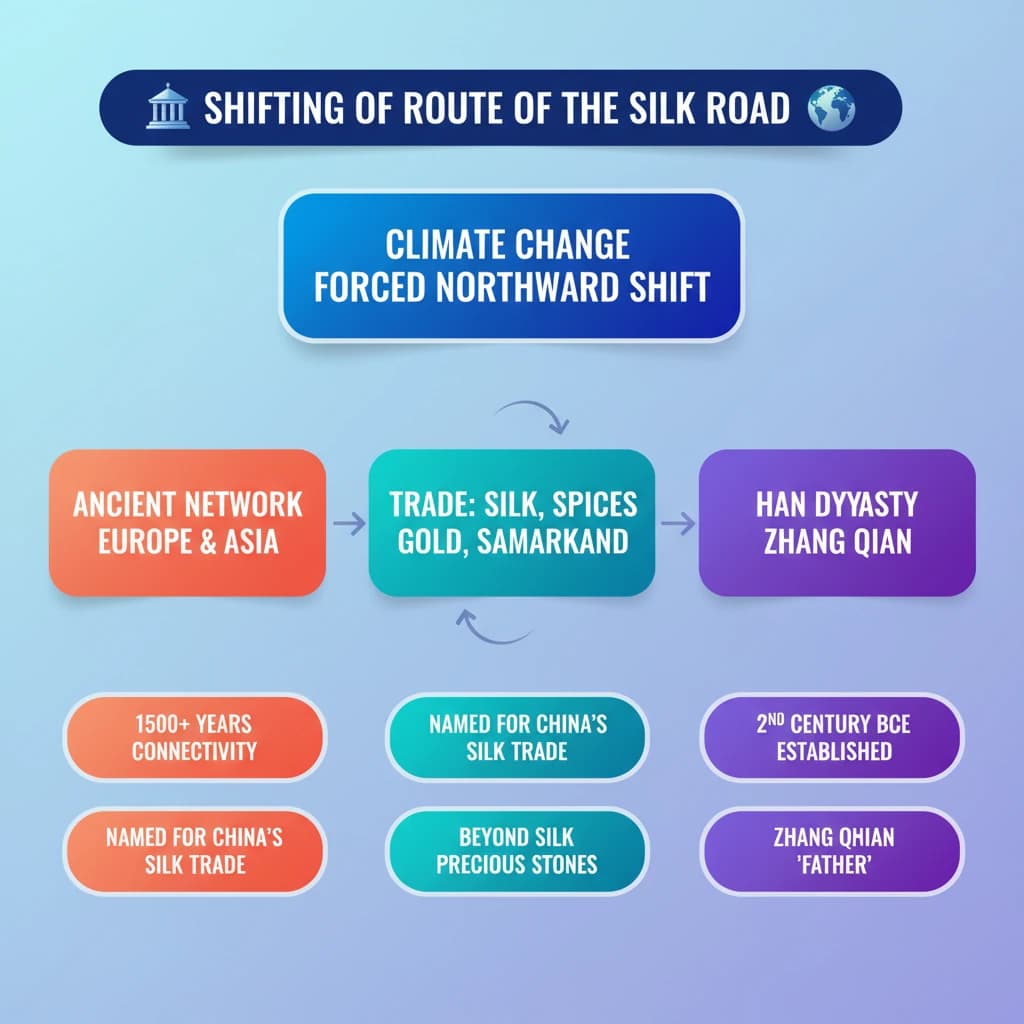
- •The Silk Road's main route shifted northward due to climate change, as per a recent study.
- •It was a vast network connecting Europe and Asia for over 1,500 years, named for China's silk trade.
- •Beyond silk, it transported spices, gold, and precious stones, passing through cities like Samarkand.
- •Established in the 2nd century BCE by China's Han Dynasty; diplomat Zhang Qian is the 'Father of the Silk Road'.
- •The Tarim Basin route was a key early segment, opened through Zhang Qian's expeditions.
- •Historical route shifts underscore the long-term impact of climate on human societies and trade.
🧠 Memory Techniques
95% Verified Content
📚 Reference Sources
•Science Bulletin (journal) - original study on Silk Road route shift
•Historical accounts of the Han Dynasty and Zhang Qian's expeditions
•Academic texts on the history and geography of the Silk Road