Loading page, please wait…
What is Indus Water Treaty (IWT)? - UPSC International Relations
What is What is Indus Water Treaty (IWT)? in UPSC International Relations?
What is Indus Water Treaty (IWT)? is a key topic under International Relations for UPSC Civil Services Examination. Key points include: Signed in 1960, brokered by the World Bank, between India and Pakistan.. Allocates Eastern Rivers (Ravi, Beas, Sutlej) to India and Western Rivers (Indus, Chenab, Jhelum) to Pakistan.. India can use Western Rivers for non-consumptive purposes like run-of-the-river hydropower.. Understanding this topic is essential for both UPSC Prelims and Mains preparation.
Why is What is Indus Water Treaty (IWT)? important for UPSC exam?
What is Indus Water Treaty (IWT)? is a Medium-level topic in UPSC International Relations. It is tested in both Prelims (factual MCQs) and Mains (analytical answer writing). Previous year UPSC questions have frequently covered aspects of What is Indus Water Treaty (IWT)?, making it essential for comprehensive IAS preparation.
How to prepare What is Indus Water Treaty (IWT)? for UPSC?
To prepare What is Indus Water Treaty (IWT)? for UPSC: (1) Study the comprehensive notes covering all key concepts on Vaidra. (2) Practice previous year questions on this topic. (3) Connect it with current affairs using daily updates. (4) Revise using key takeaways and mind maps available for International Relations. (5) Write practice answers linking What is Indus Water Treaty (IWT)? to related GS Paper topics.
Key takeaways of What is Indus Water Treaty (IWT)? for UPSC
- Signed in 1960, brokered by the World Bank, between India and Pakistan.
- Allocates Eastern Rivers (Ravi, Beas, Sutlej) to India and Western Rivers (Indus, Chenab, Jhelum) to Pakistan.
- India can use Western Rivers for non-consumptive purposes like run-of-the-river hydropower.
- Established the Permanent Indus Commission for annual meetings and information exchange.
- Features a three-step dispute resolution mechanism involving the Commission, Neutral Expert, and Court of Arbitration.
- Remains a vital, albeit occasionally strained, framework for water cooperation despite bilateral tensions.
What is Indus Water Treaty (IWT)?
Medium⏱️ 8 min read
international relations
📖 Introduction
Understanding the Indus Waters Treaty (IWT)
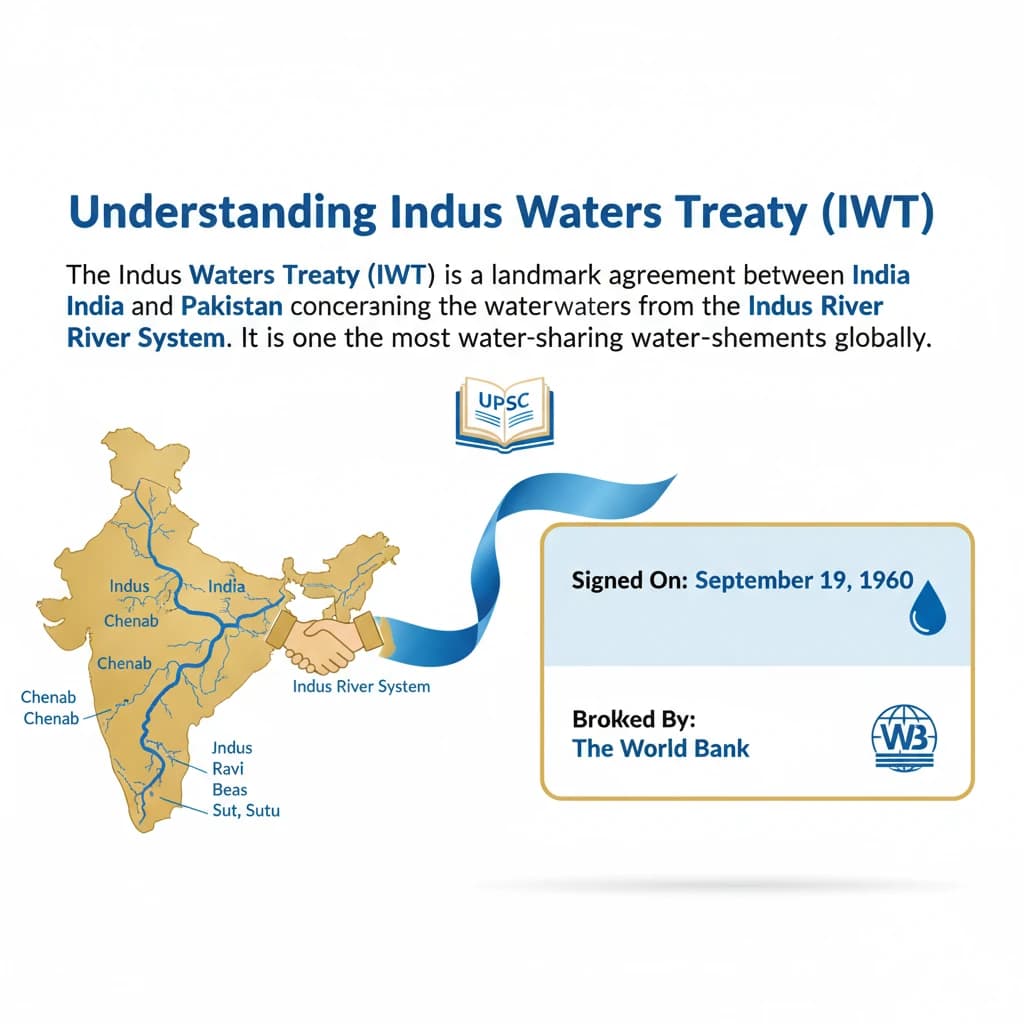
The Indus Waters Treaty (IWT) is a landmark agreement between India and Pakistan concerning the sharing of waters from the Indus River System. It is one of the most enduring water-sharing agreements globally.
Signed On: September 19, 1960
Brokered By: The World Bank
Purpose: To establish a mechanism for cooperation and information exchange regarding the use of the Indus system's waters and its tributaries.
Key Provisions of the IWT
The IWT meticulously outlines how the waters from the six rivers of the Indus River System are to be shared between the two nations. This division aims to ensure equitable access while acknowledging historical usage patterns.
Water Sharing Mechanism
- Western Rivers: Indus, Chenab, and Jhelum were allocated to Pakistan for unrestricted use.
- Eastern Rivers: Ravi, Beas, and Sutlej were allocated to India for unrestricted usage.
India retains certain non-consumptive agricultural and domestic uses on the Western Rivers. This allocation meant that approximately 80% of the water share went to Pakistan, with India retaining 20% for its use.
Permanent Indus Commission (PIC)
A crucial component of the Indus Waters Treaty is the establishment of the Permanent Indus Commission. This body is mandated to meet annually to discuss any issues related to the treaty's implementation and data exchange.
Mandate: Annual meetings between India and Pakistan to resolve 'questions' and exchange information on river flows and projects.
Dispute Resolution Mechanism
The IWT incorporates a robust, three-step dispute resolution mechanism designed to address disagreements systematically and prevent escalation.
- Step 1: Permanent Indus Commission: 'Questions' or minor issues are first addressed and resolved within the Permanent Indus Commission.
- Step 2: Inter-Governmental Level / Neutral Expert: Unresolved 'differences' can be taken up at the inter-governmental level. If still unresolved, a World Bank-appointed Neutral Expert (NE) can be engaged to address specific technical differences.
- Step 3: Court of Arbitration: More serious 'disputes' that cannot be resolved by a Neutral Expert can be referred to a Court of Arbitration, which is also set up by the World Bank.
Projects Under IWT Inspection
Several projects are subject to inspection under the IWT to ensure compliance with its provisions, particularly concerning the use of Western Rivers by India.
- Pakal Dul Hydro Electric Project: Built on the Marusudar River, a tributary of the Chenab.
- Lower Kalnai Project: Developed on the Chenab River.
- Kishanganga Hydroelectric Project: A run-of-the-river project located in Jammu & Kashmir.
💡 Key Takeaways
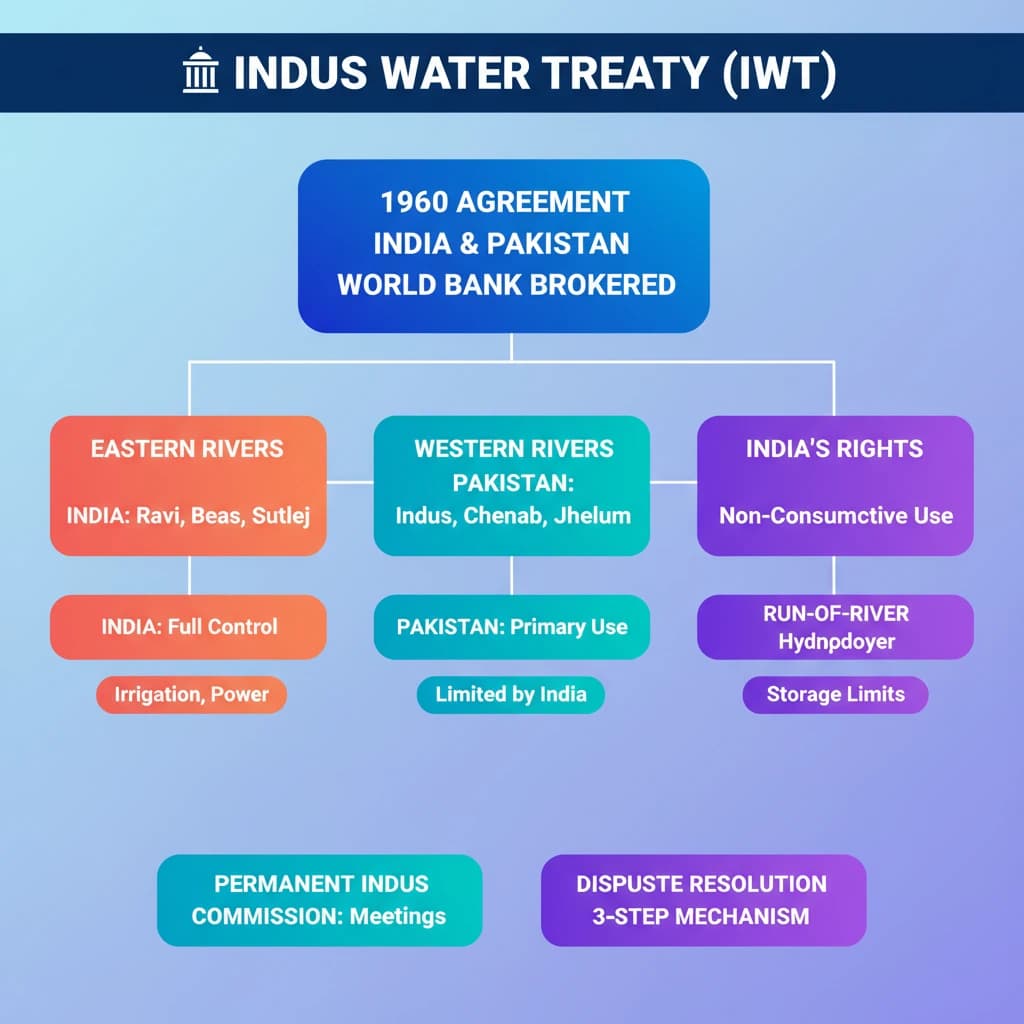
- •Signed in 1960, brokered by the World Bank, between India and Pakistan.
- •Allocates Eastern Rivers (Ravi, Beas, Sutlej) to India and Western Rivers (Indus, Chenab, Jhelum) to Pakistan.
- •India can use Western Rivers for non-consumptive purposes like run-of-the-river hydropower.
- •Established the Permanent Indus Commission for annual meetings and information exchange.
- •Features a three-step dispute resolution mechanism involving the Commission, Neutral Expert, and Court of Arbitration.
- •Remains a vital, albeit occasionally strained, framework for water cooperation despite bilateral tensions.
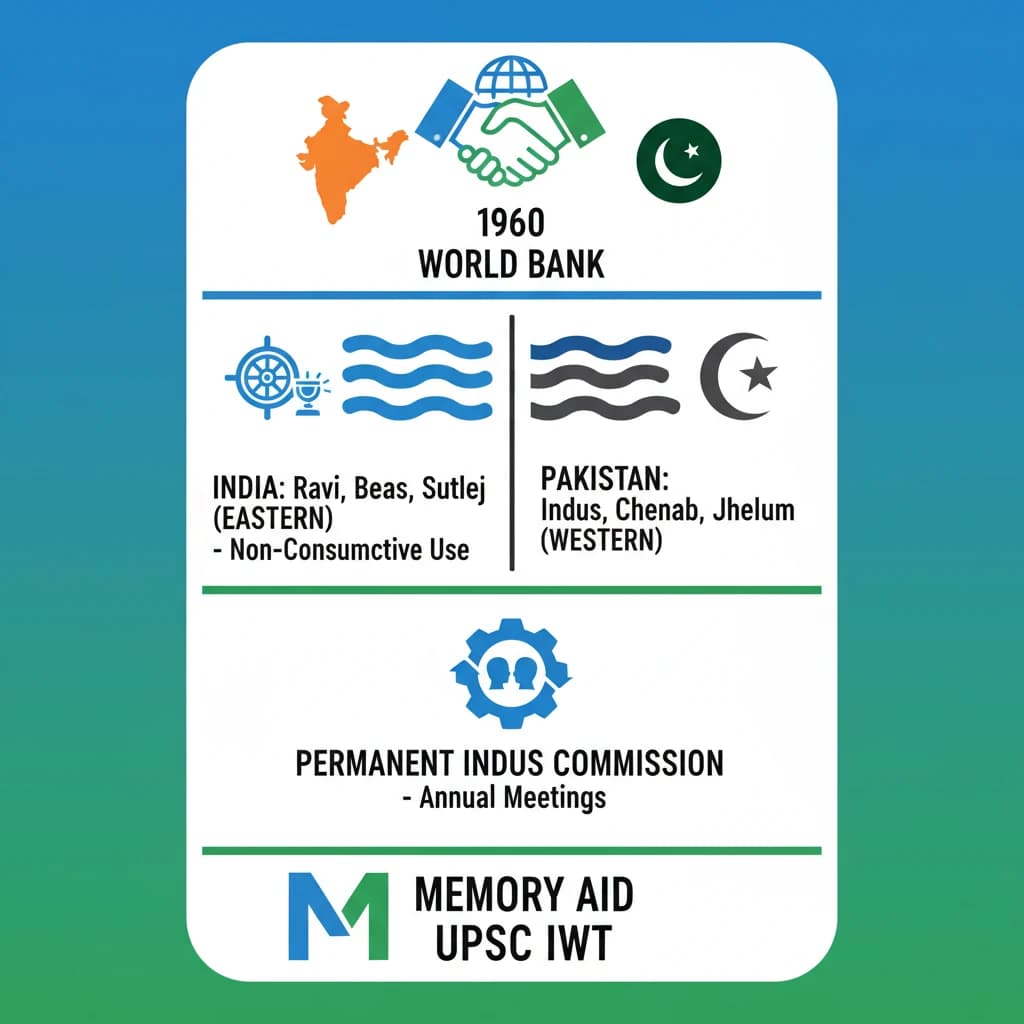
🧠 Memory Techniques
98% Verified Content
📚 Reference Sources
•World Bank official documents on Indus Waters Treaty
•Ministry of External Affairs (India) publications on IWT