Loading page, please wait…
Why is the Chabahar Port Important for India? - UPSC International Relations
What is Why is the Chabahar Port Important for India? in UPSC International Relations?
Why is the Chabahar Port Important for India? is a key topic under International Relations for UPSC Civil Services Examination. Key points include: Chabahar is Iran's closest oceanic port to India, located on the Makran coast in the Gulf of Oman.. It provides India a strategic sea-land route to Afghanistan and Central Asia, bypassing Pakistan.. India is developing the Shahid Beheshti Port, one of Chabahar's two main ports.. Understanding this topic is essential for both UPSC Prelims and Mains preparation.
Why is Why is the Chabahar Port Important for India? important for UPSC exam?
Why is the Chabahar Port Important for India? is a Medium-level topic in UPSC International Relations. It is tested in both Prelims (factual MCQs) and Mains (analytical answer writing). Previous year UPSC questions have frequently covered aspects of Why is the Chabahar Port Important for India?, making it essential for comprehensive IAS preparation.
How to prepare Why is the Chabahar Port Important for India? for UPSC?
To prepare Why is the Chabahar Port Important for India? for UPSC: (1) Study the comprehensive notes covering all key concepts on Vaidra. (2) Practice previous year questions on this topic. (3) Connect it with current affairs using daily updates. (4) Revise using key takeaways and mind maps available for International Relations. (5) Write practice answers linking Why is the Chabahar Port Important for India? to related GS Paper topics.
Key takeaways of Why is the Chabahar Port Important for India? for UPSC
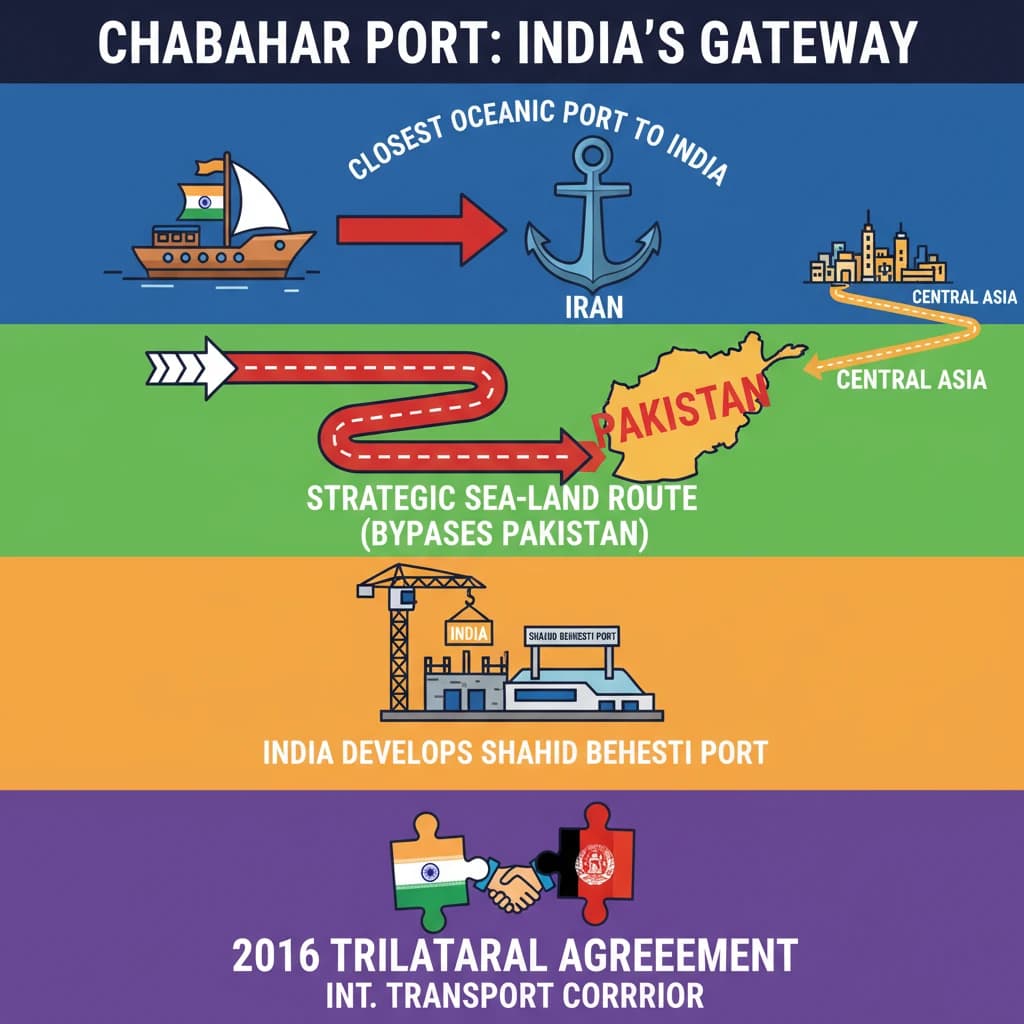
- Chabahar is Iran's closest oceanic port to India, located on the Makran coast in the Gulf of Oman.
- It provides India a strategic sea-land route to Afghanistan and Central Asia, bypassing Pakistan.
- India is developing the Shahid Beheshti Port, one of Chabahar's two main ports.
- A trilateral agreement (India, Iran, Afghanistan) in 2016 established Chabahar as an International Transport and Transit Corridor.
- A long-standing dispute over arbitration for the long-term agreement has been resolved through bilateral communication.
- Chabahar is crucial for India's regional connectivity, economic diplomacy, and strategic influence in West Asia.
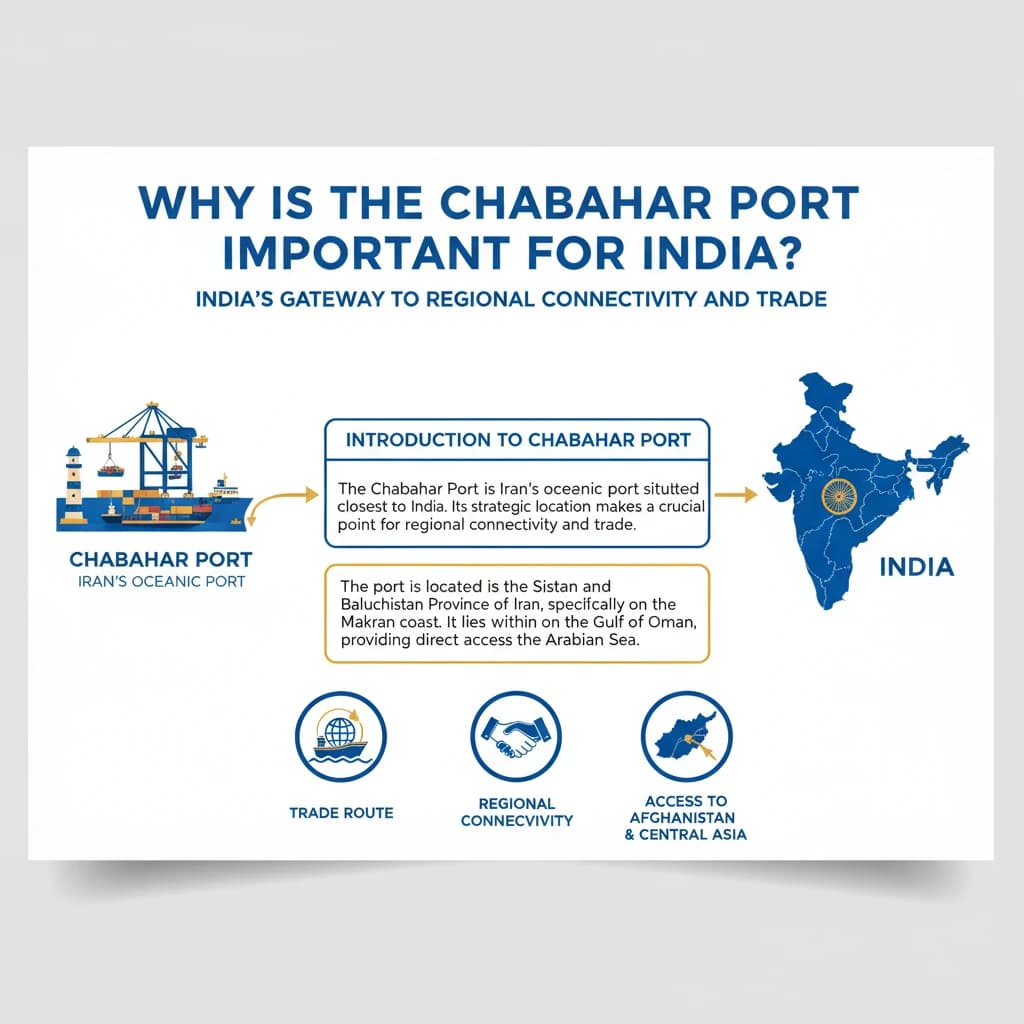
Why is the Chabahar Port Important for India?
Medium⏱️ 6 min read
international relations
📖 Introduction
Introduction to Chabahar Port
The Chabahar Port is Iran’s oceanic port situated closest to India. Its strategic location makes it a crucial point for regional connectivity and trade.
The port is located in the Sistan and Baluchistan Province of Iran, specifically on the Makran coast. It lies within the Gulf of Oman, providing direct access to the Arabian Sea.
Key Components and India's Involvement
The overall Chabahar Port project comprises two primary ports. These are the Shahid Kalantari Port and the Shahid Beheshti Port.
Iran extended an offer to India for the development of the Shahid Beheshti Port. This offer was positively received, signifying India's commitment to the project.
Evolution of the Chabahar Deal: A Timeline
India's formal engagement with the Chabahar Port project began with a significant agreement in 2015, followed by a crucial trilateral pact.
- In May 2015, India signed a Memorandum of Understanding (MoU) for the development of the Chabahar Port, marking its initial commitment.
- A year later, in May 2016, India, Iran, and Afghanistan signed a landmark trilateral agreement. This pact established the International Transport and Transit Corridor, commonly known as the Chabahar Agreement.
The primary objective of the Chabahar Agreement was to enhance transportation and trade connectivity among the three signatory nations. It designates the Chabahar Port as a vital transit point for goods and services.
Challenges in Finalizing the Long-Term Agreement
Despite the initial agreements, the finalization of the long-term agreement faced considerable delays. Several factors contributed to these setbacks, including disagreements over specific clauses within the pact.
A significant point of contention revolved around the location of arbitration for disputes. India advocated for a neutral country to handle potential disagreements, ensuring impartiality.
Conversely, Iran maintained that arbitration should occur within its own courts or a jurisdiction favorable to its interests, leading to a prolonged stalemate.
Resolution and Future Path
After extensive negotiations, both parties have successfully reached a compromise. This resolution addresses and satisfies the respective interests of both India and Iran.
The revised contract now stipulates that any disagreements arising from the project should be resolved through open communication and direct cooperation between the leaders of both countries. This mechanism prioritizes diplomatic solutions.
Understanding the Chabahar Port's strategic importance and the details of its development is crucial for UPSC Mains GS Paper 2 (International Relations). Focus on its role in India's regional connectivity and geopolitical strategy.

💡 Key Takeaways
- •Chabahar is Iran's closest oceanic port to India, located on the Makran coast in the Gulf of Oman.
- •It provides India a strategic sea-land route to Afghanistan and Central Asia, bypassing Pakistan.
- •India is developing the Shahid Beheshti Port, one of Chabahar's two main ports.
- •A trilateral agreement (India, Iran, Afghanistan) in 2016 established Chabahar as an International Transport and Transit Corridor.
- •A long-standing dispute over arbitration for the long-term agreement has been resolved through bilateral communication.
- •Chabahar is crucial for India's regional connectivity, economic diplomacy, and strategic influence in West Asia.
🧠 Memory Techniques
95% Verified Content
📚 Reference Sources
•Ministry of External Affairs (MEA), Government of India official statements
•The Hindu / Indian Express news archives on Chabahar Port development
•Official documents related to India-Iran-Afghanistan trilateral agreement