Loading page, please wait…
Space Debris & Collision Risk: Threats in Low Earth Orbit (LEO) - UPSC Science And Technology
What is Space Debris & Collision Risk: Threats in Low Earth Orbit (LEO) in UPSC Science And Technology?
Space Debris & Collision Risk: Threats in Low Earth Orbit (LEO) is a key topic under Science And Technology for UPSC Civil Services Examination. Key points include: Increased LEO congestion poses a significant collision risk, threatening space infrastructure.. Projected damages of USD 556 million and a 3.13% collision probability (2024-29) highlight the financial stakes.. A 17% increase in close encounters per satellite in the past year indicates rapidly worsening orbital density.. Understanding this topic is essential for both UPSC Prelims and Mains preparation.
Why is Space Debris & Collision Risk: Threats in Low Earth Orbit (LEO) important for UPSC exam?
Space Debris & Collision Risk: Threats in Low Earth Orbit (LEO) is a Medium-level topic in UPSC Science And Technology. It is tested in both Prelims (factual MCQs) and Mains (analytical answer writing). Previous year UPSC questions have frequently covered aspects of Space Debris & Collision Risk: Threats in Low Earth Orbit (LEO), making it essential for comprehensive IAS preparation.
How to prepare Space Debris & Collision Risk: Threats in Low Earth Orbit (LEO) for UPSC?
To prepare Space Debris & Collision Risk: Threats in Low Earth Orbit (LEO) for UPSC: (1) Study the comprehensive notes covering all key concepts on Vaidra. (2) Practice previous year questions on this topic. (3) Connect it with current affairs using daily updates. (4) Revise using key takeaways and mind maps available for Science And Technology. (5) Write practice answers linking Space Debris & Collision Risk: Threats in Low Earth Orbit (LEO) to related GS Paper topics.
Key takeaways of Space Debris & Collision Risk: Threats in Low Earth Orbit (LEO) for UPSC
- Increased LEO congestion poses a significant collision risk, threatening space infrastructure.
- Projected damages of USD 556 million and a 3.13% collision probability (2024-29) highlight the financial stakes.
- A 17% increase in close encounters per satellite in the past year indicates rapidly worsening orbital density.
- Collision risk is a critical challenge for space sustainability, demanding robust Space Traffic Management (STM).
- The 2009 Iridium-Cosmos collision serves as a stark historical reminder of actual orbital collision events.
Space Debris & Collision Risk: Threats in Low Earth Orbit (LEO)
Medium⏱️ 5 min read
science and technology
📖 Introduction
Understanding Collision Risk in LEO
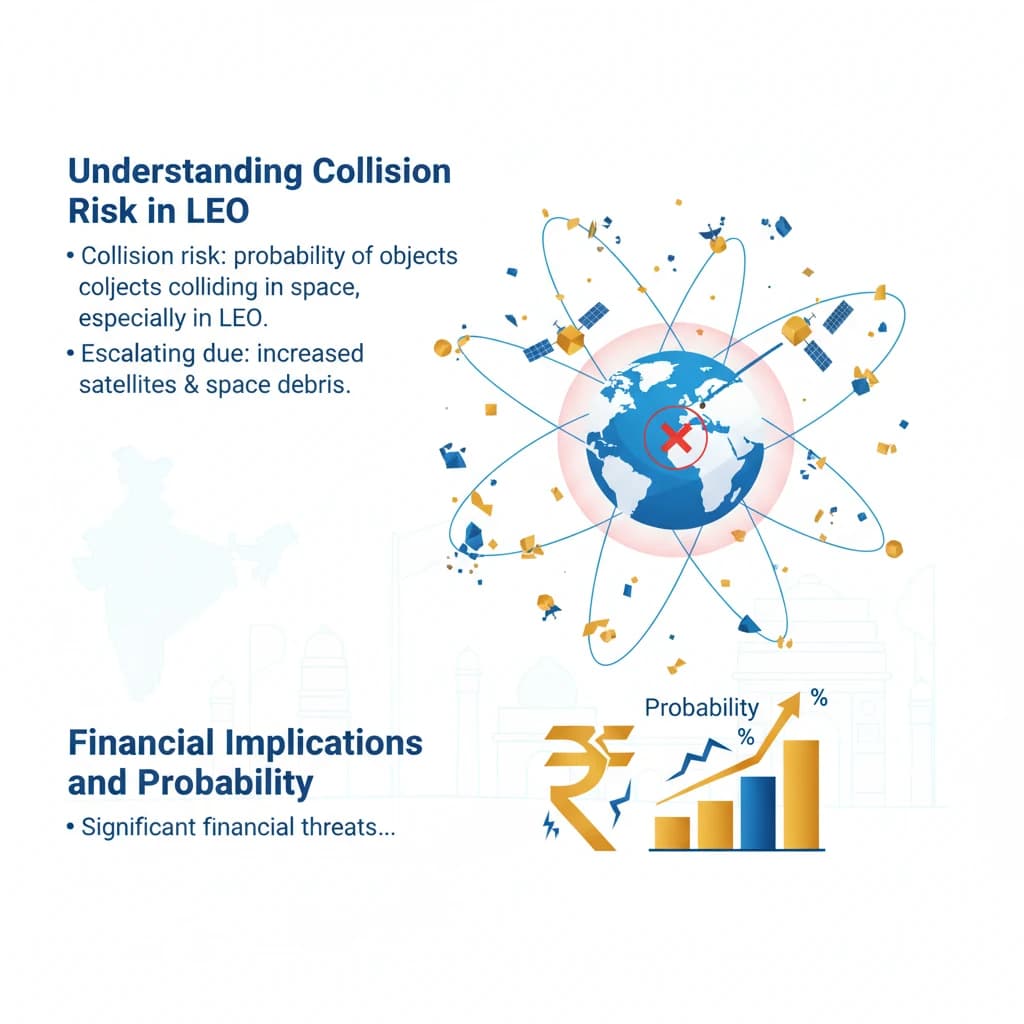
Collision risk refers to the probability of two or more objects in space, particularly in Low Earth Orbit (LEO), colliding with each other.
This risk is escalating due to the rapid increase in the number of operational satellites and the growing volume of space debris.
Financial Implications and Probability
The increasing congestion in LEO poses significant financial threats to space operations.
Projected Damages: The estimated financial damage from potential collisions in LEO is approximately USD 556 million between 2024 and 2029.
Collision Probability: There is a significant 3.13% probability of such a collision occurring within this timeframe.
Increasing Close Encounters
The frequency of near-misses, or close encounters, has also seen a sharp rise, indicating the intensifying congestion.
In the past year alone, there has been a notable 17% increase in close encounters per satellite, highlighting the growing density of objects in LEO.
The combination of increased congestion, substantial financial risk, and rising close encounters underscores the urgent need for effective Space Traffic Management (STM) and international cooperation.
💡 Key Takeaways
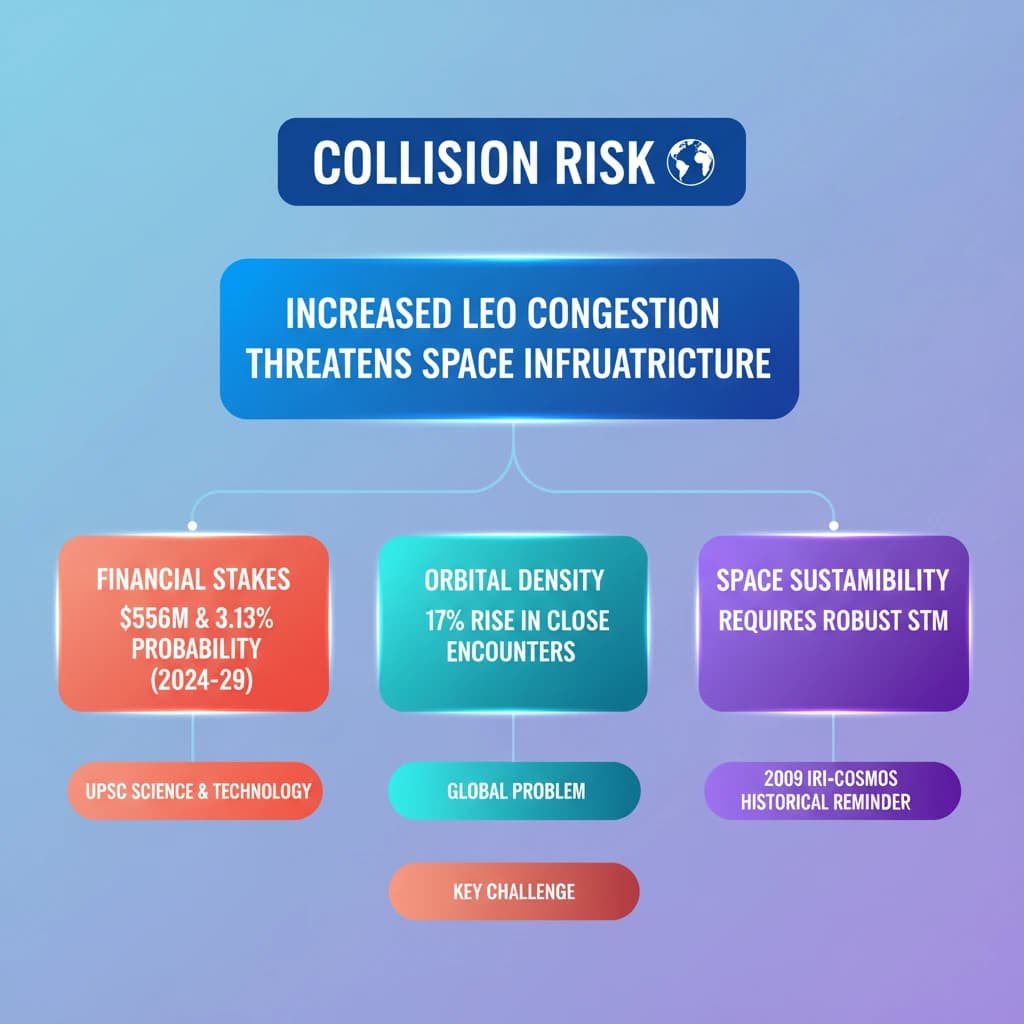
- •Increased LEO congestion poses a significant collision risk, threatening space infrastructure.
- •Projected damages of USD 556 million and a 3.13% collision probability (2024-29) highlight the financial stakes.
- •A 17% increase in close encounters per satellite in the past year indicates rapidly worsening orbital density.
- •Collision risk is a critical challenge for space sustainability, demanding robust Space Traffic Management (STM).
- •The 2009 Iridium-Cosmos collision serves as a stark historical reminder of actual orbital collision events.
🧠 Memory Techniques
95% Verified Content