Loading page, please wait…
HomeCurrent AffairsEditorialsGovt SchemesLearning ResourcesUPSC SyllabusPricingAboutBest UPSC AIUPSC AI ToolAI for UPSCUPSC ChatGPT

© 2026 Vaidra. All rights reserved.

PrivacyTerms
Vaidra Logo
Vaidra

Top 4 items + smart groups

UPSC GPT
New
Current Affairs
Daily Solutions
Daily Puzzle
Mains Evaluator

Version 2.0.0 • Built with ❤️ for UPSC aspirants

ASI Begins Excavation at Balirajgarh, Bihar – Uncovering Iron‑Age Videha Kingdom and Mahājanapada Links | GS2 UPSC Current Affairs April 2026
ASI Begins Excavation at Balirajgarh, Bihar – Uncovering Iron‑Age Videha Kingdom and Mahājanapada Links
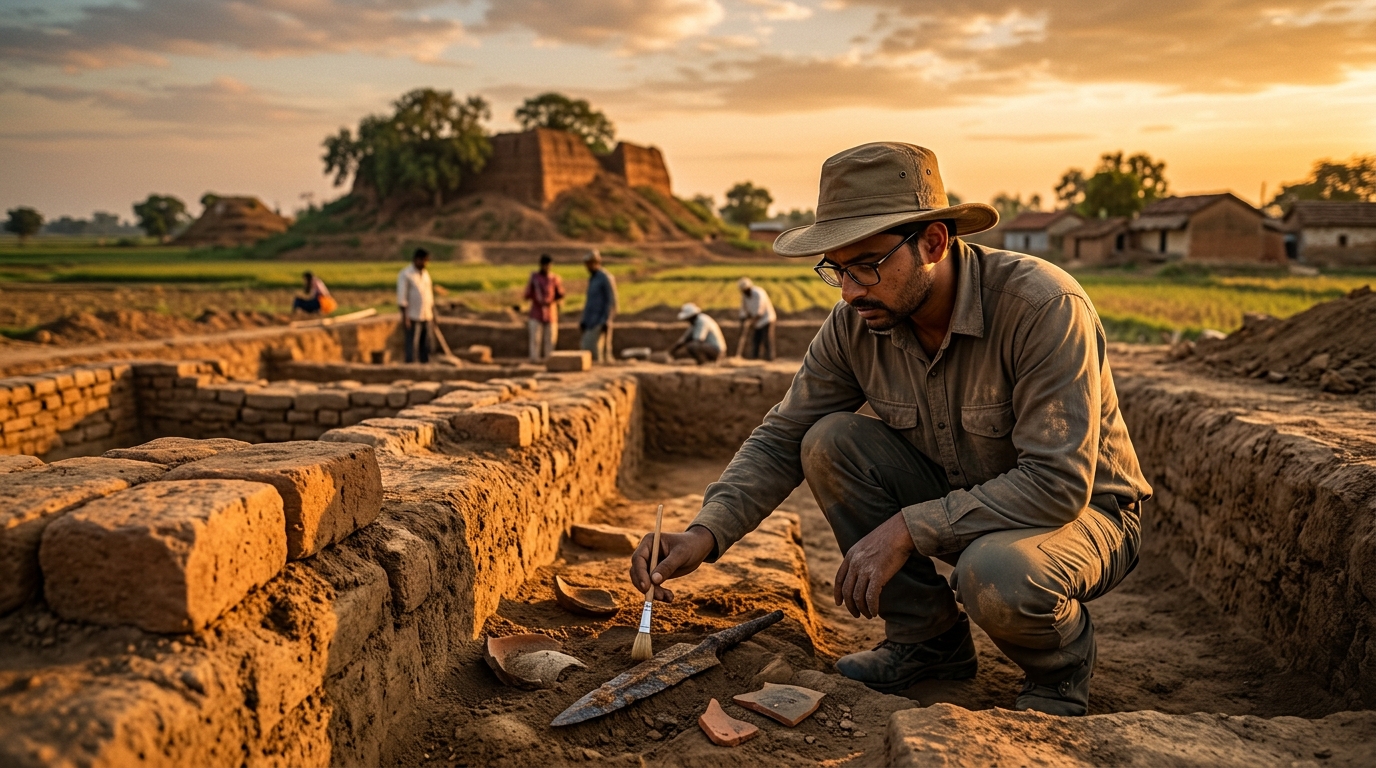
The Archaeological Survey of India has started a major excavation at Balirajgarh in Bihar to investigate its links to the Iron‑Age Videha Kingdom, a key Mahājanapada. Findings could push back the known history of Mithila, offering valuable insights for UPSC topics on ancient polity, heritage management, and early urbanisation.
Overview The Archaeological Survey of India (ASI) has launched a large‑scale dig at Balirajgarh . The excavation aims to determine whether the settlement predates the Mauryan period and to map cultural continuity from the Iron Age through successive empires. Key Developments Twenty trenches will be opened to study five chronological phases: Mauryan (NBPW), Sunga, Kushan, Gupta and Pala. Pre‑liminary surveys (2013‑2014) revealed a brick fortification covering ~176 acres and yielded artefacts such as beads, copper objects, bone tools, terracotta figurines and punch‑marked coins. Superintending Archaeologist Hari Om Sharan emphasised the goal of reaching “virgin soil” to pinpoint the earliest human occupation. The site was declared protected by the ASI in 1938 and earlier surveys have shown continuous habitation across major dynasties. Important Facts The region is historically identified with the Videha Kingdom , one of the sixteen Mahājanapadas . Within the republican confederacy of Vajji , Videha’s capital was Mithila (modern Janakpur, Nepal). The artefacts suggest a sophisticated urban layout and economic activity well before the Mauryan empire, possibly dating to the Iron Age . UPSC Relevance Understanding Balirajgarh helps aspirants link archaeological evidence with textual sources on early Indian polity. The site illustrates the transition from tribal republics (ganas/sanghas) to monarchic empires, a theme recurrent in GS Paper 1 (Ancient Indian History). It also underscores the role of the ASI in heritage management, relevant for GS Paper 3 (Cultural Heritage). The discovery of punch‑marked coins provides material culture evidence for early monetary systems, useful for economy‑related questions. Way Forward Further analysis of stratigraphy and carbon dating will clarify the chronology of settlement layers. Publication of findings can reshape the narrative of Mithila’s contribution to Indian philosophy, urban planning, and early republican governance. For UPSC preparation, candidates should integrate this case study with the broader framework of early state formation, the spread of iron technology, and the administrative structures of the Mahājanapadas.
  1. Home
  2. Prepare
  3. Current Affairs
  4. ASI Begins Excavation at Balirajgarh, Bihar – Uncovering Iron‑Age Videha Kingdom and Mahājanapada Links
Must Review
Login to bookmark articles
Login to mark articles as complete

Overview

gs.gs280% UPSC Relevance

ASI’s Balirajgarh dig spotlights early republican states and heritage‑preservation challenges for India.

Key Facts

  1. ASI launched the Balirajgarh excavation in Bihar in 2026.
  2. Twenty trenches will investigate five phases: Mauryan, Sunga, Kushan, Gupta and Pala.
  3. 2013‑14 surveys revealed a 176‑acre brick fort with beads, copper objects, bone tools, terracotta figurines and punch‑marked coins.
  4. Balirajgarh, linked to the Iron‑Age Videha Kingdom (one of the sixteen Mahājanapadas), was declared a protected monument in 1938.
  5. Superintending Archaeologist Hari Om Sharan aims to reach “virgin soil” to establish pre‑Mauryan occupation.
  6. Artefacts suggest sophisticated urban layout, early monetary systems and a transition from tribal republics to monarchic empires.

Background & Context

The excavation ties into UPSC’s ancient Indian history syllabus by illuminating the Mahājanapada era and the evolution of early states. It also relates to GS Paper 3 (Polity & Governance) as the ASI, a statutory body under the Ministry of Culture, operates under constitutional provisions (Art 49, 51A) for preserving cultural heritage, highlighting governance challenges in protecting archaeological sites.

UPSC Syllabus Connections

Essay•Education, Knowledge and CultureGS2•Constitutional posts, bodies and their powers and functions

Mains Answer Angle

In a GS 2 answer, candidates can discuss the role of statutory bodies like the ASI in safeguarding heritage, linking constitutional mandates with on‑ground challenges, and assess how new archaeological data can inform our understanding of early Indian polity.

Full Article

<h3>Overview</h3> <p>The <span class="key-term" data-definition="Archaeological Survey of India — India's premier archaeological agency under the Ministry of Culture, responsible for research, excavation, and protection of monuments (GS3: Culture/Heritage)">Archaeological Survey of India</span> (ASI) has launched a large‑scale dig at <span class="key-term" data-definition="Balirajgarh — An archaeological site in Babubarhi block, Madhubani district, Bihar, linked to the legendary King Bali and believed to be a capital of the ancient Videha Kingdom (GS1: History)">Balirajgarh</span>. The excavation aims to determine whether the settlement predates the Mauryan period and to map cultural continuity from the Iron Age through successive empires.</p> <h3>Key Developments</h3> <ul> <li>Twenty trenches will be opened to study five chronological phases: Mauryan (NBPW), Sunga, Kushan, Gupta and Pala.</li> <li>Pre‑liminary surveys (2013‑2014) revealed a brick fortification covering ~176 acres and yielded artefacts such as beads, copper objects, bone tools, terracotta figurines and punch‑marked coins.</li> <li>Superintending Archaeologist <strong>Hari Om Sharan</strong> emphasised the goal of reaching “virgin soil” to pinpoint the earliest human occupation.</li> <li>The site was declared protected by the ASI in <strong>1938</strong> and earlier surveys have shown continuous habitation across major dynasties.</li> </ul> <h3>Important Facts</h3> <p>The region is historically identified with the <span class="key-term" data-definition="Videha Kingdom — An ancient kingdom of the Mithila region, part of the sixteen Mahājanapadas, flourishing during the Iron Age and later under Mauryan influence (GS1: History)">Videha Kingdom</span>, one of the sixteen <span class="key-term" data-definition="Mahājanapadas — Large, early‑state political units (c. 6th‑4th c BCE) mentioned in Buddhist and Jain texts; included monarchies and republican sanghas such as Vajji (GS1: History)">Mahājanapadas</span>. Within the republican confederacy of <span class="key-term" data-definition="Vajji — An eight‑state republic in the foothills of the Himalayas, comprising Lichchhavi, Videha and other clans; capital of Lichchhavis was Vaishali (GS1: History)">Vajji</span>, Videha’s capital was Mithila (modern Janakpur, Nepal). The artefacts suggest a sophisticated urban layout and economic activity well before the Mauryan empire, possibly dating to the <span class="key-term" data-definition="Iron Age — A prehistoric period marked by the use of iron tools and weapons, roughly 1200‑600 BCE in South Asia, crucial for the rise of early states (GS1: History)">Iron Age</span>.</p> <h3>UPSC Relevance</h3> <p>Understanding Balirajgarh helps aspirants link archaeological evidence with textual sources on early Indian polity. The site illustrates the transition from tribal republics (ganas/sanghas) to monarchic empires, a theme recurrent in GS Paper 1 (Ancient Indian History). It also underscores the role of the <span class="key-term" data-definition="Archaeological Survey of India — India's premier archaeological agency under the Ministry of Culture, responsible for research, excavation, and protection of monuments (GS3: Culture/Heritage)">ASI</span> in heritage management, relevant for GS Paper 3 (Cultural Heritage). The discovery of punch‑marked coins provides material culture evidence for early monetary systems, useful for economy‑related questions.</p> <h3>Way Forward</h3> <p>Further analysis of stratigraphy and carbon dating will clarify the chronology of settlement layers. Publication of findings can reshape the narrative of Mithila’s contribution to Indian philosophy, urban planning, and early republican governance. For UPSC preparation, candidates should integrate this case study with the broader framework of early state formation, the spread of iron technology, and the administrative structures of the Mahājanapadas.</p>
Read Original on indianexpress

Analysis

Practice Questions

GS2
Easy
Prelims MCQ

Statutory bodies and heritage management

1 marks
4 keywords
GS2
Medium
Mains Short Answer

Ancient Indian polity and urban development

5 marks
5 keywords
GS2
Hard
Mains Essay

Heritage preservation, statutory bodies, constitutional framework

20 marks
8 keywords
Related:Daily•Weekly

Loading related articles...

Loading related articles...

Tip: Click articles above to read more from the same date, or use the back button to see all articles.

Quick Reference

Key Insight

ASI’s Balirajgarh dig spotlights early republican states and heritage‑preservation challenges for India.

Key Facts

  1. ASI launched the Balirajgarh excavation in Bihar in 2026.
  2. Twenty trenches will investigate five phases: Mauryan, Sunga, Kushan, Gupta and Pala.
  3. 2013‑14 surveys revealed a 176‑acre brick fort with beads, copper objects, bone tools, terracotta figurines and punch‑marked coins.
  4. Balirajgarh, linked to the Iron‑Age Videha Kingdom (one of the sixteen Mahājanapadas), was declared a protected monument in 1938.
  5. Superintending Archaeologist Hari Om Sharan aims to reach “virgin soil” to establish pre‑Mauryan occupation.
  6. Artefacts suggest sophisticated urban layout, early monetary systems and a transition from tribal republics to monarchic empires.

Background

The excavation ties into UPSC’s ancient Indian history syllabus by illuminating the Mahājanapada era and the evolution of early states. It also relates to GS Paper 3 (Polity & Governance) as the ASI, a statutory body under the Ministry of Culture, operates under constitutional provisions (Art 49, 51A) for preserving cultural heritage, highlighting governance challenges in protecting archaeological sites.

UPSC Syllabus

  • Essay — Education, Knowledge and Culture
  • GS2 — Constitutional posts, bodies and their powers and functions

Mains Angle

In a GS 2 answer, candidates can discuss the role of statutory bodies like the ASI in safeguarding heritage, linking constitutional mandates with on‑ground challenges, and assess how new archaeological data can inform our understanding of early Indian polity.

Explore:Current Affairs·Editorial Analysis·Govt Schemes·Study Materials·Previous Year Questions·UPSC GPT