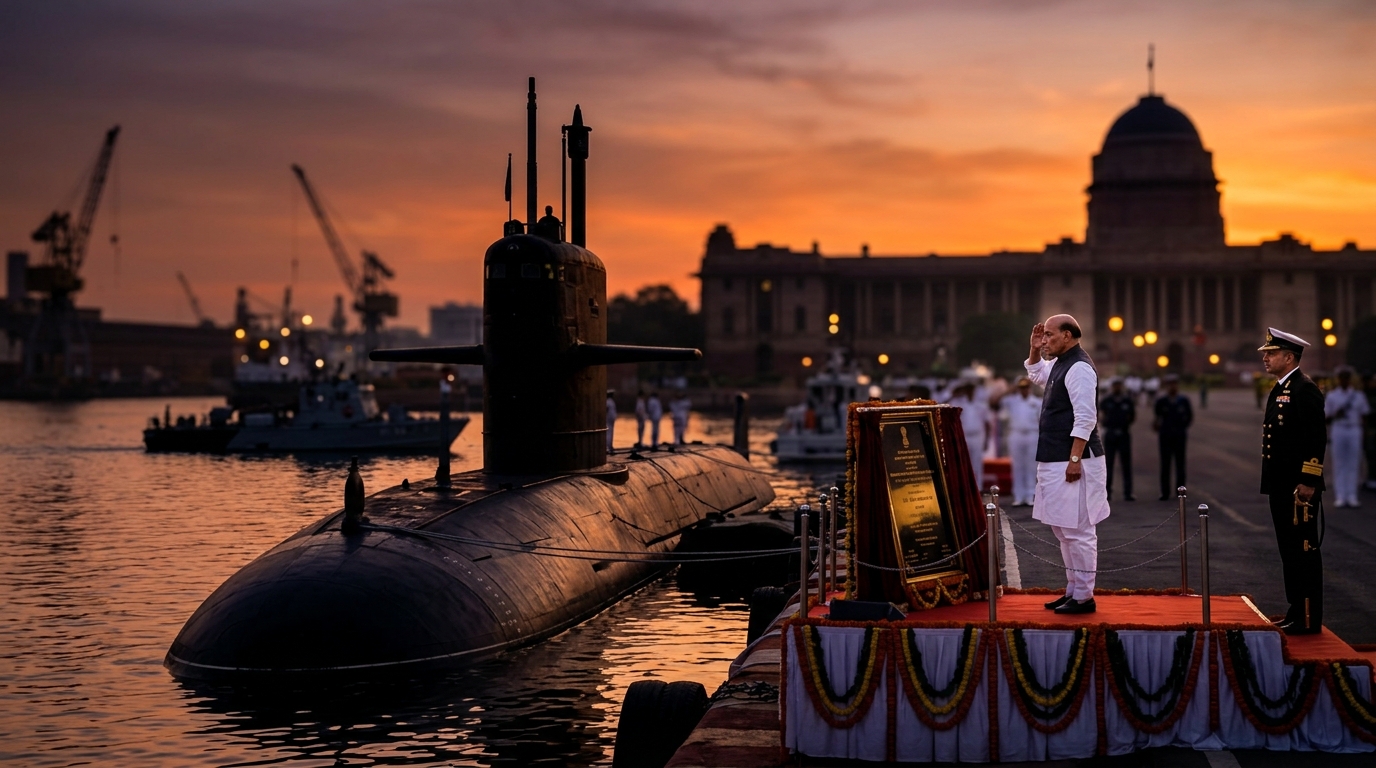
Defence Minister Rajnath Singh Commissions India’s Third SSBN INS Aridhaman – Boost to Nuclear Triad
On 3 April 2026, Defence Minister Rajnath Singh quietly commissioned INS Aridhaman (S4), India’s third indigenous SSBN, enhancing the country’s nuclear triad. The larger submarine can carry up to 24 K‑15 or eight K‑4 nuclear‑capable missiles, marking a significant step in strategic autonomy and maritime deterrence.
Defence Minister Rajnath Singh presided over the quiet commissioning of INS Aridhaman (S4) , the third indigenously built SSBN of the Arihant‑class , at Visakhapatnam on 3 April 2026 . The vessel strengthens India’s nuclear triad and falls under the Strategic Forces . Key Developments Commissioning of INS Aridhaman (S4) confirmed by the Defence Minister’s cryptic tweet. Commissioning coincided with the induction of the stealth guided‑missile frigate INS Taragiri . Project executed by the Ship Building Centre (SBC), Visakhapatnam. Aridhaman (S4) and the upcoming S4* (potentially named Arisudan ) are larger (≈7,000 t) than earlier boats (≈6,000 t). Important Facts Aridhaman can carry up to 24 K‑15 Sagarika missiles , or eight K‑4 missiles , or future K‑5 missiles , all nuclear‑capable. Earlier SSBNs – INS Arihant and INS Arighaat – could carry about 12 K‑15 or four K‑4 missiles. K‑15 Sagarika missile range: ~750 km. K‑4 missile range: ~3,500 km. India joins the United States, Russia, China and France as a nation with a credible nuclear triad. Indigenous development of SSNs is underway, with at least two expected by 2036‑2039 . UPSC Relevance The commissioning underscores India’s strategic autonomy in defence production (GS2) and its commitment to a credible second‑strike capability, a core topic in GS3 – Security & Defence . Understanding the technical specifications of SSBNs, missile ranges, and the role of the Strategic Forces helps answer questions on nuclear doctrine, deterrence, and maritime security. Way Forward Complete sea‑trials and induction of the S4* (potentially Arisudan ) to further augment sea‑based deterrence. Accelerate indigenous development of advanced SLBMs (e.g., K‑5) to extend strike range. Expand the indigenous SSN programme to ensure a balanced submarine fleet for both strategic and conventional roles. Strengthen the Ship Building Centre infrastructure to meet future production targets.
Quick Reference
Key Insight
India’s third indigenous SSBN commissioned, cementing sea‑based leg of nuclear triad
Key Facts
- INS Aridhaman (S4), the third Arihant‑class nuclear‑powered ballistic missile submarine, was commissioned on 3 April 2026 at Visakhapatnam.
- Built by the Ship Building Centre (SBC), Visakhapatnam; displacement ≈7,000 t, larger than earlier SSBNs (~6,000 t).
- Can carry up to 24 K‑15 Sagarika (≈750 km range) or eight K‑4 (≈3,500 km) SLBMs, and future K‑5 missiles.
- Strengthens India’s nuclear triad, placing it among the US, Russia, China and France with a credible sea‑based second‑strike capability.
- Operates under the Strategic Forces Command, underscoring strategic autonomy and indigenisation of defence production under ‘Make in India’.
- Commissioning coincided with induction of the stealth guided‑missile frigate INS Taragiri, signalling broader naval modernisation.
- Future plans include a larger S4* (potentially named Arisudan) and indigenous SSNs by 2036‑2039 to balance strategic and conventional submarine fleets.
Background
The commissioning of INS Aridhaman marks a major stride in India's strategic autonomy, reinforcing the sea‑based leg of the nuclear triad—a core component of the country's nuclear doctrine. It aligns with the GS3 syllabus on security and defence, while also reflecting GS2 themes of indigenous defence production and maritime security.
Mains Angle
In a Mains answer, candidates can discuss how the induction of a larger SSBN enhances second‑strike credibility and ties into India's broader strategic autonomy, a typical GS3 question on nuclear deterrence and maritime security.