Overview
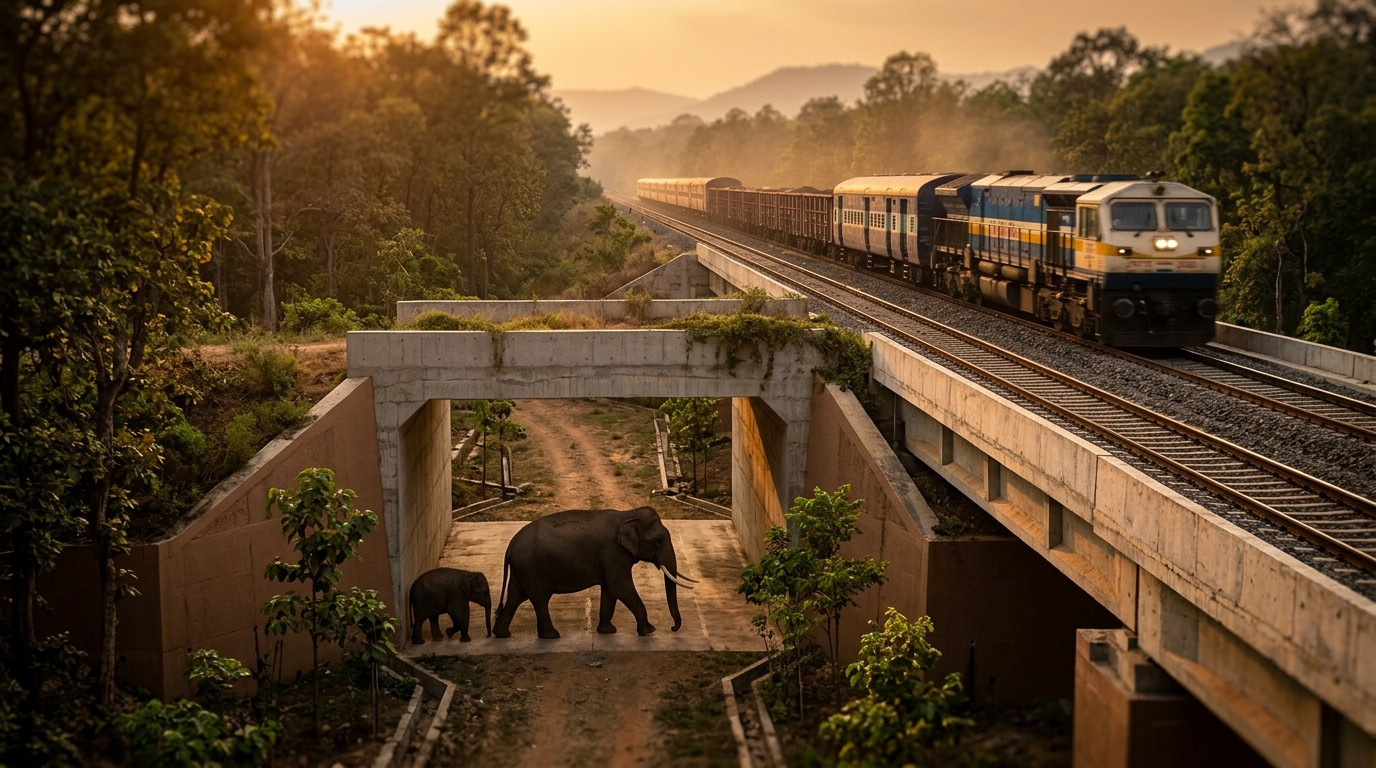
The Environment Ministry and Indian Railways have identified 110 sensitive stretches in elephant ranges and 17 stretches in tiger‑range states to prevent wildlife‑train collisions. Joint field surveys involving Project Elephant, the Wildlife Institute of India (WII), state forest departments and railways evaluated ecological conditions and proposed site‑specific mitigation.
Key Developments
- Out of 127 surveyed railway stretches (covering 3,452.4 km), 77 stretches (1,965.2 km) across 14 states were prioritised for mitigation.
- A package of 705 structures—including ramps, level crossings, bridge extensions, fencing, under‑passes and over‑passes—has been designed.
- Technology pilots such as Distributed Acoustic System (DAS)‑based Intrusion Detection System (IDS) are operational on 64.03 km of elephant corridors in Assam.
- An AI‑based early‑warning system at Madukkarai, Tamil Nadu, uses 12 tower‑mounted thermal cameras to detect elephants within 100 m and alert officials.
- New railway projects (track‑doubling, tripling, gauge conversion) now incorporate wildlife‑friendly designs, e.g., the Gevra‑Pendra line through the Achanakmar‑Amarkantak elephant corridor in Chhattisgarh.
Important Facts
The mitigation package comprises:
- 503 ramps and level crossings
- 72 bridge extensions/modifications
- 39 fencing or trenching structures
- 4 exit ramps
- 65 new under‑passes
- 22 over‑passes
Four pilot DAS‑IDS installations have been commissioned in the Northeast Frontier Railway zone, covering 141 km of railway block sections. Replication is underway in north Bengal and parts of Odisha under the East Coast Railway.
Exam Relevance
These interventions illustrate the intersection of environmental conservation and infrastructure development, a recurring theme in GS 1 (Environment) and GS 3 (Infrastructure, Technology). Understanding the role of inter‑ministerial coordination, the use of advanced monitoring technologies, and the concept of wildlife corridors is essential for answering questions on sustainable development, biodiversity protection, and policy implementation.
Way Forward
- Scale up the DAS‑IDS and AI‑based systems to all identified sensitive stretches.
- Integrate wildlife‑friendly designs in all new railway projects, especially in identified elephant corridors.
- Strengthen real‑time communication between forest officials and train operators to ensure rapid response.
- Monitor effectiveness through periodic mortality audits and adjust mitigation measures accordingly.
Continued collaboration among the Environment Ministry, railways, and wildlife agencies will be pivotal in reducing wildlife mortality on rail tracks while sustaining India's transport growth.