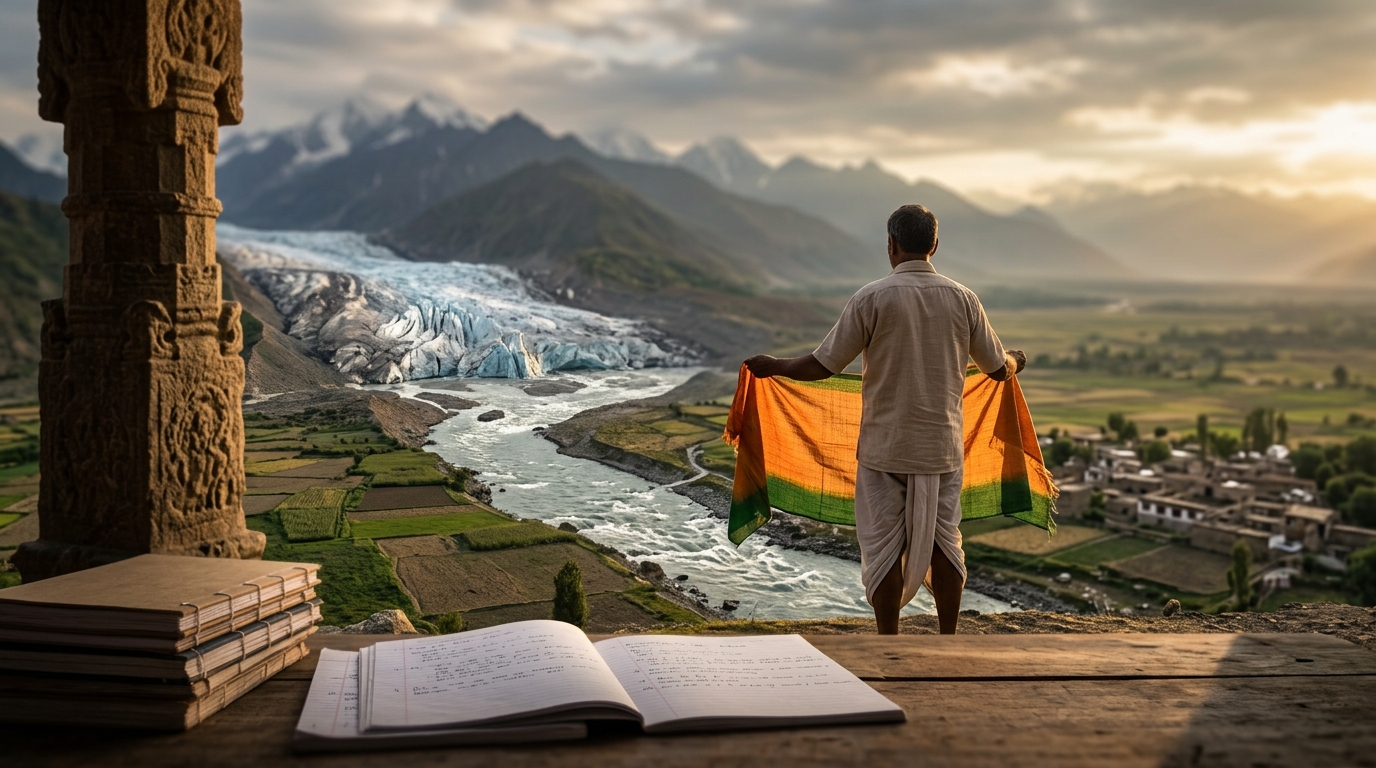
Written by: Nitendra Pal Singh10 min readNew DelhiUpdated: Apr 4, 2026 01:17 PM ISTAttempt a question on the significance of glaciers in today's answer writing practice. (Representational/File)Make us preferred source on GoogleWhatsapptwitterFacebookRedditPRINTUPSC Essentials brings to you its initiative for the practice of Mains answer writing. It covers the essential topics of static and dynamic parts of the UPSC Civil Services syllabus covered under various GS papers. This answer-writing practice is designed to help you as a value addition to your UPSC CSE Mains. Attempt today’s answer writing on questions related to topics of GS-1 to check your progress.
🚨 Click Here to read the UPSC Essentials magazine for March 2026. Share your views and suggestions in the comment box or at [email protected]🚨
QUESTION 1
Discuss the significance of glaciers in shaping physical geography and sustaining human life. Highlight the impact of glacier retreat due to climate change.
QUESTION 2
“The Swadeshi Movement marked a decisive shift in the Indian national movement by introducing new methods of protest, promoting economic self-reliance, and broadening mass participation.” Discuss.QUESTION 1: Discuss the significance of glaciers in shaping physical geography and sustaining human life. Highlight the impact of glacier retreat due to climate change.
Relevance: The question is linked with physical geography and human geography. It is also important for understanding Himalayan ecology and dependence of India on glacial-fed rivers. Aspirants should also focus on climate change and its impact on the glaciers.
Note: This is not a model UPSC answer. It only provides you with a thought process which you may incorporate into the answers.
Introduction:Story continues below this ad
— Glaciers, which are essentially vast and thick slabs of ice created on land by the accumulation of snow over the years, hold around 70% of the world’s freshwater supplies.
— While glaciers are relatively solitary settings, life thrives around them. Their meltwater sustains a diversity of freshwater systems, while newly exposed land from glacial retreat is ready for colonisation by pioneer species.
Body:
You may incorporate some of the following points in your answer:
— Over time, these uncovered areas can transform into grasslands, forests, wetlands, and other ecosystems that provide a variety of biodiversity and ecosystem services. However, this shift is not necessarily good news: glacial regression is a symptom of ongoing climate change, and animals that have evolved to live in glacier conditions risk losing their only habitat once the glaciers melt.Story continues below this ad
— Glaciers not only govern water, but they also affect hazard patterns in mountainous areas. Glacier melt increases runoff and the likelihood of flooding during certain seasons, while shifting patterns can exacerbate dryness in others. Glacier decline can have a significant impact on mountain people’ homes, crops, infrastructure, and livelihoods.
— Glaciers are integral to many Indigenous and local people’ sense of place and collective memory, and their loss reflects not only environmental devastation but also cultural bereavement. Recognising glaciers as cultural touchstones broadens their story beyond science and risk, reminding us that cryosphere loss is about belonging, legacy, and how people cope with tremendous landscape change.
Impacts of glacier retreat due to climate change
— As global warming intensifies, glaciers worldwide are melting at an alarming rate, affecting regional water cycles and the global climate system. The melting of glaciers also contributes to the global sea level rise and aggravates the risks for coastal populations. These challenges underscore the urgent need for climate action and sustainable glacier management.
The challenges of climate change in mountain landscapes. Credit: UNEP
— The continuous retreat of glaciers could lead to the formation and expansion of glacial lakes. These lakes will pose serious risks to downstream communities and infrastructure through glacial lake outburst floods (GLOFs).Story continues below this ad
ALSO READ | PM Modi’s Ethanol push at Jewar airport. Why this biofuel is important for your UPSC exam
— In polar regions, rising temperatures could also enhance the process of calving — where large chunks of ice break off from glaciers — affecting the dynamics of glaciers and ice sheets. This phenomenon not only disrupts regional ecosystems but also contributes to global sea level rise.
Conclusion:
— To promote awareness about the importance of conserving glacier health in a warming world, the United Nations has designated 2025 as the International Year of Glacier Preservation. Furthermore, beginning in 2025, March 21 is designated as the World Day of Glaciers.
— Continued warming may result in lower water availability over time, reducing agricultural output and having negative socio economic repercussions. Furthermore, rising temperatures have caused a rise in the quantity and size of glacial lakes.
(Source: UN urges to save glaciers, secure the planet, http://www.unep.org)
Points to PonderStory continues below this ad
How do glaciers influence the formation of major landforms and river systems?
What are the long-term implications of glacier loss on climate, ecosystems, and human settlements?
Related Previous Year Questions
How do the melting of the Arctic ice and glaciers of the Antarctic differently affect the weather patterns and human activities on the Earth? Explain. (2021)
How will the melting of Himalayan glaciers have a far-reaching impact on the water resources of India? (2020)Story continues below this ad
QUESTION 2: “The Swadeshi Movement marked a decisive shift in the Indian national movement by introducing new methods of protest, promoting economic self-reliance, and broadening mass participation.” Discuss.
Relevance: The topic bridges modern history with contemporary economic policy debates. It will also help in analysing continuity between nationalist economic ideas and present initiatives like Atmanirbhar Bharat.
The three pillars of the Swadeshi Movement: (from left) Lala Lajpat Rai, Bal Gangadhar Tilak, and Bipin Chandra Pal. Wikimedia Commons
Note: This is not a model UPSC answer. It only provides you with a thought process which you may incorporate into the answers.
Introduction:
— On July 19, 1905, the then Viceroy of India, Lord Curzon, announced the division of Bengal into two provinces – East Bengal and Assam and the western province called Bengal.Story continues below this ad
— Lord Curzon’s decision (first announced in December 1903) can be traced back to his conflict with the nationalist intelligentsia that began with his unpopular reforms in the Calcutta Corporation in 1899, followed by the amendments in the University Act of 1904 and the Official Secrets Act of 1904.
— Nationalists, irrespective of their political affiliations, viewed partition as a blow to national unity and pride. The widespread protest in response to this unpopular strategy paved the way for a new phase in the Indian national movement.
Body:
You may incorporate some of the following points in your answer:
— The failure of moderates’ ‘mendicant policies’ (appealing to the British through prayers and petitions) to counter Curzon’s repressive reforms led to the search for a new technique to demand revocation of the Bengal partition. The idea of boycotting British goods was first proposed in Krishnakumar Mitra’s weekly Sanjivani on July 13, 1905, and later adopted by nationalist leaders at a public meeting in Calcutta Town Hall on August 7, 1905.Story continues below this ad
— The Swadeshi public also welcomed the emergence of Samitis or national volunteer organisations engaged in philanthropic work during famines and epidemics. These Samitis trained volunteers in social work, organised indigenous arbitration courts and schools, and spread the message of Swadeshi during festivals.
— Militant leaders like Aurobindo Ghose and Bipin Chandra Pal expanded the Swadeshi agenda and called for the boycott of British goods, educational institutions, courts, renunciation of titles, and relinquishment of government services. During this phase, Bengal, Maharashtra, and Punjab, under the leadership of the Lal-Bal-Pal triumvirate (Lala Lajpat Rai, Bal Gangadhar Tilak, and Bipin Chandra Pal), emerged as epicentres of revolutionary politics.
— The Swadeshi movement, which challenged the monopoly of the colonial economy, also contributed to the revival of the indigenous economy. For Gopal Krishna Gokhale, the movement was a revolt against the state of dependence in all branches of national life. Surendranath Banerjee described it as a “protectionist movement”.
— The movement encouraged Indian industries and revived sectors like handloom, silk-weaving, and other indigenous artisan crafts. National banks and insurance companies were opened with Indian capital. As the movement spread to Madras, V O Chidambaram mooted a Swadeshi shipping venture to challenge the British monopoly in navigation and maritime trade.
— The idea of Swadeshi can be traced back to M. G. Ranade’s lecture series of 1872, where he argued that goods produced in one’s own country should be preferred, regardless of the level of satisfaction they provide. Proponents of constructive Swadeshi, like Rabindranath Tagore, emphasised self-help (atma-shakti), and called for the revival of traditional Hindu samaj (community) to engage in constructive work at the village level.
— The Swadeshi movement (1905-1911) laid the groundwork for many strategies adopted during the Gandhian phase of the national movement. Later, Mahatma Gandhi extended the idea of Swadeshi into the spiritual realm by linking it to a moral duty.
Conclusion:
— The Swadeshi movement succeeded in mobilising the masses into nationalist politics and uniting diverse political forces but extremist tendencies that deviated from the declared goal could not be contained. The history of the national movement suggests that emotional responses to powerful forces need to be accompanied by adequate capital, inclusive participation, and well-defined strategies to achieve long-term success.
(Source: Revisiting the legacy of Swadeshi movement amid Trump’s tariff tirade)
Points to Ponder
What were the core economic and ideological objectives of the Swadeshi Movement?
Can economic nationalism coexist with globalisation in the current world order?
Related Previous Year Questions
What were the events that led to the Quit India Movement? Point out its results. (2024)
Bring out the constructive programmes of Mahatma Gandhi during Non-Cooperation Movement and Civil Disobedience Movement. (2021)
Previous Mains Answer Practice
UPSC Essentials: Mains answer practice — GS 3 (Week 148)
UPSC Essentials: Mains answer practice — GS 3 (Week 147)
UPSC Essentials: Mains answer practice — GS 2 (Week 146)
UPSC Essentials: Mains answer practice — GS 2 (Week 147)
UPSC Essentials: Mains answer practice — GS 1 (Week 146)
UPSC Essentials: Mains answer practice — GS 1 (Week 147)
Subscribe to our UPSC newsletter and stay updated with the news cues from the past week.Stay updated with the latest UPSC articles by joining our Telegram channel – IndianExpress UPSC Hub, and follow us on Instagram and X.Expand © IE Online Media Services Pvt LtdTags:Current Affairsgovernment jobsMains Answer PracticeSarkari NaukriUPSCUPSC Civil Services ExamUPSC Essentials
Loading page, please wait…