MoEFCC’s Jumpstart Approach Enables First Great Indian Bustard Chick Hatching in Gujarat after 10 Years — UPSC Current Affairs | March 28, 2026
MoEFCC’s Jumpstart Approach Enables First Great Indian Bustard Chick Hatching in Gujarat after 10 Years
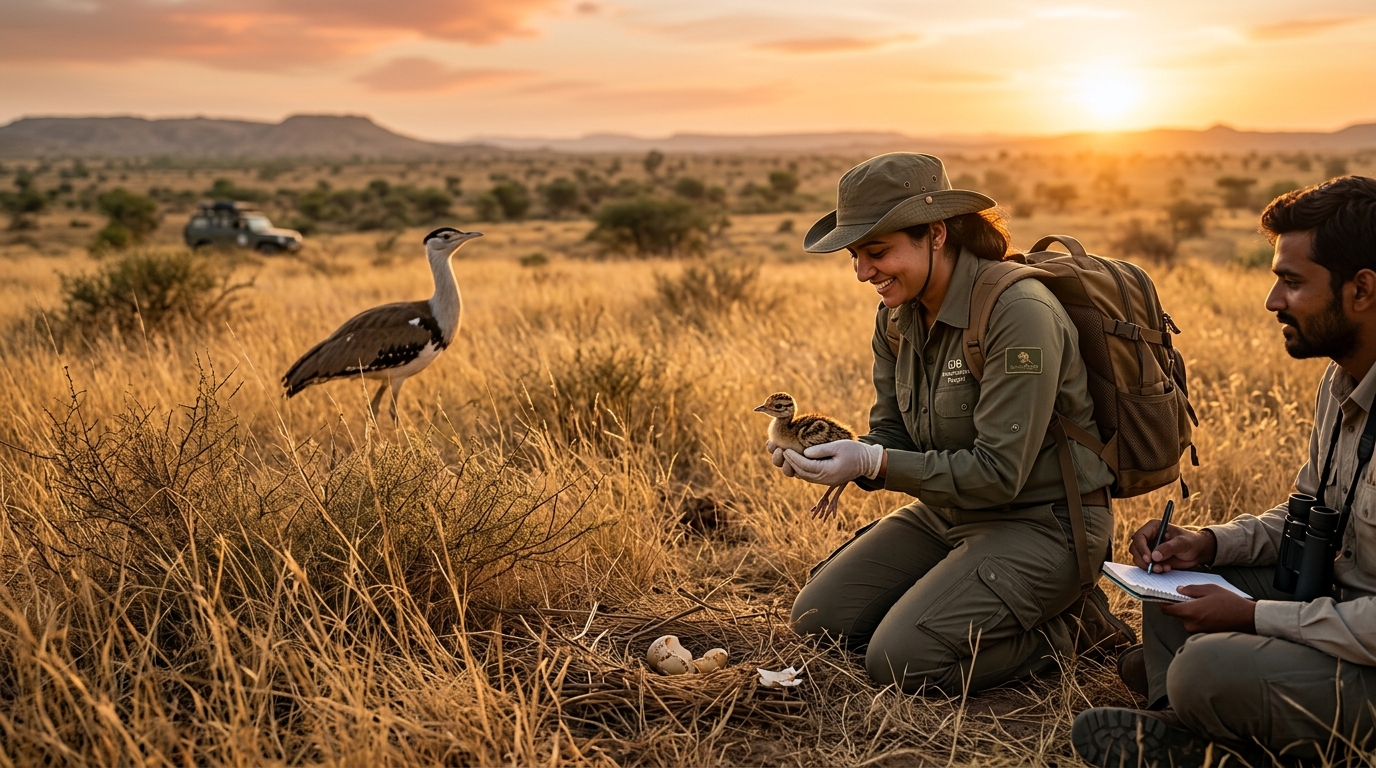
The Ministry of Environment, Forest and Climate Change, in coordination with Rajasthan and Gujarat forest departments and the Wildlife Institute of India, successfully hatched a Great Indian Bustard chick in Gujarat using the Jumpstart Approach—transporting a fertile egg from a Rajasthan breeding centre to a wild nest. This marks the first inter‑state conservation success for the species, underscoring India's commitment to rewilding and broader wildlife‑conservation policies.
The Union Ministry of Environment, Forest and Climate Change ( MoEFCC ) announced a landmark achievement in the conservation of the critically endangered Great Indian Bustard (GIB) . After a decade, a chick hatched in the grasslands of Kutch, Gujarat, thanks to a novel Jumpstart Approach coordinated by MoEFCC, the forest departments of Rajasthan and Gujarat, and the Wildlife Institute of India (WII) . Key Developments 22 March 2026: A fertile egg, incubated at the Conservation Breeding Centre in Sam, Rajasthan, was transported 770 km in a handheld incubator to the nest of a female GIB in Naliya, Gujarat. 26 March 2026: The female successfully incubated the egg and the chick hatched, marking the first successful trans‑state conservation effort for GIB. Current status: Only three female GIBs remain in Kutch; the hatchling is being reared by its foster mother in the wild. Conservation breeding numbers: 73 birds are now housed in the Conservation Breeding Centres at Sam and Ramdevra, Rajasthan, with five new chicks added this season. Future plan: India is moving towards large‑scale rewilding of GIB and other threatened birds. Important Facts Project GIB was envisioned by Prime Minister Narendra Modi in 2011 and formally launched in 2016. The egg transport required a continuous, halt‑free corridor from Sam (Rajasthan) to Naliya (Gujarat), covering 770 km in 19 hours. The female GIB that laid the infertile egg in August 2025 was tagged for monitoring. The successful hatch demonstrates the feasibility of moving fertile eggs across state borders to boost wild populations. UPSC Relevance This case study touches upon several UPSC syllabus points: environmental policy implementation (MoEFCC’s role), species‑specific conservation strategies (Jumpstart Approach, rewilding), inter‑state coordination (Rajasthan‑Gujarat collaboration), and the significance of flagship species like the Great Indian Bustard in biodiversity preservation (GS4: Environment). Understanding such initiatives helps answer questions on wildlife management, policy design, and the challenges of conserving critically endangered fauna. Way Forward Scale the Jumpstart Approach to other GIB habitats across India. Strengthen habitat restoration in Kutch to support the survival of the fledgling and remaining females. Expand rewilding programmes for other threatened avian species. Enhance monitoring infrastructure (GPS tagging, community participation) to track post‑release survival. Mobilise additional funding and technical expertise through public‑private partnerships and international conservation bodies.
Must Review
Login to bookmark articles
Login to mark articles as complete
Overview
MoEFCC’s Jumpstart Approach revives Great Indian Bustard, showcasing inter‑state wildlife governance
Key Facts
22 March 2026: Fertile Great Indian Bustard egg moved from Sam (Rajasthan) to Naliya (Gujarat) in a handheld incubator, covering 770 km in 19 hours.
26 March 2026: First GIB chick hatched in Kutch after a decade, confirming success of the trans‑state Jumpstart Approach.
Only three female GIBs remain in Kutch; the hatchling is being reared by its foster mother in the wild.
Conservation Breeding Centres at Sam and Ramdevra house 73 GIBs, with five new chicks added in the 2026 season.
Project GIB, envisioned by PM Narendra Modi in 2011 and launched in 2016, now aims for large‑scale rewilding of the species.
The effort was coordinated by MoEFCC, Rajasthan and Gujarat forest departments, and the Wildlife Institute of India (WII).
Background & Context
The Jumpstart Approach exemplifies MoEFCC's policy implementation for critically endangered fauna, integrating scientific breeding, habitat restoration, and inter‑state coordination—key themes under GS‑III (Environment) and GS‑II (Federal Structure). It also underscores the importance of flagship species like the Great Indian Bustard in India's biodiversity commitments and international conservation obligations.
UPSC Syllabus Connections
Essay•Environment and SustainabilityGS3•Conservation, environmental pollution and degradationPrelims_GS•Ecology and BiodiversityGS2•Functions and responsibilities of Union and StatesEssay•Media, Communication and InformationGS3•Biodiversity and its ConservationGS2•Government policies and interventions for development
Mains Answer Angle
In a GS‑III answer, discuss how innovative breeding techniques and inter‑state collaboration can strengthen flagship‑species conservation, evaluating challenges and policy implications. A possible question: ‘Assess the role of MoEFCC and state agencies in reviving the Great Indian Bustard through the Jumpstart Approach.’