Overview
The Himachal Pradesh government is actively pursuing the legalization and regulation of cannabis cultivation, aiming to transform the state's economy and agricultural landscape. This initiative is projected to generate annual revenues ranging from ₹1,000 crore to ₹2,000 crore, offering a substantial boost to the state's finances.
Key Developments
Policy Finalization
Chief Minister Sukhvinder Singh Sukhu announced that the government is in the final stages of formulating the policy, which includes rules and regulations compliant with the Narcotic Drugs and Psychotropic Substances Act, 1985, and the Narcotic Drugs and Psychotropic Substances Rules, 1989. The policy is expected to be ready for State Cabinet approval within a month or two.
Strategic Repositioning of Cannabis
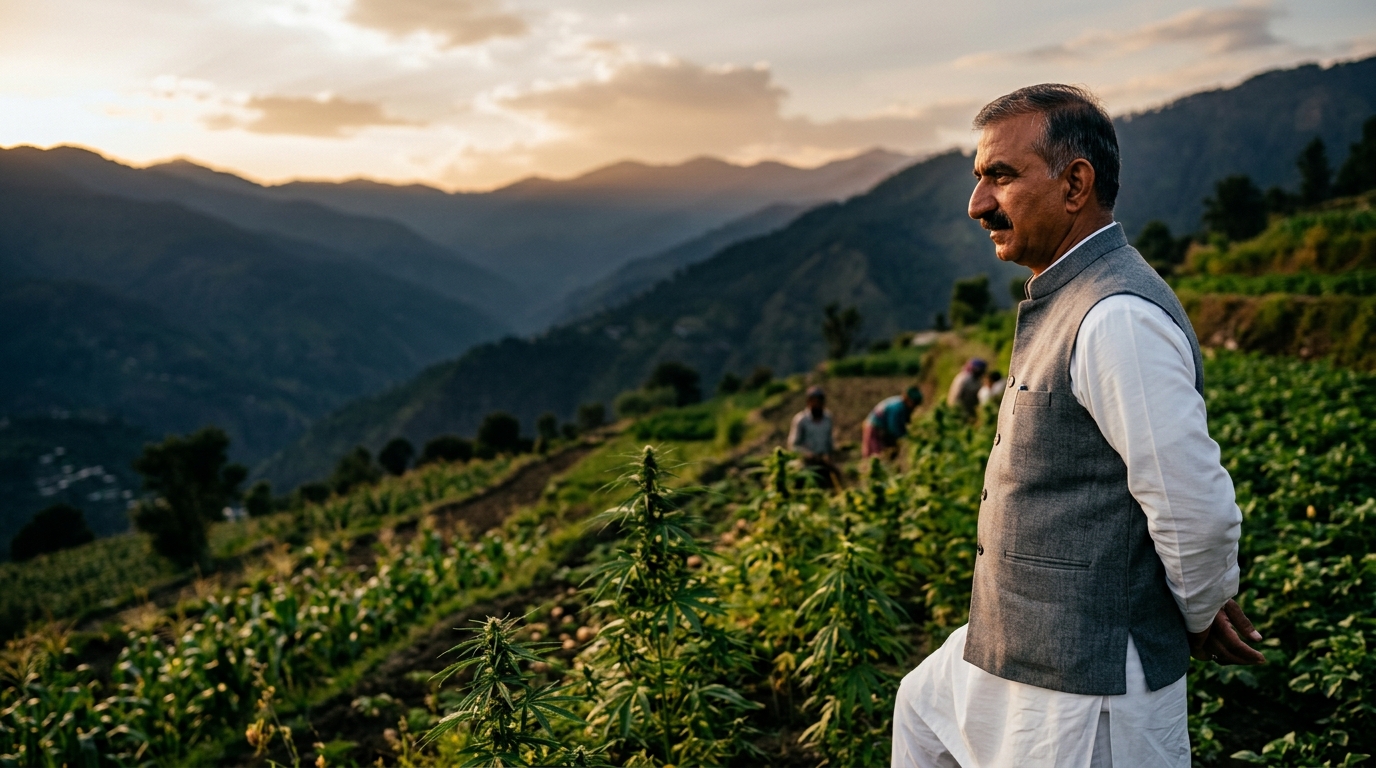
For decades, cannabis has grown wild in the valleys of Kullu, Mandi, and Chamba, often associated with illegal drug trade. The proposed policy seeks to reposition cannabis for its medicinal value, including applications in pain management and anti-inflammatory treatments, as well as for industrial uses in textiles, paper, and packaging.
Hemp Cultivation and THC Content
The policy will mandate that industrial hemp cultivation maintain a tetrahydrocannabinol (THC) content of less than 0.3%. This ensures that the crop remains non-intoxicating while retaining its industrial utility. Hemp is a variety of Cannabis sativa cultivated for industrial and medicinal purposes.
Economic and Agricultural Impact
The initiative aims to transform a natural resource into a versatile industrial asset, producing high-value goods ranging from eco-friendly textiles to bio-plastics. This ‘green to gold’ initiative seeks to move the State away from illicit trade towards becoming a hub in the global bio-economy through regulated hemp cultivation.
With farmers increasingly abandoning traditional crops due to damage caused by wild animals, this initiative could provide an alternative and sustainable livelihood. Regulated cultivation can generate ₹1,000-2,000 crore annually once fully operational, helping capture markets currently dominated by illegal trade and imports, particularly in the pharmaceutical and wellness sectors.
Research and Development
Chaudhary Sarwan Kumar Himachal Pradesh Krishi Vishvavidyalaya, Palampur, and Dr. Y.S. Parmar University of Horticulture and Forestry, Nauni, are already conducting pilot studies to develop high-yield, low-THC hemp varieties suitable for the Himalayan region.
Exam Relevance
This news is relevant to the UPSC syllabus under GS2: Government Policies and Interventions, GS3: Economy, and GS3: Agriculture. It highlights government efforts to diversify the economy, promote sustainable agriculture, and leverage natural resources for economic development. The policy's focus on regulating cannabis cultivation and ensuring low THC content is also relevant to discussions on drug policy and public health.
Important Facts
- Himachal Pradesh is planning to legalize and regulate cannabis cultivation.
- Projected annual revenue: ₹1,000 crore to ₹2,000 crore.
- Policy compliance with Narcotic Drugs and Psychotropic Substances Act, 1985.
- THC content limit: less than 0.3% in industrial hemp.
- Pilot studies by Chaudhary Sarwan Kumar Himachal Pradesh Krishi Vishvavidyalaya, Palampur, and Dr. Y.S. Parmar University of Horticulture and Forestry, Nauni.