Loading page, please wait…
HomeCurrent AffairsEditorialsGovt SchemesLearning ResourcesUPSC SyllabusPricingAboutBest UPSC AIUPSC AI ToolAI for UPSCUPSC ChatGPT

© 2026 Vaidra. All rights reserved.

PrivacyTerms
Vaidra Logo
Vaidra

Top 4 items + smart groups

UPSC GPT
New
Current Affairs
Daily Solutions
Daily Puzzle
Mains Evaluator

Version 2.0.0 • Built with ❤️ for UPSC aspirants

Home Minister Amit Shah Declares India Naxal‑Free After Three‑Year LWE Campaign — UPSC Current Affairs | April 1, 2026
Home Minister Amit Shah Declares India Naxal‑Free After Three‑Year LWE Campaign
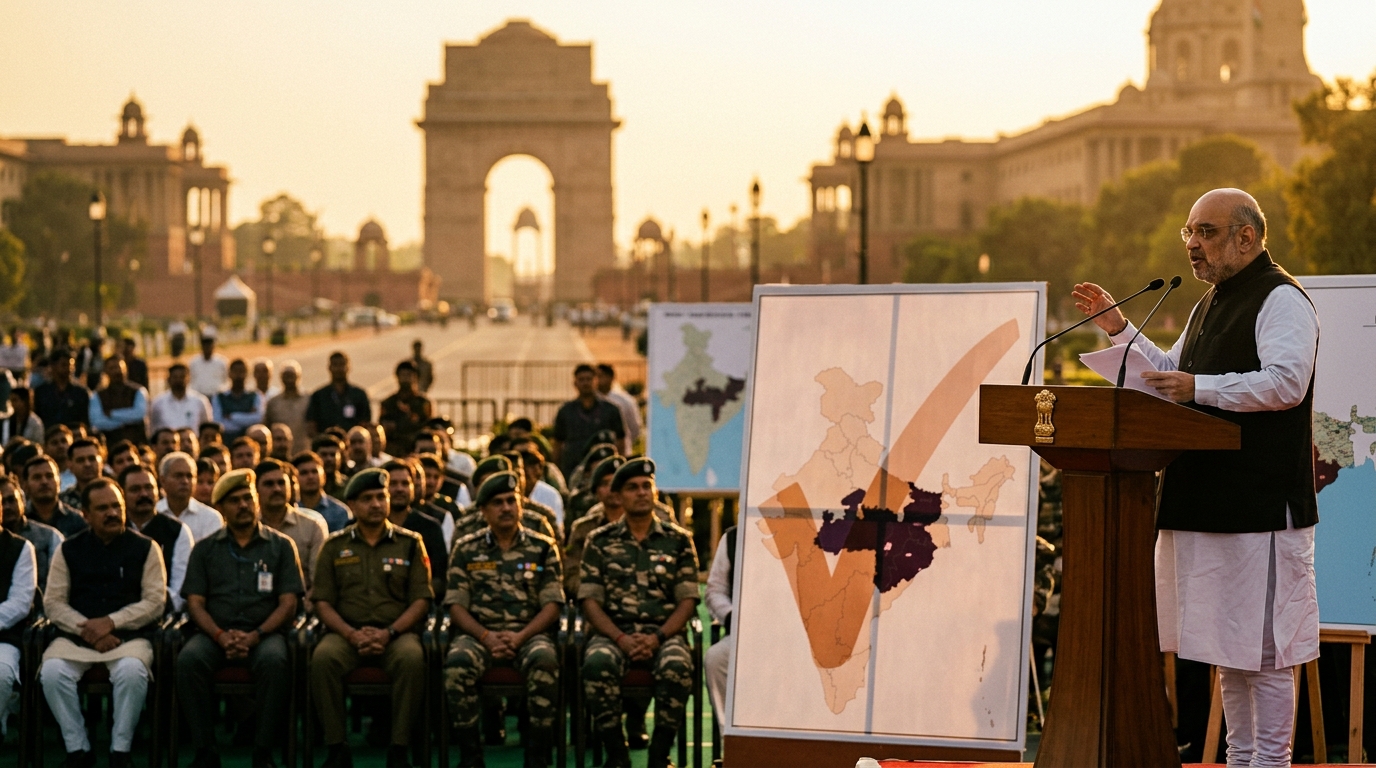
On 30 March 2026, Home Minister Amit Shah declared India Naxal‑free after three years of intensive operations that saw thousands of Maoists surrender, arrested or neutralised. The announcement underscores a shift to a hard‑line security strategy, raising UPSC‑relevant questions about internal security, human rights, and the need for inclusive development in tribal‑affected regions.
On 30 March 2026 , Amit Shah announced in the Lok Sabha that India is now Naxal‑free . The declaration came a day before the self‑imposed deadline to eradicate Left Wing Extremism (LWE) across the country. Key Developments (2023‑2026) Paramilitary operations resulted in 4,839 Maoists surrendering , 2,218 arrests , and 706 neutralised in encounters . Launch of a dual strategy: dialogue and rehabilitation for surrenderers and a "no‑mercy" stance for hardliners. Initiatives to provide a school in every village and extend Aadhaar and ration cards in the most affected districts. Intensified security operations in the erstwhile Maoist belt covering parts of Bihar, Jharkhand, Chhattisgarh, Odisha, Andhra Pradesh and Maharashtra . Important Facts The Maoist influence, at its peak, spanned more than 180 districts rich in tribal, forest and mineral resources. The previous government under Manmohan Singh had initiated Operation Green Hunt , but adopted a more cautious approach due to humanitarian and institutional costs. The current administration’s approach has been described as “uncompromising militarist”, with critics labeling dissenting activists as urban Naxals . Security measures have reportedly exceeded the provisions of existing anti‑terror laws, raising concerns about civil liberties. UPSC Relevance Understanding the evolution of Maoists and the state’s response is essential for GS2 (Internal Security) and GS4 (Ethics & Governance). The shift from a negotiated, development‑oriented strategy to a hard‑line security model illustrates the balance between national security and human rights , a recurring theme in the UPSC syllabus. The role of welfare tools like Aadhaar in conflict‑prone regions also links to GS3 (Governance & Public Policy). Way Forward While the operational success in curbing LWE is notable, the next phase must focus on: Ensuring genuine tribal rights and participatory governance in resource‑rich areas. Preventing the emergence of “crony‑capitalist” extraction that could reignite alienation. Institutionalising rehabilitation and livelihood programmes to sustain peace. Balancing security imperatives with civil liberties to uphold democratic values. In sum, the declaration marks a milestone, but lasting peace will depend on inclusive development, accountability in resource management, and a reconciliatory political approach.
  1. Home
  2. Prepare
  3. Current Affairs
  4. Home Minister Amit Shah Declares India Naxal‑Free After Three‑Year LWE Campaign
Must Review
Login to bookmark articles
Login to mark articles as complete

Overview

India declared Naxal‑free, underscoring internal security‑development nexus for UPSC

Key Facts

  1. 30 March 2026: Home Minister Amit Shah announced India is Naxal‑free in the Lok Sabha.
  2. Three‑year LWE eradication campaign (2023‑2026) culminated on the self‑imposed deadline of 31 March 2026.
  3. Operational outcomes: 4,839 Maoist surrenderers, 2,218 arrests, and 706 neutralised in encounters.
  4. Operations spanned the erstwhile Maoist belt – Bihar, Jharkhand, Chhattisgarh, Odisha, Andhra Pradesh and Maharashtra (peak influence in 180 districts).
  5. Dual strategy: (i) dialogue and rehabilitation for surrenderers; (ii) a "no‑mercy" stance for hardliners.
  6. Welfare push: school in every village and extension of Aadhaar and ration cards in the most affected districts.
  7. Historical reference: Operation Green Hunt (2009‑10) launched under the Manmohan Singh government.

Background & Context

The declaration ties into GS‑2 (Internal Security) as it marks the culmination of a militarised yet development‑oriented response to Left Wing Extremism. It also illustrates the GS‑3 linkage between governance tools (Aadhaar, welfare schemes) and the mitigation of insurgency, highlighting the perennial balance between security imperatives and civil liberties.

UPSC Syllabus Connections

GS3•Linkages between development and spread of extremismEssay•Democracy, Governance and Public AdministrationEssay•Economy, Development and InequalityEssay•Society, Gender and Social JusticeGS1•Poverty and Developmental IssuesGS4•Dimensions of ethics - private and public relationshipsPrelims_GS•Constitution and Political SystemGS2•Governance, transparency, accountability and e-governance

Mains Answer Angle

In a GS‑2/GS‑4 answer, evaluate the success of the three‑year LWE campaign, analysing the security gains against concerns over human rights, tribal welfare and sustainable development.

Full Article

Read Original on hindu

Analysis

Practice Questions

Prelims
Easy
Prelims MCQ

Left Wing Extremism – key dates

1 marks
4 keywords
GS2
Medium
Mains Short Answer

Policy response to LWE

5 marks
5 keywords
GS2
Hard
Mains Essay

Balancing security and rights in LWE eradication

250 marks
6 keywords
Related:Daily•Weekly

Loading related articles...

Loading related articles...

Tip: Click articles above to read more from the same date, or use the back button to see all articles.

Explore:Current Affairs·Editorial Analysis·Govt Schemes·Study Materials·Previous Year Questions·UPSC GPT