Loading page, please wait…
HomeCurrent AffairsEditorialsGovt SchemesLearning ResourcesUPSC SyllabusPricingAboutBest UPSC AIUPSC AI ToolAI for UPSCUPSC ChatGPT

© 2026 Vaidra. All rights reserved.

PrivacyTerms
Vaidra Logo
Vaidra

Top 4 items + smart groups

UPSC GPT
New
Current Affairs
Daily Solutions
Daily Puzzle
Mains Evaluator

Version 2.0.0 • Built with ❤️ for UPSC aspirants

India-Canada Seal $2.6 bn Uranium Deal & CEPA, Aim for $50 bn Trade by 2030 — UPSC Current Affairs | March 2, 2026
India-Canada Seal $2.6 bn Uranium Deal & CEPA, Aim for $50 bn Trade by 2030
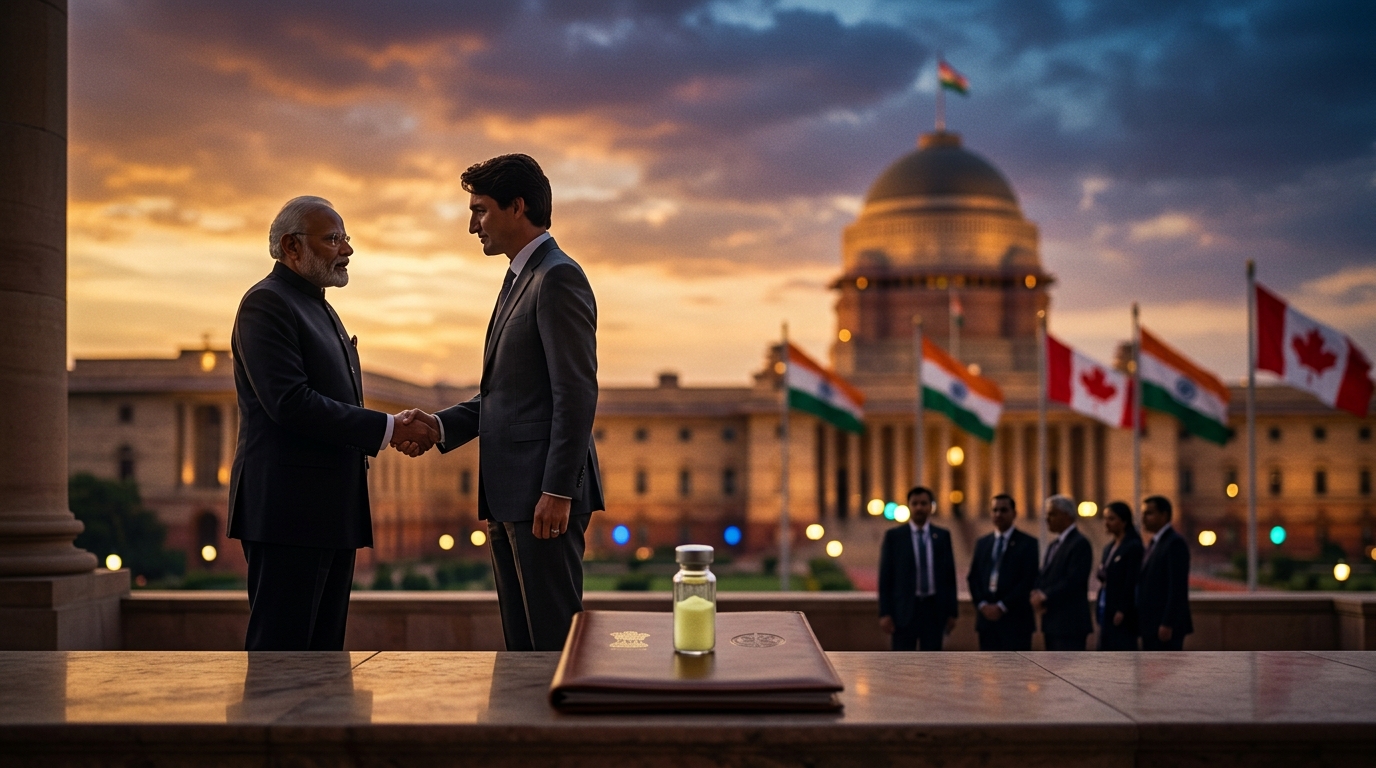
On 2 March 2026, India and Canada signed a $2.6 bn uranium supply deal, a critical‑minerals MoU and pledged a $50 bn trade target by 2030, while agreeing to launch a CEPA and a defence dialogue. The agreements deepen energy security, economic cooperation and strategic ties, offering a practical case for UPSC topics on foreign policy, trade and technology collaboration.
India‑Canada Strategic Partnership 2026 On 2 March 2026 , Prime Minister Narendra Modi and Canadian Prime Minister Mark Carney concluded a series of agreements that deepen cooperation in energy, minerals, defence, education and trade. The talks set a clear target of reaching $50 billion in bilateral trade by 2030 and paved the way for a CEPA between the two nations. Key Developments Signing of a Uranium supply agreement worth $2.6 billion to support India’s civil nuclear programme. MoU on critical minerals to create resilient supply chains. Agreement to cooperate on SMR and advanced reactor technology. Establishment of an defence dialogue covering maritime domain awareness and military exchanges. Launch of a renewable energy partnership and a strategic energy partnership. Commitment to expand educational ties, including Canadian university campuses in India and joint AI, healthcare and agriculture research. Important Facts Current two‑way trade stands at roughly $13 billion . Canada’s pension funds have already invested about $100 billion in India, signalling confidence in the Indian growth story. The agreements also address common security challenges, with both sides pledging cooperation against terrorism, extremism and radicalisation . UPSC Relevance These developments illustrate the interplay of economic diplomacy (CEPA, trade targets), energy security (uranium, critical minerals, SMRs, renewable energy), and strategic security (defence dialogue, counter‑terrorism). Aspirants should link them to GS2 (India’s foreign policy, bilateral relations), GS3 (trade policy, energy sector, investment flows) and GS4 (science‑technology cooperation). The reset of India‑Canada ties after the 2023 diplomatic row also offers a case study on managing bilateral crises. Way Forward Finalize the CEPA before the end of 2026 to unlock new investment avenues. Operationalise the critical‑minerals supply chain by setting up joint exploration and processing units. Accelerate SMR pilot projects to diversify India’s nuclear energy mix. Institutionalise the defence dialogue with annual joint exercises and information sharing mechanisms. Promote people‑to‑people contact through expanded university collaborations and scholarship programmes. Collectively, these steps aim to transform the bilateral relationship into a “next‑level partnership” that supports India’s economic growth, energy transition and strategic autonomy.
  1. Home
  2. Prepare
  3. Current Affairs
  4. India-Canada Seal $2.6 bn Uranium Deal & CEPA, Aim for $50 bn Trade by 2030
Must Review
Login to bookmark articles
Login to mark articles as complete

Overview

India‑Canada uranium deal and CEPA aim for $50 bn trade, strengthening energy security and diplomacy

Key Facts

  1. 2 March 2026: PM Narendra Modi and PM Mark Carney signed a suite of agreements.
  2. Uranium supply agreement valued at $2.6 billion to fuel India's civil nuclear programme.
  3. Bilateral trade target raised from ~ $13 billion to $50 billion by 2030.
  4. MoU on critical minerals, cooperation on Small Modular Reactors (SMRs) and renewable energy.
  5. Defence dialogue instituted covering maritime domain awareness and counter‑terrorism cooperation.
  6. Canadian pension funds have invested about $100 billion in India.
  7. Comprehensive Economic Partnership Agreement (CEPA) to be finalised by end‑2026.

Background & Context

The agreements exemplify India's economic diplomacy (GS2) by expanding trade and investment, while bolstering energy security (GS3) through uranium, critical minerals and SMR cooperation. They also intersect with environmental objectives via renewable‑energy partnerships and address strategic autonomy in a competitive global minerals market.

UPSC Syllabus Connections

GS2•Bilateral, regional and global groupings involving IndiaPrelims_GS•Environmental Issues and Climate ChangeEssay•Economy, Development and InequalityGS3•Infrastructure - Energy, Ports, Roads, Airports, RailwaysPrelims_GS•International Current AffairsEssay•Environment and SustainabilityEssay•International Relations and GeopoliticsEssay•Science, Technology and SocietyGS3•Indian Economy - Planning, mobilization of resources, growth, development and employmentGS1•Distribution of Key Natural Resources

Mains Answer Angle

In a GS2 answer, candidates can discuss the India‑Canada partnership as a case of strategic bilateral relations; in GS3, they can analyse its impact on energy security and the transition to clean energy.

Full Article

Read Original on hindu

Analysis

Practice Questions

Prelims
Medium
Prelims MCQ

India‑Canada bilateral relations

2 marks
4 keywords
GS3
Easy
Mains Short Answer

Energy security

5 marks
5 keywords
GS2
Hard
Mains Essay

Economic diplomacy and strategic autonomy

250 marks
6 keywords
Related:Daily•Weekly

Loading related articles...

Loading related articles...

Tip: Click articles above to read more from the same date, or use the back button to see all articles.

Explore:Current Affairs·Editorial Analysis·Govt Schemes·Study Materials·Previous Year Questions·UPSC GPT