Loading page, please wait…
HomeCurrent AffairsEditorialsGovt SchemesLearning ResourcesUPSC SyllabusPricingAboutBest UPSC AIUPSC AI ToolAI for UPSCUPSC ChatGPT

© 2026 Vaidra. All rights reserved.

PrivacyTerms
Vaidra Logo
Vaidra

Top 4 items + smart groups

UPSC GPT
New
Current Affairs
Daily Solutions
Daily Puzzle
Mains Evaluator

Version 2.0.0 • Built with ❤️ for UPSC aspirants

Indian Navy to Commission Indigenous Stealth Frigate ‘Taragiri’ (F41) on 3 April 2026 — UPSC Current Affairs | March 21, 2026
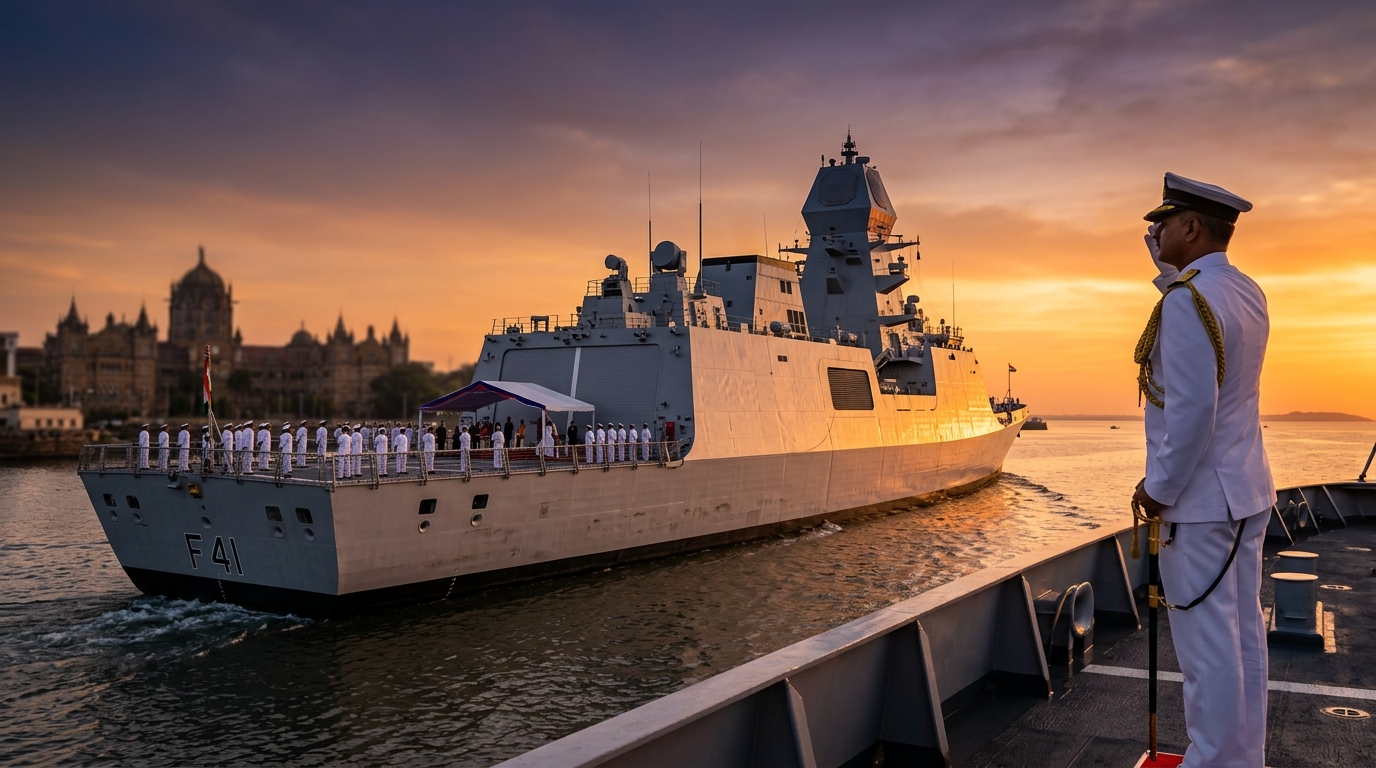
Indian Navy to Commission Indigenous Stealth Frigate ‘Taragiri’ (F41) on 3 April 2026
The Indian Navy will commission the indigenous stealth frigate <strong>Taragiri (F41)</strong> on 3 April 2026, marking the fourth vessel of the <span class="key-term" data-definition="Project 17A — A class of advanced stealth frigates being built indigenously for the Indian Navy, reflecting the country’s push for self‑reliant defence capabilities (GS2: Polity & GS3: Defence).">Project 17A</span> programme. Built by <span class="key-term" data-definition="Mazagon Dock Shipbuilders Limited (MDL) — A premier Indian shipyard in Mumbai that constructs warships and submarines for the Navy, exemplifying public sector defence production (GS3: Economy).">MDL</span> under the <span class="key-term" data-definition="Make in India — Government initiative launched in 2014 to encourage domestic manufacturing and reduce import dependence, crucial for defence indigenisation (GS3: Economy).">Make in India</span> drive, the frigate showcases India's push for a self‑reliant maritime force.
The Indian Navy will commission its newest stealth frigate, Taragiri (F41) , on 03 April 2026 at Visakhapatnam, with the ceremony presided over by Raksha Mantri Shri Rajnath Singh . The vessel marks a major step in India’s quest for a fully self‑reliant maritime force. Key Developments Commissioning of Taragiri (F41) , the fourth ship of the Project 17A programme. Construction completed by Mazagon Dock Shipbuilders Limited (MDL) , showcasing the Make in India drive. Indigenous content exceeds 75 % , involving over 200 MSMEs and creating thousands of jobs. Equipped with a CODOG plant for high‑speed, high‑endurance missions. Advanced weapon suite integrated via a state‑of‑the‑art Combat Management System , including supersonic SSMs, medium‑range SAMs and ASW capabilities. Designed for multi‑role operations, from high‑intensity combat to Humanitarian Assistance and Disaster Relief (HADR) missions. Important Facts The frigate displaces 6,670 tonnes and features a reduced radar cross‑section, enhancing stealth. Its construction underscores the Aatmanirbhar ethos: designed, built and operated by Indians. UPSC Relevance Understanding the commissioning of Taragiri helps aspirants grasp several GS themes: the evolution of India’s naval capabilities (GS3: Defence), the impact of the Make in India policy on strategic sectors, and the role of public‑sector enterprises like MDL . The involvement of MSMEs illustrates the broader industrial ecosystem, a point of interest for GS2 (Polity) and GS3 (Economy) questions on indigenous production and employment generation. Way Forward Future steps include induction of the remaining Project 17A ships, further enhancement of indigenous weapon systems, and expanding the navy’s HADR capacity to address climate‑induced disasters in the Indian Ocean Region. Continuous investment in domestic R&D and MSME participation will sustain the momentum toward a fully Aatmanirbhar defence posture.
  1. Home
  2. Prepare
  3. Current Affairs
  4. Indian Navy to Commission Indigenous Stealth Frigate ‘Taragiri’ (F41) on 3 April 2026
Login to bookmark articles
Login to mark articles as complete

Overview

Indigenous stealth frigate ‘Taragiri’ commissioned, boosting India’s self‑reliant blue‑water navy

Key Facts

  1. Taragiri (F41), the fourth Project 17A stealth frigate, commissioned on 3 April 2026 at Visakhapatnam.
  2. Defence Minister Rajnath Singh presided over the commissioning ceremony.
  3. Built by Mazagon Dock Shipbuilders Limited (MDL) under the Make in India drive; indigenous content exceeds 75%.
  4. Displaces 6,670 tonnes; powered by CODOG propulsion and fitted with an advanced Combat Management System, supersonic SSMs, medium‑range SAMs and ASW suite.
  5. Involves over 200 MSMEs, creating thousands of jobs and exemplifying the Aatmanirbhar defence ethos.
  6. Designed for multi‑role missions, from high‑intensity combat to HADR operations in the Indian Ocean Region.
  7. Completes the first batch of Project 17A; the remaining ships are slated for induction by 2029.

Background & Context

The commissioning underscores India's push for a self‑reliant defence industrial base under Make in India and Aatmanirbhar Bharat. It also enhances maritime security and blue‑water capability, aligning with strategic imperatives in the Indian Ocean Region as covered in GS2 (Polity & Economy) and GS3 (Defence).

Mains Answer Angle

In a GS3 answer, discuss how indigenous warship construction like Project 17A advances self‑reliance, boosts domestic industry and strengthens India's maritime deterrence; in GS2, link it to policy frameworks such as Make in India and employment generation through MSMEs.

Full Article

Read Original on pib

Analysis

Practice Questions

Prelims
Easy
Prelims MCQ

Indigenous warship construction

1 marks
4 keywords
GS3
Medium
Mains Short Answer

Defence indigenisation

5 marks
5 keywords
GS3
Hard
Mains Essay

Maritime security and blue‑water capability

20 marks
7 keywords
Related:Daily•Weekly

Loading related articles...

Loading related articles...

Tip: Click articles above to read more from the same date, or use the back button to see all articles.

Explore:Current Affairs·Editorial Analysis·Govt Schemes·Study Materials·Previous Year Questions·UPSC GPT