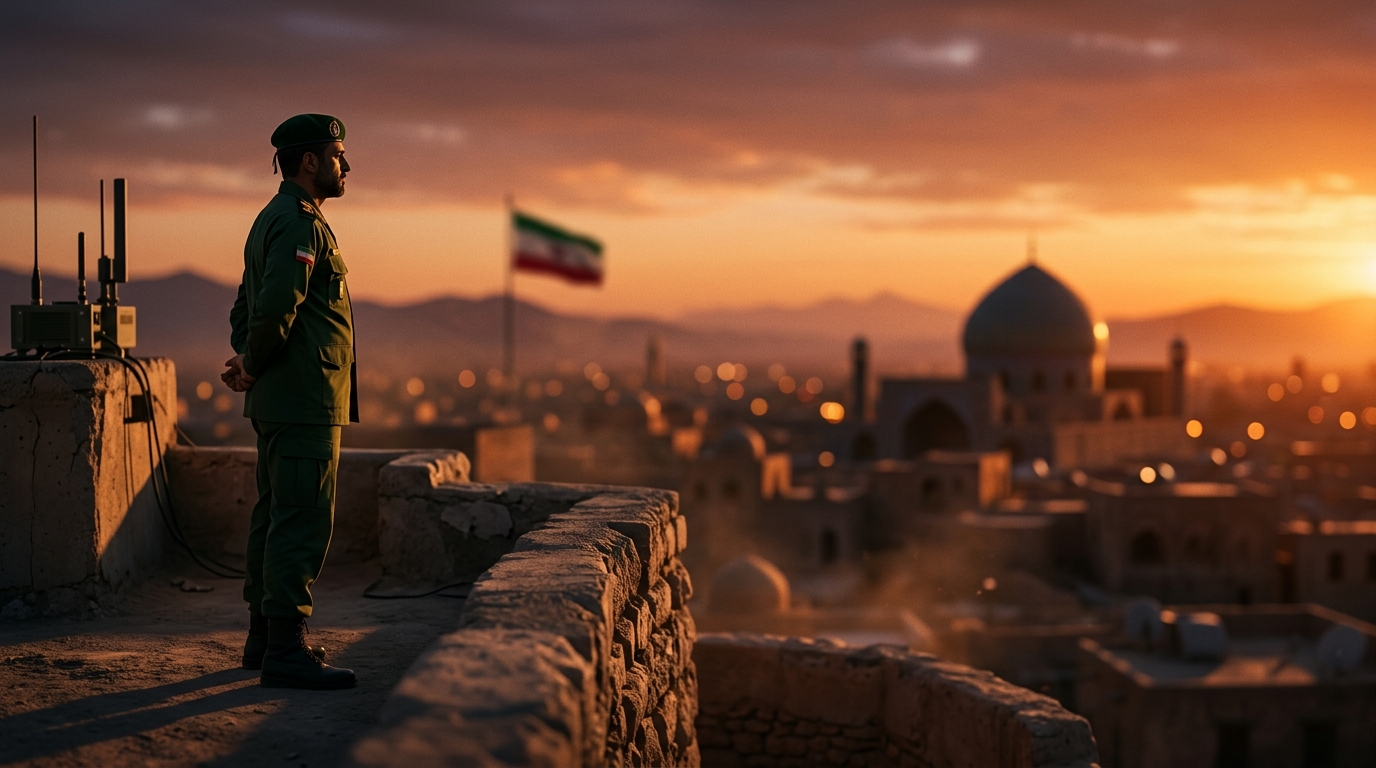
IRGC’s Central Role in Iran’s War Strategy and the ‘Axis of Resistance’ – UPSC Perspective — UPSC Current Affairs | March 10, 2026
IRGC’s Central Role in Iran’s War Strategy and the ‘Axis of Resistance’ – UPSC Perspective
The IRGC, Iran’s elite revolutionary force, has declared readiness for a prolonged war after President Trump demanded Tehran’s unconditional surrender, highlighting its central role in protecting the regime and leading the regional ‘Axis of Resistance’. For UPSC candidates, the Guard’s influence on Iran’s foreign policy, proxy wars, and control of strategic assets like the Strait of Hormuz is vital for GS 2 and GS 3 analysis.
Overview The seventh day of the U.S.–Israeli conflict with Iran saw President Donald Trump demand an unconditional surrender of Tehran, prompting the IRGC to declare full readiness for a prolonged war. The episode underscores the IRGC’s dominance over Iran’s security architecture and its leadership of the regional Axis of Resistance . Key Developments (Bullet Points) Trump’s social‑media post (6 Mar) demanded “unconditional surrender” of Iran. The IRGC issued a statement confirming preparedness for a “prolonged war”. Ali Larijani and Supreme Leader Ali Khamenei reaffirmed the Guard’s loyalty. IRGC’s overseas arm, the Quds Force , continues to back Hezbollah, Hamas, Houthis and other Shia militias. Strategic assets such as the Strait of Hormuz remain under IRGC naval patrol. Important Facts The IRGC, also called Sepah‑e‑Pasdaran , was founded by Ayatollah Khomeini to ensure loyalty of the armed forces to the theocratic system. It now commands roughly 190,000 personnel, about half the size of Iran’s regular army ( Artesh ). The Guard operates three parallel structures: a conventional army, an Basij network, and the Quds Force for external operations. Historically, the IRGC gained prominence during the 1980‑88 Iran‑Iraq war, later shaping regional conflicts: supporting Shia militias in Iraq (2003‑2011), backing President Bashar al‑Assad in Syria (2011‑2024), and fostering Hezbollah in Lebanon (since 1982). The fall of the Assad regime in December 2024 and Israel’s 2025 strikes on Iranian targets have intensified the Guard’s confrontational stance. UPSC Relevance Understanding the IRGC is essential for GS 2 (Polity & International Relations) as it illustrates how a quasi‑military institution can influence a nation’s foreign policy, proxy warfare, and internal security. The Guard’s control over strategic chokepoints like the Strait of Hormuz links to GS 3 (Economy) through global oil‑price dynamics. Its ideological roots and constitutional status are pertinent to GS 1 (History) and GS 4 (Ethics) when analysing state‑religion nexus and the use of non‑state actors in statecraft. Way Forward For policymakers, the challenge lies in balancing diplomatic pressure on Tehran with the risk of escalating a broader regional war. Strengthening maritime security in the Gulf, enhancing intelligence on IRGC proxy networks, and engaging regional partners to contain the Axis of Resistance are critical steps. Aspirants should monitor how the IRGC’s dual domestic‑foreign role shapes Iran’s strategic calculus and its implications for South‑Asian security.
Must Review
Login to bookmark articles
Login to mark articles as complete
Overview
IRGC’s dominance shapes Iran’s foreign policy and threatens global energy security
Key Facts
IRGC was created in 1979 by Ayatollah Khomeini to safeguard the Islamic Republic.
It commands roughly 190,000 personnel, about half the size of Iran’s regular army (Artesh).
The Guard operates three parallel structures: conventional forces, the Basij militia, and the Quds Force for extraterritorial operations.
Quds Force supports Hezbollah, Hamas, Houthis and Iraqi Shia militias, forming the ‘Axis of Resistance’.
IRGC naval units patrol the Strait of Hormuz, a chokepoint through which ~20% of world oil passes.
On 6 March 2025, President Donald Trump demanded Iran’s unconditional surrender; IRGC pledged readiness for a prolonged war.
Supreme Leader Ali Khamenei, a former IRGC commander, reaffirmed the Guard’s loyalty to the regime.
Background & Context
The IRGC functions as a quasi‑military institution that drives Iran’s external aggression through proxy networks, linking GS‑2 (Polity & International Relations) with GS‑3 (Economy) via control of the Strait of Hormuz. Its ideological roots and constitutional status also intersect with GS‑1 (History) and GS‑4 (Ethics) in debates on state‑religion nexus and non‑state actors in statecraft.
UPSC Syllabus Connections
GS3•Various security forces and agenciesGS4•Dimensions of ethics - private and public relationshipsEssay•Democracy, Governance and Public AdministrationEssay•Media, Communication and InformationGS2•Functions and responsibilities of Union and StatesGS1•Effects of Globalization on Indian SocietyGS2•Important international institutions and agencies
Mains Answer Angle
In a GS‑2 answer, candidates can analyse how the IRGC’s dual domestic‑foreign role shapes Iran’s foreign policy and regional security dynamics, and evaluate policy options for India and the international community.