Loading page, please wait…
HomeCurrent AffairsEditorialsGovt SchemesLearning ResourcesUPSC SyllabusPricingAboutBest UPSC AIUPSC AI ToolAI for UPSCUPSC ChatGPT

© 2026 Vaidra. All rights reserved.

PrivacyTerms
Vaidra Logo
Vaidra

Top 4 items + smart groups

UPSC GPT
New
Current Affairs
Daily Solutions
Daily Puzzle
Mains Evaluator

Version 2.0.0 • Built with ❤️ for UPSC aspirants

Myanmar Junta Chief Min Aung Hlaing Elected President – Consolidation of Military Rule — UPSC Current Affairs | April 3, 2026
Myanmar Junta Chief Min Aung Hlaing Elected President – Consolidation of Military Rule
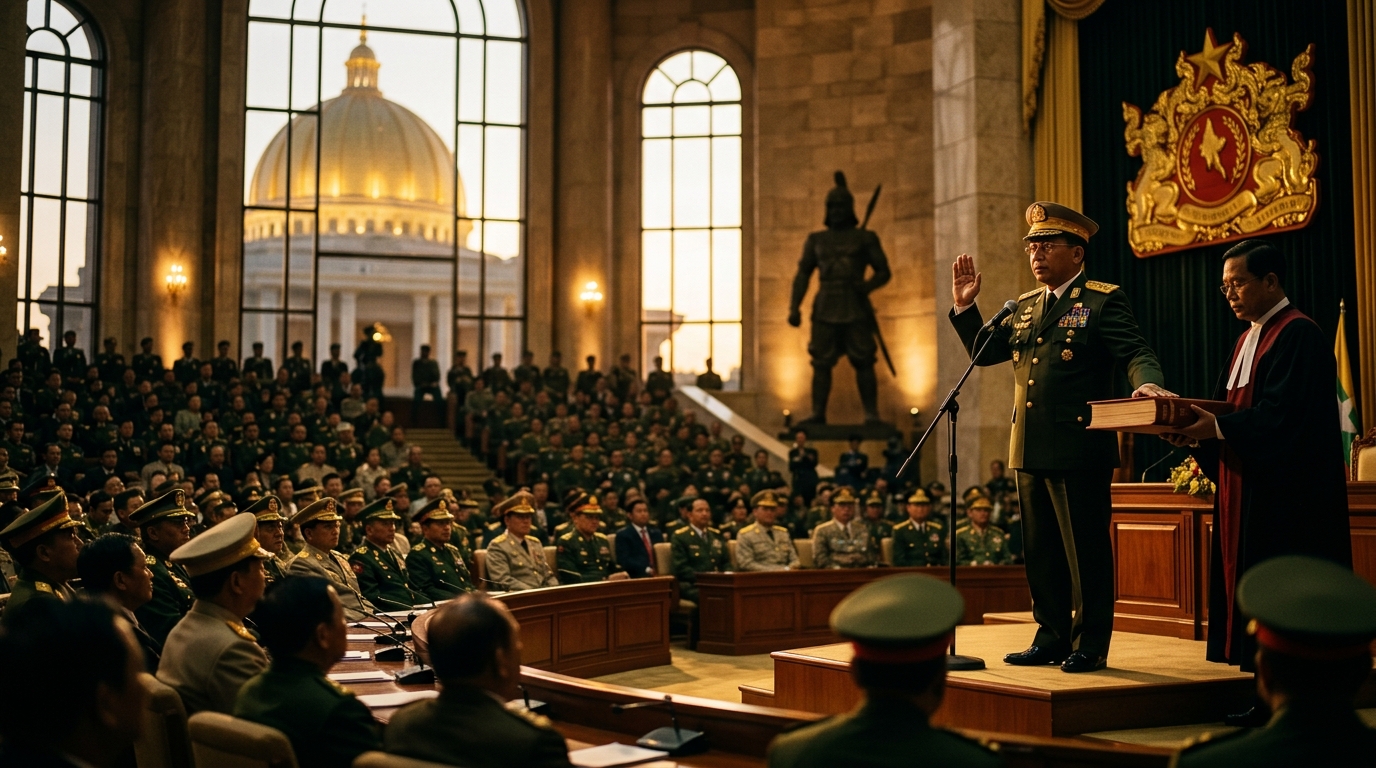
On 3 April 2026, Myanmar’s junta chief <strong>Min Aung Hlaing</strong> was elected president by a parliament dominated by the pro‑military USDP and a military‑appointed quota, cementing military rule. The move coincides with a new anti‑junta coalition and a five‑year civil war, highlighting challenges to democratic transition and regional security.
Myanmar’s Military Leader Becomes President On 3 April 2026 , the parliament of Myanmar voted to install Min Aung Hlaing , the long‑time junta chief, as the country’s president. The move formalises the military’s grip on power five years after the February 2021 coup that ousted the elected government of Nobel laureate Aung San Suu Kyi . The election that preceded the vote was widely dismissed as a sham, with the army‑backed Union Solidarity and Development Party winning a landslide. Key Developments Parliamentary vote on 3 April 2026 confirms Min Aung Hlaing as president. The legislature is dominated by the election‑winning USDP and the military’s quota of appointed legislators. During the nomination, Min Aung Hlaing appointed Ye Win Oo as the new commander‑in‑chief. Opposition forces, including remnants of the National League for Democracy and ethnic armed groups, formed the Steering Council for the Emergence of a Federal Democratic Union to challenge the regime. Analysts warn that the civil war, now in its fifth year, may intensify as the junta seeks international legitimacy amid global economic stress. Important Facts The parliamentary vote was conducted in a chamber where the military quota of legislators guaranteed a comfortable majority for the president‑elect. The election that preceded the vote, held in December 2025–January 2026 , was criticised by Western governments as a façade to perpetuate military rule. The ongoing civil war involves a patchwork of ethnic militias and pro‑democracy fighters. The newly formed coalition’s statement emphasised a goal to “completely dismantle all forms of dictatorship, including the military dictatorship, and to collectively initiate a new political landscape.” UPSC Relevance Understanding Myanmar’s power transition is vital for GS2: Polity . The case illustrates how armed forces can use constitutional mechanisms (parliamentary vote, appointed seats) to legitise authoritarian rule, a recurring theme in South‑East Asian politics. The civil war component links to GS1: History . Economic ramifications, such as fuel shortages and sanctions, tie into GS3: Economy , important for assessing regional security and development challenges. Way Forward Analysts suggest three possible trajectories: Consolidation of power: The junta may deepen civilian‑fronted governance while tightening security operations against opposition. Escalation of armed resistance: Ethnic and pro‑democracy groups could intensify their campaigns, leading to broader humanitarian crises. International pressure: Continued sanctions and diplomatic isolation might force the regime to negotiate, though economic hardships could also weaken opposition cohesion. For UPSC aspirants, tracking Myanmar’s evolving political architecture offers insights into the dynamics of hybrid regimes, the role of constitutional engineering in authoritarian resilience, and the impact of internal conflict on regional stability.
  1. Home
  2. Prepare
  3. Current Affairs
  4. Myanmar Junta Chief Min Aung Hlaing Elected President – Consolidation of Military Rule
Must Review
Login to bookmark articles
Login to mark articles as complete

Overview

Myanmar’s junta chief becomes president, cementing military rule and regional security concerns

Key Facts

  1. 3 April 2026: Myanmar parliament voted Min Aung Hlaing president.
  2. December 2025–January 2026 elections: USDP won a landslide; election dismissed as sham by Western governments.
  3. Military quota reserves 25% of parliamentary seats, guaranteeing a majority for the junta’s candidate.
  4. During the nomination, Min Aung Hlaing appointed Ye Win Oo as the new commander‑in‑chief.
  5. Opposition groups formed the Steering Council for the Emergence of a Federal Democratic Union (SCEFDU).
  6. Myanmar’s civil war entered its fifth year, with intensified ethnic‑armed resistance.
  7. Post‑election, international sanctions and diplomatic isolation on Myanmar deepened.

Background & Context

The election of Min Aung Hlaing exploits constitutional provisions—particularly the military quota—to legitimize authoritarian rule, exemplifying hybrid regimes studied in GS2 Polity. The prolonged civil war and heightened sanctions also affect regional stability and economic development, linking to GS1 History and GS3 Economy.

UPSC Syllabus Connections

Prelims_GS•Constitution and Political SystemEssay•Democracy, Governance and Public AdministrationEssay•International Relations and Geopolitics

Mains Answer Angle

GS2 Polity: Analyse how constitutional engineering, such as reserved military seats, enables authoritarian resilience in Myanmar and compare with other hybrid regimes.

Full Article

Read Original on hindu

Analysis

Practice Questions

Prelims
Easy
Prelims MCQ

Current Affairs – Myanmar political transition

1 marks
5 keywords
GS2
Medium
Mains Short Answer

Polity – Constitutional mechanisms

10 marks
5 keywords
GS2
Hard
Mains Essay

International Relations & Geopolitics – Myanmar crisis

250 marks
7 keywords
Related:Daily•Weekly

Loading related articles...

Loading related articles...

Tip: Click articles above to read more from the same date, or use the back button to see all articles.

Explore:Current Affairs·Editorial Analysis·Govt Schemes·Study Materials·Previous Year Questions·UPSC GPT