Loading page, please wait…
HomeCurrent AffairsEditorialsGovt SchemesLearning ResourcesUPSC SyllabusPricingAboutBest UPSC AIUPSC AI ToolAI for UPSCUPSC ChatGPT

© 2026 Vaidra. All rights reserved.

PrivacyTerms
Vaidra Logo
Vaidra

Top 4 items + smart groups

UPSC GPT
New
Current Affairs
Daily Solutions
Daily Puzzle
Mains Evaluator

Version 2.0.0 • Built with ❤️ for UPSC aspirants

Myanmar Parliament Nominates Junta Chief Min Aung Hlaing as Vice‑President Amid Military Leadership Change — UPSC Current Affairs | March 30, 2026
Myanmar Parliament Nominates Junta Chief Min Aung Hlaing as Vice‑President Amid Military Leadership Change
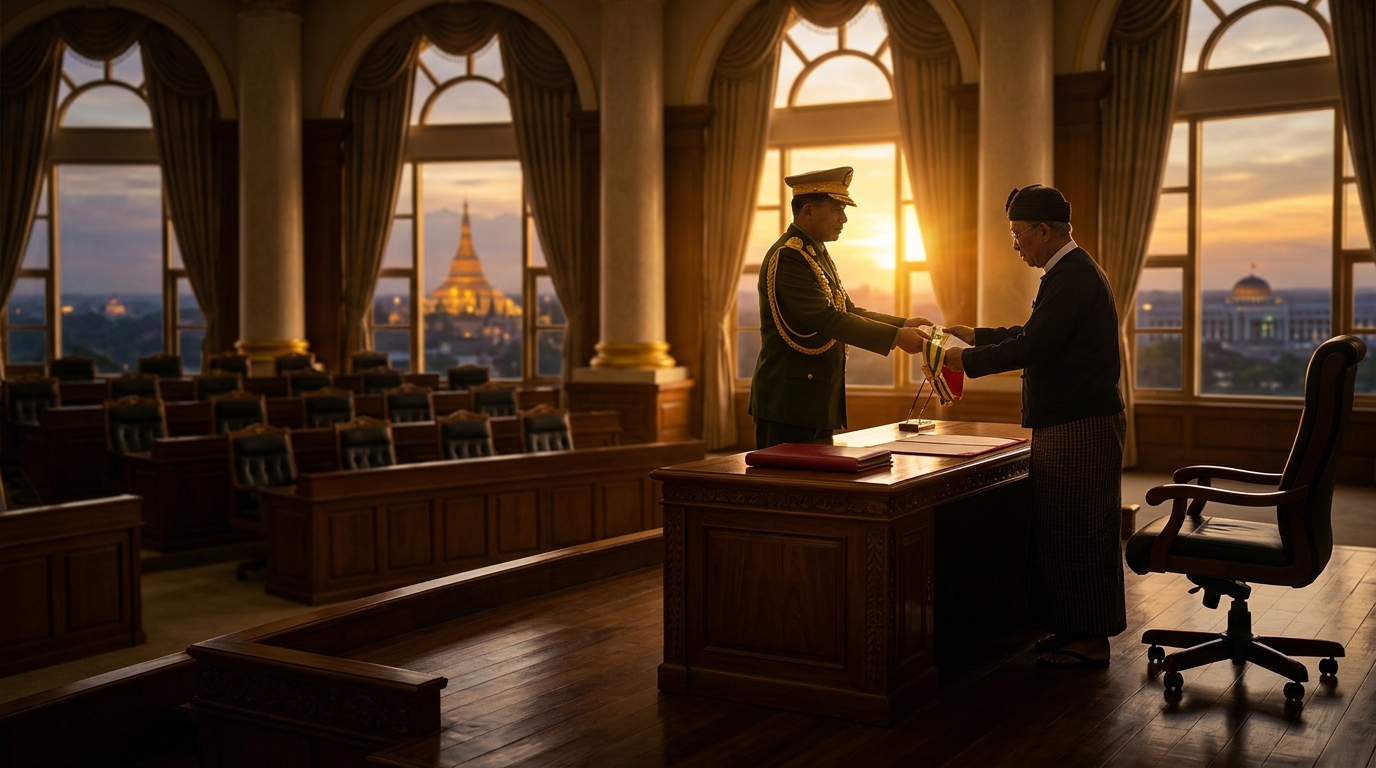
On 30 March 2026, Myanmar’s lower house MP Kyaw Kyaw Htay nominated junta chief <span class="key-term" data-definition="Min Aung Hlaing">Min Aung Hlaing</span> for Vice‑President, a move that could pave his path to the Presidency. Simultaneously, former spymaster Ye Win Oo was appointed as the new military commander‑in‑chief, indicating a strategic reshuffle within the junta.
Myanmar’s Political Shuffle: Junta Chief Nominated for Vice‑President On 30 March 2026 , the lower house of Myanmar’s parliament witnessed a pivotal move when MP Kyaw Kyaw Htay nominated Min Aung Hlaing for the post of Vice‑President . The nomination signals an attempt by the junta to retain power under a civilian façade. Key Developments (30 March 2026) MP Kyaw Kyaw Htay formally nominated Min Aung Hlaing as a candidate for Vice‑President during a live broadcast of the lower house session. Myanmar’s constitution mandates three Vice‑Presidents; one of them is later elected as President . In a parallel development, the State Administration Council appointed former spymaster Ye Win Oo as the new military commander‑in‑chief at a ceremony in Naypyidaw . Important Facts The nomination does not guarantee election; the President is chosen by a vote among the three Vice‑Presidents and the military‑appointed members of parliament. The replacement of Min Aung Hlaing as the top military officer, while he remains a Vice‑Presidential candidate, reflects a strategic reshuffle aimed at diffusing internal dissent within the armed forces. UPSC Relevance Understanding Myanmar’s power structure is essential for GS 2 (Polity) and GS 1 (International Relations). The case illustrates: How military regimes use constitutional mechanisms to legitimize rule. The role of the lower house in a hybrid parliamentary system. Implications for regional security and India’s neighbourhood policy, given Myanmar’s strategic location. Way Forward Analysts anticipate that the parliament will likely endorse the nomination, enabling Min Aung Hlaing to assume the Presidency while retaining de‑facto control through the military hierarchy. Observers will watch for any opposition from civilian parties or international pressure that could alter the trajectory of Myanmar’s political transition.
  1. Home
  2. Prepare
  3. Current Affairs
  4. Myanmar Parliament Nominates Junta Chief Min Aung Hlaing as Vice‑President Amid Military Leadership Change
Login to bookmark articles
Login to mark articles as complete

Overview

Myanmar’s junta uses constitutional Vice‑Presidency to cement military rule

Key Facts

  1. 30 March 2026: MP Kyaw Kyaw Htay nominated Senior General Min Aung Hlaing for Vice‑President in the lower house.
  2. Myanmar’s Constitution (Article 59) mandates three Vice‑Presidents; one is later elected President by the Vice‑Presidents and military‑appointed MPs.
  3. On the same day, former spymaster Ye Win Oo was appointed as the new military commander‑in‑chief, replacing Min Aung Hlaing.
  4. The nomination seeks to give the junta a civilian façade while Min Aung Hlaing retains de‑facto control as head of the State Administration Council.
  5. If elected President, Min Aung Hlaing would combine the highest civilian office with his role as the top military commander.
  6. International observers, including India, have warned that the move deepens militarisation of Myanmar’s political institutions.

Background & Context

The episode illustrates how a military regime exploits constitutional provisions to legitimize its rule, a key theme under GS 2’s separation of powers and executive structure. It also highlights the hybrid nature of Myanmar’s polity, where elected bodies coexist with a powerful armed forces apparatus, affecting regional security and India’s neighbourhood policy.

UPSC Syllabus Connections

GS2•Executive and Judiciary - structure, organization and functioning

Mains Answer Angle

GS 2 (Polity) – Analyse how constitutional mechanisms are employed by military regimes to sustain power and discuss the implications for democratic consolidation in Myanmar.

Full Article

Read Original on hindu

Analysis

Practice Questions

GS2
Easy
Prelims MCQ

Constitutional provisions – Executive

1 marks
3 keywords
GS2
Medium
Mains Short Answer

Civil‑military relations

5 marks
4 keywords
GS2
Hard
Mains Essay

Democratic consolidation and militarisation

20 marks
5 keywords
Related:Daily•Weekly

Loading related articles...

Loading related articles...

Tip: Click articles above to read more from the same date, or use the back button to see all articles.

Explore:Current Affairs·Editorial Analysis·Govt Schemes·Study Materials·Previous Year Questions·UPSC GPT