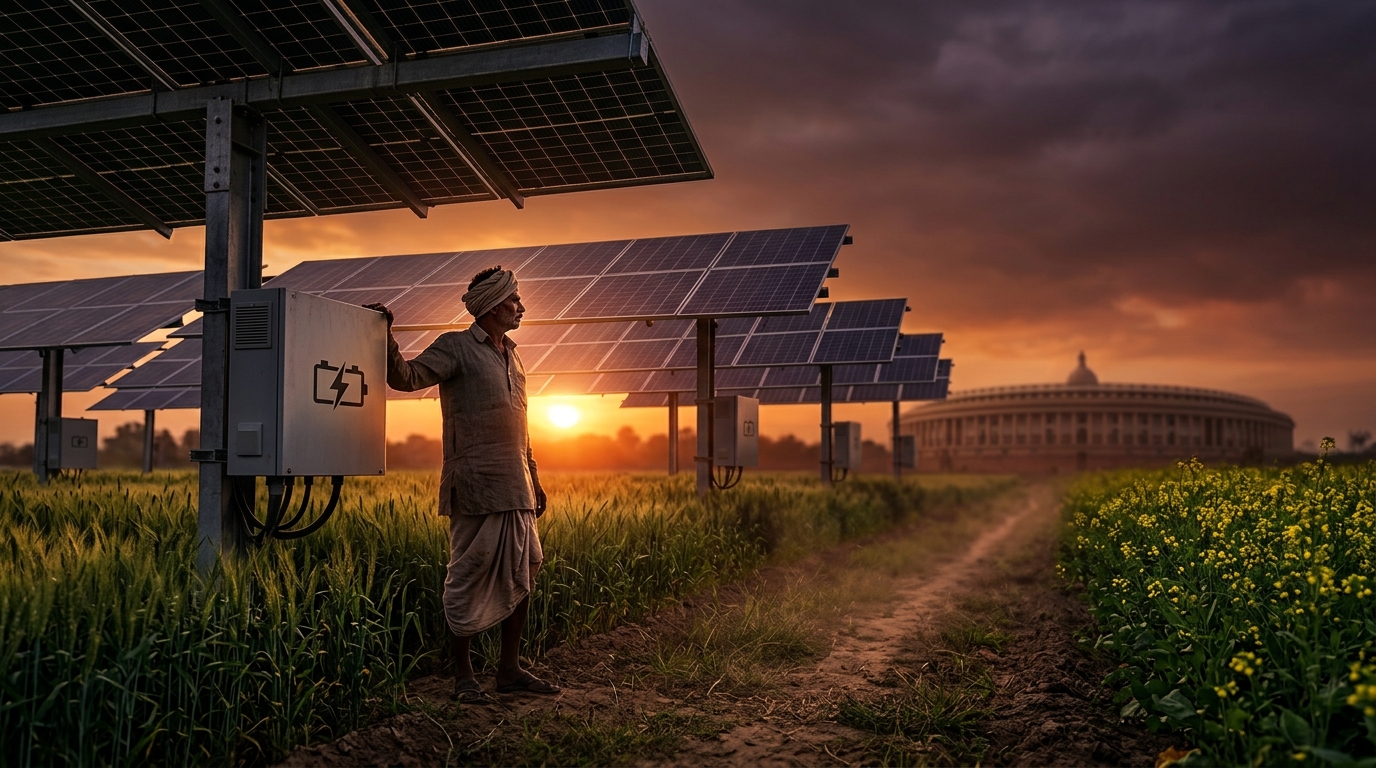
Written by: Khushboo Kumari7 min readNew DelhiUpdated: Apr 1, 2026 12:53 PM ISTDirect questions have been asked on government schemes. In this regard, learn about the proposed PM KUSUM 2.0 scheme. (AI-generated image)Make us preferred source on GoogleWhatsapptwitterFacebookRedditPRINTTake a look at the essential concepts, terms, quotes, or phenomena every day and brush up your knowledge. Here’s your knowledge nugget on PM KUSUM scheme.
Knowledge Nugget: PM KUSUM
Subject: Schemes and policies
(Relevance: Direct questions have been asked on government schemes. Since the government has set a target of enhancing India’s solar energy capacity. In this regard, it is important to understand this scheme and what the new components are to be added to the scheme.)
Why in the news?
The centre is considering incorporating a new provision for battery energy storage in the revamped Pradhan Mantri Kisan Urja Suraksha evam Utthaan Mahabhiyaan (PM KUSUM) scheme, as it works on formulating a new version of the flagship programme, The Indian Express has learnt.
Key takeaways:
1. Launched in 2019, this scheme promotes the installation of small grid-connected solar power plants, standalone solar pumps, and solarisation of existing grid-connected pumps in rural areas.UPSC ESSENTIALS
Climate goal targets
India has promised to ensure that at least 60 per cent of its total electricity generation capacity would comprise non-fossil fuel sources by 2035, as per India’s third nationally-determined contribution (NDCs) submitted last year. Also, at COP-26, the Government has set a target of 500 GW Non-fossil energy capacity by 2030. PM KUSUM scheme has been consistently positioned as a key pillar of its clean energy transition and reaching these targets.2. The scheme allows farmers not only to use solar power for their own needs but also, in certain cases, to earn by selling surplus electricity. This dual benefit, energy access and income generation, sets it apart from earlier agricultural power initiatives.
.infographic-kusum{font-family:"Roboto",sans-serif;margin-bottom:25px;max-width:640px;background:#fff;border-radius:10px;overflow:hidden;border:1px solid #e2e8f0;}
.infographic-kusum__header{background:#2cᒢpadding:16px 20px;}
.infographic-kusum__title{font-size:15px;font-weight:700;color:#fff;line-height:1.4;margin:0;}
.infographic-kusum__subtitle{font-size:12px;color:#bee3f8;margin-top:3px;}
.infographic-kusum__hero{background:#1a365d;padding:14px 20px;display:flex;align-items:flex-start;justify-content:space-between;flex-wrap:wrap;gap:10px;}
.infographic-kusum__hero-number{font-size:32px;font-weight:700;color:#ffd700;line-height:1.1;}
.infographic-kusum__hero-unit{font-size:16px;font-weight:400;color:#bee3f8;}
.infographic-kusum__hero-label{font-size:12px;color:#bee3f8;}
.infographic-kusum__hero-target{font-size:22px;font-weight:700;color:#fcline-height:1.1;}
.infographic-kusum__hero-target-unit{font-size:14px;font-weight:400;color:#bee3f8;}
.infographic-kusum__hero-target-label{font-size:12px;color:#bee3f8;text-align:right;}
.infographic-kusum__progress-wrap{background:#1a365d;padding:0 20px 12px;}
.infographic-kusum__progress-bar{background:#2dheight:8px;border-radius:4px;overflow:hidden;}
.infographic-kusum__progress-fill{width:35%;height:100%;background:#ffd700;border-radius:4px;}
.infographic-kusum__progress-label{font-size:11px;color:#bee3f8;margin-top:5px;}
.infographic-kusum__body{padding:16px 20px;}
.infographic-kusum__section-tag{font-size:11px;font-weight:700;color:#71ᾠtext-transform:uppercase;letter-spacing:0.6px;margin-bottom:12px;}
.infographic-kusum__grid{display:grid;grid-template-columns:repeat(2,1fr);gap:12px;}
.infographic-kusum__card{padding:13px;border-radius:0 6px 6px 0;border-left:4px solid;}
.infographic-kusum__card--a{background:#ebf8ff;border-color:#2cᒢ}
.infographic-kusum__card--b{background:#f0fff4;border-color:#2f855a;}
.infographic-kusum__card--c{background:#fffaf0;border-color:#c0ᗵgrid-column:1/-1;}
.infographic-kusum__card-tag{font-size:11px;font-weight:700;text-transform:uppercase;letter-spacing:0.5px;margin-bottom:5px;}
.infographic-kusum__card-tag--a{color:#2cᒢ}
.infographic-kusum__card-tag--b{color:#2f855a;}
.infographic-kusum__card-tag--c{color:#c0ᗵ}
.infographic-kusum__card-desc{font-size:12px;color:#2dline-height:1.4;margin-bottom:8px;}
.infographic-kusum__card-number{font-size:22px;font-weight:700;line-height:1.1;}
.infographic-kusum__card-number--a{color:#2cᒢ}
.infographic-kusum__card-number--b{color:#2f855a;}
.infographic-kusum__card-sub{font-size:11px;color:#4aᗀmargin-top:3px;}
.infographic-kusum__c-grid{display:grid;grid-template-columns:repeat(2,1fr);gap:10px;margin-top:10px;}
.infographic-kusum__c-sub{background:#fff;border-radius:5px;padding:10px;border:0.5px solid #fbd38d;}
.infographic-kusum__c-sub-tag{font-size:11px;font-weight:700;color:#c0ᗵtext-transform:uppercase;letter-spacing:0.5px;}
.infographic-kusum__c-sub-name{font-size:11px;color:#2dmargin:3px 0 6px;}
.infographic-kusum__c-sub-number{font-size:18px;font-weight:700;color:#c0ᗵline-height:1.1;}
.infographic-kusum__c-sub-note{font-size:11px;color:#4aᗀmargin-top:2px;}
.infographic-kusum__source{padding:7px 20px;font-size:11px;color:#71ᾠbackground:#f7fafc;border-top:1px solid #e2e8f0;}
.infographic-kusum__branding{background:#3Cᇍpadding:10px 20px;text-align:center;}
.infographic-kusum__branding-text{font-size:13px;font-weight:700;color:#ffd700;}
@media(max-width:480px){.infographic-kusum__hero{flex-direction:column;gap:6px;}.infographic-kusum__hero-target-label{text-align:left;}}PM KUSUM: Component-wise Performance
Installed capacity as of February 2026 · Target: March 2026Total installed capacity
12,164 MWOverall target
34,800 MW35% of target achievedThree componentsComponent A
Decentralised solar power plants
839.4 MW
Grid-connected solar plantsComponent B
Standalone solar pumps (off-grid)
10 Lakh+
Agricultural pumps installedComponent C
Solarisation of grid-connected agricultural pumpsIPS
Individual pump solarisation
12,787+
Pumps solarised individuallyFLS
Feeder-level solarisation
13 Lakh+
Pumps · 6,636.9 MW installedSource: Ministry of Power & MNRE, Parliament data
Express InfoGenIE3. With the focus on promoting solarisation in the agricultural sector, It aimed to add Solar capacity of 34,800 MW by March 2026. As of February 2026, a total of 12,164 MW capacity has been installed under the scheme. It consisted of three components:
Component A: setting up of decentralised solar power plants
Component B: installing standalone solar pumps in off-grid areas
Component C: solarising grid-connected agricultural pumps
4. Under Component C, the Centre supports both individual pump solarisation (IPS) and feeder-level solarisation (FLS). While IPS enables farmers with grid-connected agricultural pumps to solarise their individual units, FLS allows states to solarise entire agricultural feeders instead of individual pumps.Story continues below this ad
Don't miss | UPSC Current Affairs Pointers of the past week (March 23–29, 2026) | What every aspirant must know for Prelims exam
5. As per the data provided by the Ministry of Power and the Ministry of New and Renewable Energy (MNRE) in the parliament, 839.4 MW of capacity has been installed under Component A. Under Component B, over 10 lakh standalone agricultural pumps have been installed. Under Component C, over 12,787 pumps have been solarised through IPS, while feeder-level solarisation has covered over 13 lakh pumps, with a total installed capacity of 6,636.9 MW.
Objective of the PM-KUSUM scheme
→ Reliable energy source for farmers for irrigation by decreasing the dependence on diesel and irregular grid energy
→ Income generation for farmers through solar power generation, surplus electricity sales, and land leasing opportunities.
→ Move towards clean energy by reducing diesel use and fulfilling the goal of the Paris Agreement. This leads to a reduction in the CO2 emissions from agriculture. As per the third NDCs, India has promised to attain at least a 47 per cent reduction in the emission intensity of its GDP (emission per unit of GDP) from the 2005 baseline by 2035.Story continues below this ad
→ Reduce the agriculture electricity subsidy burden on states by improving the financial health of DISCOMS. Subsidy on account of agricultural electricity production has burdened the State’s exchequer.
→ Reducing the import bills by reducing the diesel consumption, which in turn reduced the import bill on account of petroleum products.
Rationale for New Battery Storage Provisions
Agricultural demand rises in the morning, remaining steady throughout the day, and declines after sunset. In contrast, solar generation gradually increases during the day, peaks around noon, and tapers off thereafter. This misalignment has posed operational challenges for power distribution and grid management.
ALSO READ | Knowledge Nugget | RBI Foundation Day Special: History, new initiatives, and rupee stabilisation
The proposed battery storage component is expected to bridge this gap by storing surplus solar power generated during peak hours and supplying it when demand persists but generation falls. Discussions on the design of the scheme are ongoing.
Agri-PV componentStory continues below this ad
While addressing the 4th National Agro-RE Summit, Union Minister of New & Renewable Energy Shri Pralhad Joshi informed that the government may include a dedicated 10 GW Agri-PV component in PM-KUSUM 2.0 to promote the co-location of solar panels with crops.
Agriphotovoltaics (Agriphotovoltaics), the co-location of solar power generation and agricultural activity, offers an initiative to utilize the same agricultural land for generating electricity while continuing agricultural activities, creating a new model for decentralised renewable energy generation in rural India.
BEYOND THE NUGGET: Key schemes to achieve renewable energy targets
📌PM Surya Ghar: Muft Bijli Yojana: Launched in February, 2024, the initiative, aims to install rooftop solar panels in 1 crore households and provide up to 300 units of free electricity per month. The scheme offers substantial subsidies: ₹30,000 per kW for up to 2 kW, ₹18,000 per kW for additional capacity up to 3 kW, and a total subsidy capped at ₹78,000. As of March 2026, more than 31 lakh households have already benefited from rooftop solar installations under the scheme, enabling families to generate their own electricity and reduce electricity bills.
📌New Solar Power Scheme (for PVTG Habitations/Villages) under PM JANMAN: Pradhan Mantri Janjati Adivasi Nyaya Maha Abhiyan (PM JANMAN) is being implemented through nine line ministries and focuses on eleven critical interventions for Particularly Vulnerable Tribal Groups (PVTGs). One of these interventions is the New Solar Power Scheme (for PVTG Habitations/Villages), which aims to electrify one lakh un‑electrified PVTG households by providing off‑grid solar systems in areas where grid‑based electricity supply is not techno‑economically feasible.Story continues below this ad
📌Development of Solar Parks and Ultra Mega Solar Power: Initiated in December 2014, this programme aims to facilitate solar project developers in setting up projects expeditiously. This initiative helps in establishing “transmission infrastructure, road, water, drainage, communication network etc., with all statutory clearances” for the rapid development of solar energy projects.
Post Read Question
The objective of the PM KUSUM scheme (66th BPSC)
(a) to reduce farmers’ dependence on monsoon for irrigation
(b) to reduce farmers’ dependence on moneylenders for credit
(c) promotion of floriculture in India
(d) to remove farmers’ dependence on diesel and kerosene and to link pump sets to solar energy
(e) None of the above/More than one of the aboveStory continues below this adAnswer key(d)(Sources: India making strides in advancing renewable energy, pmsuryaghar.gov.in)
Subscribe to our UPSC newsletter. Stay updated with the latest UPSC articles by joining our Telegram channel – IndianExpress UPSC Hub, and follow us on Instagram and X.
🚨 Click Here to read the UPSC Essentials magazine for March 2026. Share your views and suggestions in the comment box or at [email protected]🚨ExpandKhushboo KumariKhushboo Kumari is a Deputy Copy Editor with The Indian Express. She has done her graduation and post-graduation in History from the University of Delhi. At The Indian Express, she writes for the UPSC section. She holds experience in UPSC-related content development. You can contact her via email: [email protected]... Read More© IE Online Media Services Pvt LtdTags:central schemesCurrent Affairsgovernment jobsSarkari NaukriUPSCUPSC Civil ServicesUPSC Civil Services ExamUPSC Essentials
Loading page, please wait…