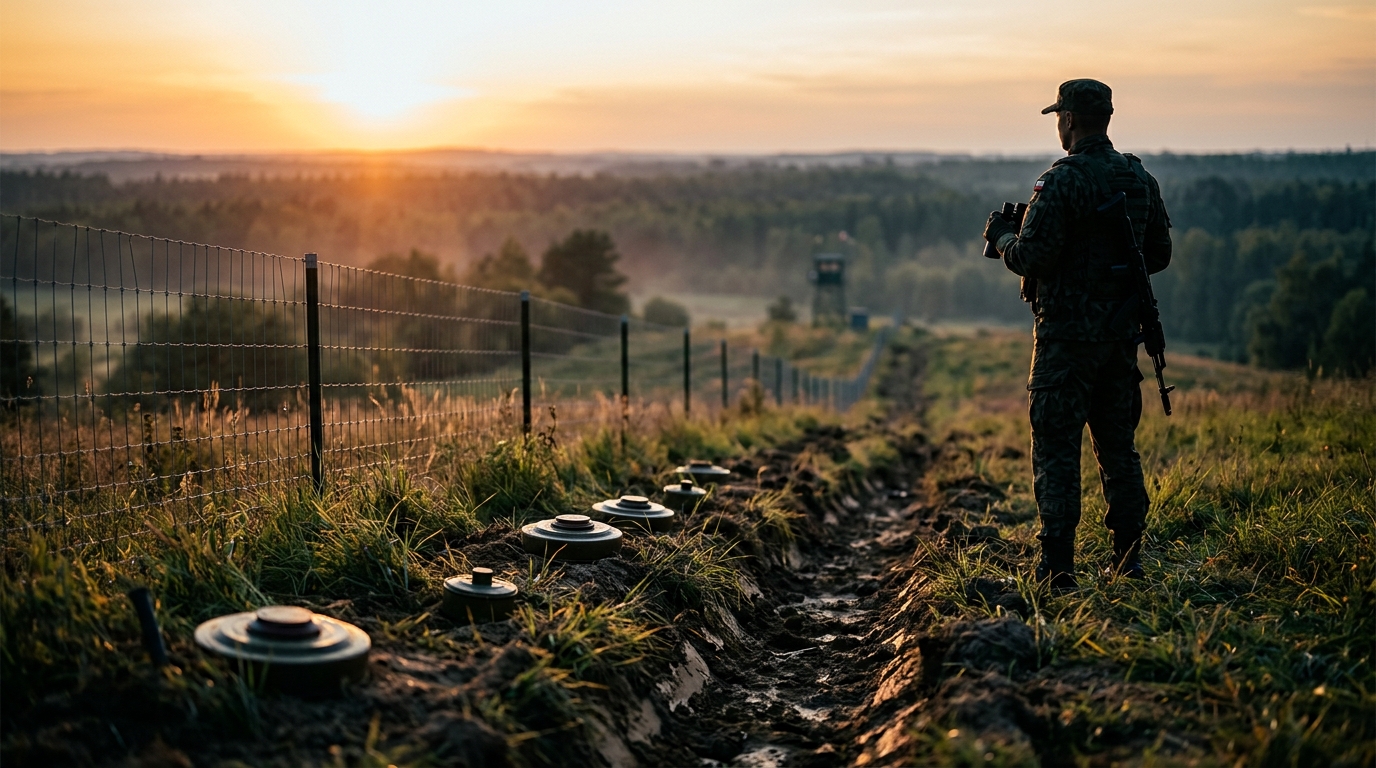
<h3>Overview</h3>
<p>On <strong>20 February 2026</strong>, the <span class="key-term" data-definition="Poland — Central European NATO member state sharing a border with Belarus and Ukraine; its security policies are relevant to GS2: Polity and GS1: International Relations.">Poland</span> ने घोषणा की कि वह अपने <span class="key-term" data-definition="eastern border — The frontier of Poland adjoining Belarus and the Russian‑controlled Kaliningrad enclave, a strategic frontier in NATO’s eastern flank (GS2: Polity).">eastern border</span> पर <span class="key-term" data-definition="Anti‑personnel mine — Explosive device designed to detonate by the presence, proximity or contact of a person; a humanitarian concern under international law (GS3: Security).">anti‑personnel mines</span> और <span class="key-term" data-definition="Anti‑tank mine — Land mine specifically engineered to destroy or disable armored vehicles; used in conventional warfare (GS3: Security).">anti‑tank mines</span> दोनों तैनात करेगा ताकि <span class="key-term" data-definition="Russia — Federation of Russia, a major geopolitical actor whose actions in Eastern Europe influence regional security (GS1: International Relations).">Russia</span> से “बढ़ते खतरे” का मुकाबला किया जा सके। यह निर्णय Poland के <span class="key-term" data-definition="Ottawa Convention — Common name for the 1997 Anti‑Personnel Mine Ban Treaty that bans the use, stockpiling and transfer of antipersonnel mines; a key instrument in arms control (GS3: International Relations).">Ottawa Convention</span> से औपचारिक निकास के साथ मेल खाता है, जो एक प्रमुख हथियार नियंत्रण संधि है।</p>
<h3>Key Developments</h3>
<ul>
<li>Poland अपने border defence architecture में antipersonnel और anti‑tank mines को एकीकृत करेगा।</li>
<li>यह कदम <span class="key-term" data-definition="Deputy Defence Minister — Senior official in the Ministry of Defence responsible for policy implementation; relevant to GS2: Polity.">Deputy Defence Minister</span> ने Associated Press को बताया।</li>
<li>Poland ने आधिकारिक रूप से <strong>1997 Anti‑Personnel Mine Ban Treaty</strong> से वापसी की, जिससे इस संधि के तहत उसकी बाध्यताएँ समाप्त हो गईं।</li>
<li>यह निर्णय क्षेत्र में <span class="key-term" data-definition="Russia — Federation of Russia, a major geopolitical actor whose actions in Eastern Europe influence regional security (GS1: International Relations).">Russia</span> की कार्रवाइयों के बाद बढ़ती सुरक्षा चिंताओं को दर्शाता है।</li>
</ul>
<h3>Important Facts</h3>
<ul>
<li>1997 Anti‑Personnel Mine Ban Treaty (Ottawa Convention) हस्ताक्षरकर्ताओं को antipersonnel mines के उपयोग, उत्पादन और स्थानांतरण को रोकने के लिए बाध्य करता है।</li>
<li>जिन देशों को माइन प्रदूषण से नुकसान हुआ है, उनमें <em>Cambodia, Angola and Bosnia and Herzegovina</em> शामिल हैं, जो दीर्घकालिक मानवीय प्रभाव को दर्शाते हैं।</li>
<li>Antipersonnel mines दशकों तक सक्रिय रह सकती हैं, जिससे संघर्ष समाप्त होने के बाद भी नागरिकों को जोखिम रहता है।</li>
<li>Poland का इस संधि से बाहर निकलना NATO सदस्य के लिए व्यापक समर्थन वाले निरस्त्रीकरण व्यवस्था से बाहर निकलने का एक दुर्लभ उदाहरण है।</li>
</ul>
<h3>UPSC Relevance</h3>
<p>यह घटना कई GS पेपरों को छूती है।</p>