Loading page, please wait…
HomeCurrent AffairsEditorialsGovt SchemesLearning ResourcesUPSC SyllabusPricingAboutBest UPSC AIUPSC AI ToolAI for UPSCUPSC ChatGPT

© 2026 Vaidra. All rights reserved.

PrivacyTerms
Vaidra Logo
Vaidra

Top 4 items + smart groups

UPSC GPT
New
Current Affairs
Daily Solutions
Daily Puzzle
Mains Evaluator

Version 2.0.0 • Built with ❤️ for UPSC aspirants

SHANTI Act 2025: Opening India’s Nuclear Power to Private Players to Reach 100 GW by 2047 — UPSC Current Affairs | April 6, 2026
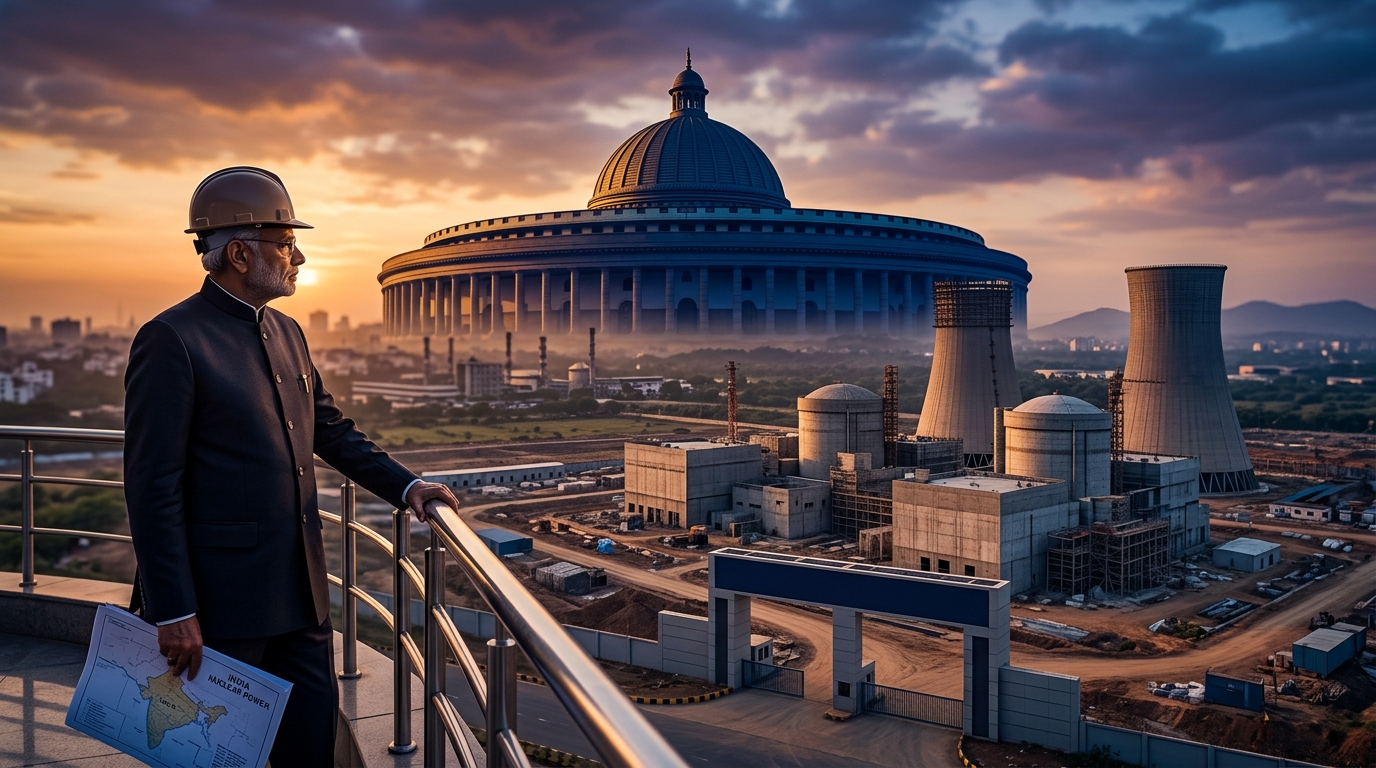
SHANTI Act 2025: Opening India’s Nuclear Power to Private Players to Reach 100 GW by 2047
The 2025‑26 Budget introduced the <span class="key-term" data-definition="Sustainable Harnessing and Advancement of Nuclear Energy for Transforming India Act — a 2025 legislation that opens India’s nuclear power sector to private participation and revises liability rules (GS2: Polity)">SHANTI Act</span>, aiming to boost installed nuclear capacity from 8.2 GW to 100 GW by 2047. Achieving this requires private investment, indigenisation of reactor designs, development of <span class="key-term" data-definition="Small Modular Reactors — compact nuclear reactors (typically < 300 MW) that can be factory‑built and deployed faster, crucial for decentralised power and UPSC energy security topics (GS3: Economy)">SMRs</span>, and a robust regulatory framework.
Background In the 2025‑26 Budget , Finance Minister Nirmala Sitharaman announced an ambitious target: raise India’s installed nuclear capacity from 8,180 MW to 100 GW by 2047 . To realise this, the government fast‑tracked the SHANTI Act , which repealed the 1962 Atomic Energy Act and the 2010 CLNDA . Key Developments (December 2025) Private companies can now build, own and operate nuclear power plants. The AERB gains statutory status, enhancing oversight. Liability framework revised to attract domestic and foreign investors. Repeal of the 1962 Atomic Energy Act and 2010 CLNDA . Important Facts • As of June 2025, India’s total generation capacity stood at 476 GW , with 50 % non‑fossil (renewables 227 GW + nuclear 8.8 GW). • Renewable generation contributed 403 TWh (22 % of total 1,824 TWh), while thermal (coal) supplied 75 % of electricity. • Nuclear’s share was only 3 % of generation despite 1.8 % of capacity, reflecting its baseload role. • To meet the Viksit Bharat goal, total capacity must exceed 2,000 GW . • Current nuclear fleet: 24 plants (NPCIL) totalling 8,780 MW . Designs include PHWR (220‑700 MW), BWR , and Russian VVERs. UPSC Relevance The shift from a state‑monopoly to a mixed‑ownership model touches on GS2: Polity (legislative reforms, regulatory autonomy) and GS3: Economy (energy security, investment climate, net‑zero commitments). Understanding the liability changes and the role of the AERB is crucial for questions on governance of strategic sectors. The nuclear‑energy push also links to climate‑change targets (net‑zero by 2070) and the broader energy‑mix strategy, a frequent GS3 theme. Way Forward Indigenise foreign designs (EDF, Westinghouse) to achieve cost parity with China’s reactors. Accelerate R&amp;D for SMRs , especially molten‑salt and thorium‑based concepts. Develop financing models that balance high upfront capital with low‑cost long‑term operation (e.g., public‑private partnerships, sovereign guarantees). Revise exclusion‑zone rules to allow single‑unit captive reactors for industries with high power demand. Finalize tariffs, fuel‑ownership, waste‑management and insurance frameworks to provide regulatory certainty. Only with clear rules, robust financing and a domestic supply chain can the SHANTI Act deliver the promised 100 GW nuclear capacity and support India’s Viksit Bharat and net‑zero aspirations.
  1. Home
  2. Prepare
  3. Current Affairs
  4. SHANTI Act 2025: Opening India’s Nuclear Power to Private Players to Reach 100 GW by 2047
Login to bookmark articles
Login to mark articles as complete

Overview

gs.gs379% UPSC Relevance

Private nuclear power drives India's 100 GW target, reshaping energy security and governance

Key Facts

  1. SHANTI Act 2025 repeals the Atomic Energy Act (1962) and CLNDA (2010), permitting private firms to build, own and operate nuclear power plants.
  2. The Union Budget 2025‑26 sets a target of expanding nuclear capacity from ~8,180 MW (24 plants, 8,780 MW) to 100 GW by 2047.
  3. Atomic Energy Regulatory Board (AERB) is granted statutory status under the Act, strengthening safety oversight.
  4. Liability provisions are overhauled to limit operator liability and introduce insurer pools, aiming to attract domestic and foreign investment.
  5. As of June 2025, nuclear generated only 3 % of electricity despite 1.8 % of installed capacity; total national capacity stood at 476 GW with 50 % non‑fossil.
  6. Viksit Bharat vision requires total generation capacity >2,000 GW by 2047, making nuclear a key baseload component.
  7. Policy roadmap includes indigenising foreign reactor designs, fast‑track SMR deployment, PPP financing models, and clear tariff‑waste‑insurance frameworks.

Background & Context

The SHANTI Act marks a paradigm shift from a state‑monopoly to a mixed‑ownership model, aligning with GS2 (Polity) reforms on legislative autonomy and regulatory independence, while GS3 (Economy) themes of energy security, investment climate and net‑zero commitments are reinforced. Environmentally, scaling nuclear to 100 GW supports India's climate‑change mitigation targets by diversifying the clean‑energy mix.

UPSC Syllabus Connections

GS3•Infrastructure - Energy, Ports, Roads, Airports, RailwaysPrelims_GS•Physics and Chemistry in Everyday LifePrelims_GS•Environmental Issues and Climate ChangeGS1•Distribution of Key Natural ResourcesEssay•Economy, Development and InequalityGS3•Government BudgetingPrelims_GS•National Current AffairsPrelims_CSAT•Basic NumeracyEssay•Environment and SustainabilityGS2•Development processes - role of NGOs, SHGs and stakeholders

Mains Answer Angle

GS3 – Discuss the implications of opening the nuclear sector to private players for India's energy security, investment climate and climate‑change goals, evaluating both opportunities and challenges.

Full Article

<h2>Background</h2> <p>In the <strong>2025‑26 Budget</strong>, Finance Minister <strong>Nirmala Sitharaman</strong> announced an ambitious target: raise India’s installed nuclear capacity from <strong>8,180 MW</strong> to <strong>100 GW</strong> by <strong>2047</strong>. To realise this, the government fast‑tracked the <span class="key-term" data-definition="Sustainable Harnessing and Advancement of Nuclear Energy for Transforming India Act — a 2025 legislation that opens India’s nuclear power sector to private participation and revises liability rules (GS2: Polity)">SHANTI Act</span>, which repealed the 1962 <span class="key-term" data-definition="Atomic Energy Act — the original law governing all nuclear activities in India, placing them under the exclusive control of the Department of Atomic Energy (GS2: Polity)">Atomic Energy Act</span> and the 2010 <span class="key-term" data-definition="Civil Liability for Nuclear Damage Act — law that defines liability for nuclear accidents, previously limiting private investment (GS2: Polity)">CLNDA</span>. </p> <h3>Key Developments (December 2025)</h3> <ul> <li>Private companies can now <em>build, own and operate</em> nuclear power plants.</li> <li>The <span class="key-term" data-definition="Atomic Energy Regulatory Board — the statutory regulator for nuclear safety and security in India (GS2: Polity)">AERB</span> gains statutory status, enhancing oversight.</li> <li>Liability framework revised to attract domestic and foreign investors.</li> <li>Repeal of the 1962 <span class="key-term" data-definition="Atomic Energy Act — the original law governing all nuclear activities in India, placing them under the exclusive control of the Department of Atomic Energy (GS2: Polity)">Atomic Energy Act</span> and 2010 <span class="key-term" data-definition="Civil Liability for Nuclear Damage Act — law that defines liability for nuclear accidents, previously limiting private investment (GS2: Polity)">CLNDA</span>.</li> </ul> <h3>Important Facts</h3> <p>• As of June 2025, India’s total generation capacity stood at <strong>476 GW</strong>, with <strong>50 % non‑fossil</strong> (renewables 227 GW + nuclear 8.8 GW).<br> • Renewable generation contributed <strong>403 TWh</strong> (22 % of total 1,824 TWh), while thermal (coal) supplied <strong>75 %</strong> of electricity. </p> <p>• Nuclear’s share was only <strong>3 %</strong> of generation despite <strong>1.8 %</strong> of capacity, reflecting its baseload role. </p> <p>• To meet the <span class="key-term" data-definition="Viksit Bharat — the vision of a fully developed India by 2047, the 100‑year anniversary of independence (GS1: History)">Viksit Bharat</span> goal, total capacity must exceed <strong>2,000 GW</strong>. </p> <p>• Current nuclear fleet: <strong>24 plants</strong> (NPCIL) totalling <strong>8,780 MW</strong>. Designs include <span class="key-term" data-definition="Pressurised Heavy Water Reactor — India’s indigenous reactor type using heavy water as moderator and natural uranium as fuel (GS3: Economy)">PHWR</span> (220‑700 MW), <span class="key-term" data-definition="Boiling Water Reactor — a reactor where water boils inside the core to generate steam directly (GS3: Economy)">BWR</span>, and Russian VVERs. </p> <h3>UPSC Relevance</h3> <p>The shift from a state‑monopoly to a mixed‑ownership model touches on <strong>GS2: Polity</strong> (legislative reforms, regulatory autonomy) and <strong>GS3: Economy</strong> (energy security, investment climate, net‑zero commitments). Understanding the liability changes and the role of the <span class="key-term" data-definition="Atomic Energy Regulatory Board — the statutory regulator for nuclear safety and security in India (GS2: Polity)">AERB</span> is crucial for questions on governance of strategic sectors. The nuclear‑energy push also links to climate‑change targets (net‑zero by 2070) and the broader energy‑mix strategy, a frequent GS3 theme.</p> <h3>Way Forward</h3> <ul> <li><strong>Indigenise foreign designs</strong> (EDF, Westinghouse) to achieve cost parity with China’s <$2 million/MW> reactors.</li> <li>Accelerate R&amp;D for <span class="key-term" data-definition="Small Modular Reactors — compact nuclear reactors (typically < 300 MW) that can be factory‑built and deployed faster, crucial for decentralised power and UPSC energy security topics (GS3: Economy)">SMRs</span>, especially molten‑salt and thorium‑based concepts.</li> <li>Develop financing models that balance high upfront capital with low‑cost long‑term operation (e.g., public‑private partnerships, sovereign guarantees).</li> <li>Revise exclusion‑zone rules to allow single‑unit captive reactors for industries with high power demand.</li> <li>Finalize tariffs, fuel‑ownership, waste‑management and insurance frameworks to provide regulatory certainty.</li> </ul> <p>Only with clear rules, robust financing and a domestic supply chain can the <span class="key-term" data-definition="Sustainable Harnessing and Advancement of Nuclear Energy for Transforming India Act — a 2025 legislation that opens India’s nuclear power sector to private participation and revises liability rules (GS2: Polity)">SHANTI Act</span> deliver the promised <strong>100 GW</strong> nuclear capacity and support India’s <span class="key-term" data-definition="Viksit Bharat — the vision of a fully developed India by 2047, the 100‑year anniversary of independence (GS1: History)">Viksit Bharat</span> and net‑zero aspirations.</p>
Read Original on hindu

Analysis

Practice Questions

GS2
Easy
Prelims MCQ

Legislative reforms in strategic sectors

1 marks
3 keywords
GS3
Medium
Mains Short Answer

Nuclear liability and investment climate

10 marks
4 keywords
GS3
Hard
Mains Essay

Energy security, nuclear expansion, policy implementation

250 marks
7 keywords
Related:Daily•Weekly

Loading related articles...

Loading related articles...

Tip: Click articles above to read more from the same date, or use the back button to see all articles.

Explore:Current Affairs·Editorial Analysis·Govt Schemes·Study Materials·Previous Year Questions·UPSC GPT