Loading page, please wait…
HomeCurrent AffairsEditorialsGovt SchemesLearning ResourcesUPSC SyllabusPricingAboutBest UPSC AIUPSC AI ToolAI for UPSCUPSC ChatGPT

© 2026 Vaidra. All rights reserved.

PrivacyTerms
Vaidra Logo
Vaidra

Top 4 items + smart groups

UPSC GPT
New
Current Affairs
Daily Solutions
Daily Puzzle
Mains Evaluator

Version 2.0.0 • Built with ❤️ for UPSC aspirants

Snow‑bound Chatroo Belt Encounters: Army‑Police Ops against JeM Terrorists in Kishtwar (Feb 2026)

Snow‑bound Chatroo Belt Encounters: Army‑Police Ops against JeM Terrorists in Kishtwar (Feb 2026)
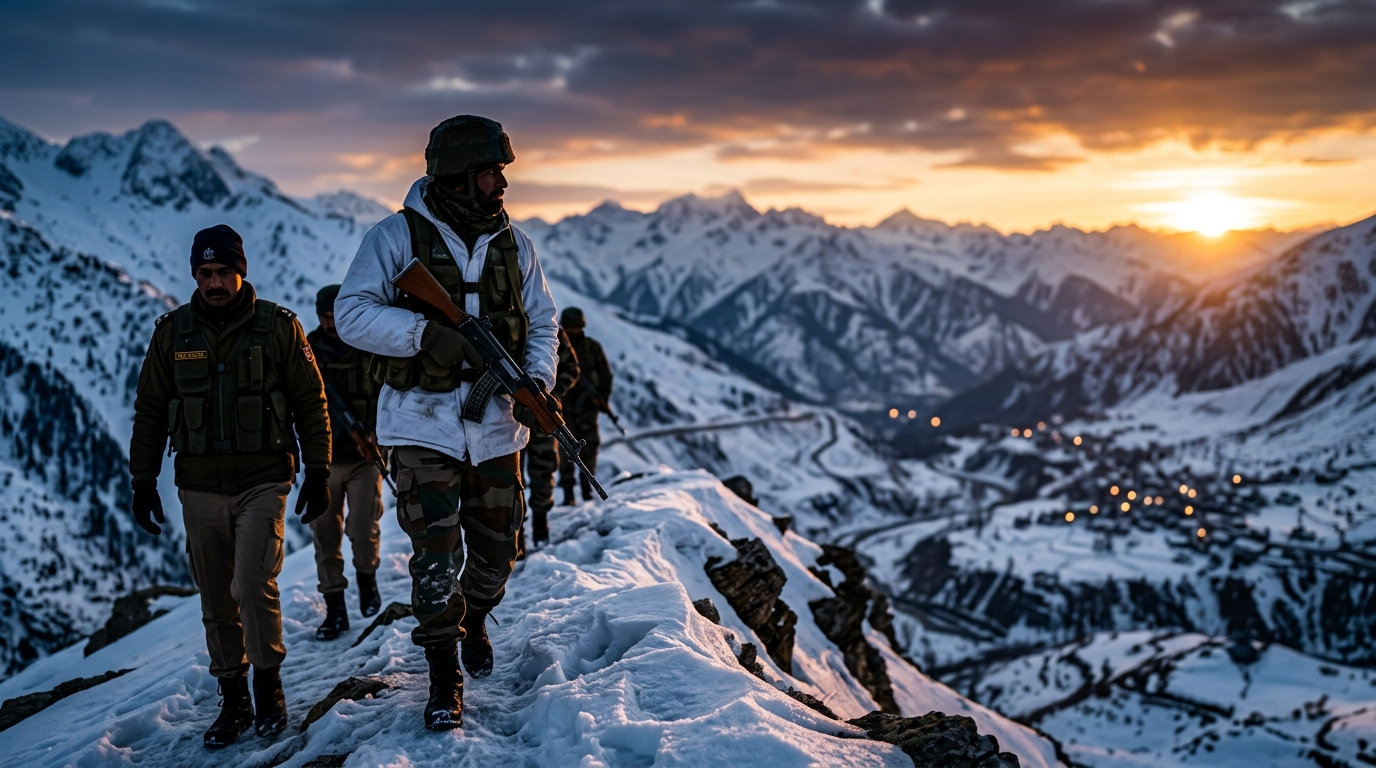
A fifth gunfight between Indian security forces and JeM militants occurred on February 4, 2026, in the snow‑bound Chatroo belt of Kishtwar, highlighting the challenges of counter‑insurgency in harsh winter terrain. Over the past 18 days, multiple encounters have underscored the persistence of cross‑border terrorism despite heavy snowfall and difficult topography.
Overview On February 4, 2026 , a fresh gunfight erupted in the snow‑bound higher reaches of Kishtwar district in Jammu & Kashmir’s Charo (Chatroo) belt . The clash involved a joint search party of the Indian Army and Jammu & Kashmir Police pursuing a group of Pakistani militants linked to the Jaish‑e‑Mohammad (JeM) outfit. The encounter underscores the challenges of counter‑insurgency operations in rugged, snow‑covered terrain and highlights the persistence of cross‑border terrorism in the region. Key Developments Development 1: The latest encounter began when the joint Army‑Police team was conducting searches in Sanjinala‑Dichhar area of Chingam forest , leading to an exchange of fire that continued as of the last reports. Development 2: This is the fifth encounter in the Chatroo belt within an 18‑day span, following earlier skirmishes on January 18 (Sonnar village) , January 22 , January 26 , and January 31 . Development 3: Despite heavy snowfall—over two feet—and dense vegetation, security forces have persisted in their pursuit, though the militants have repeatedly evaded capture by exploiting the difficult topography. Important Facts Fact 1: The first encounter on January 18 resulted in the death of a paratrooper and injuries to seven other soldiers. Fact 2: The Chatroo belt, part of the Pir Panjal range, remains snow‑bound throughout winter, complicating logistics, communication, and medical evacuation for security operations. UPSC Relevance This episode is directly relevant to the UPSC syllabus under GS Paper II – Internal Security (terrorism, insurgency, and counter‑terrorism measures) and GS Paper III – Geography (mountainous terrain, climate impact on security). It also touches upon GS Paper I – Polity & Governance (role of central and state agencies) and can be linked to optional subjects such as International Relations (Pakistan‑India terrorism nexus) and Security Studies . Potential question angles include the effectiveness of joint operations, challenges of winter warfare, and policy responses to cross‑border terrorism. Way Forward To mitigate recurring encounters, a multi‑pronged approach is essential: strengthening intelligence sharing between the Army, police, and intelligence agencies; enhancing winter‑warfare capabilities through specialized training and equipment; improving infrastructure (helicopter pads, all‑weather roads) in the Chatroo belt; and pursuing diplomatic pressure on Pakistan to curb JeM’s support. Continuous monitoring and community engagement can also help isolate militant networks in the region.
  1. Home
  2. Prepare
  3. Current Affairs
  4. Snow‑bound Chatroo Belt Encounters: Army‑Police Ops against JeM Terrorists in Kishtwar (Feb 2026)
Must Review
Login to bookmark articles
Login to mark articles as complete

Overview

gs.gs378% UPSC Relevance

Full Article

<h2>Overview</h2> <p>On <strong>February 4, 2026</strong>, a fresh gunfight erupted in the snow‑bound higher reaches of <strong>Kishtwar district</strong> in Jammu & Kashmir’s <strong>Charo (Chatroo) belt</strong>. The clash involved a joint search party of the <strong>Indian Army</strong> and <strong>Jammu & Kashmir Police</strong> pursuing a group of Pakistani militants linked to the <strong>Jaish‑e‑Mohammad (JeM)</strong> outfit. The encounter underscores the challenges of counter‑insurgency operations in rugged, snow‑covered terrain and highlights the persistence of cross‑border terrorism in the region.</p> <h3>Key Developments</h3> <ul> <li><strong>Development 1:</strong> The latest encounter began when the joint Army‑Police team was conducting searches in <strong>Sanjinala‑Dichhar</strong> area of <strong>Chingam forest</strong>, leading to an exchange of fire that continued as of the last reports.</li> <li><strong>Development 2:</strong> This is the fifth encounter in the Chatroo belt within an 18‑day span, following earlier skirmishes on <strong>January 18 (Sonnar village)</strong>, <strong>January 22</strong>, <strong>January 26</strong>, and <strong>January 31</strong>.</li> <li><strong>Development 3:</strong> Despite heavy snowfall—over two feet—and dense vegetation, security forces have persisted in their pursuit, though the militants have repeatedly evaded capture by exploiting the difficult topography.</li> </ul> <h3>Important Facts</h3> <ul> <li><strong>Fact 1:</strong> The first encounter on <strong>January 18</strong> resulted in the death of a paratrooper and injuries to seven other soldiers.</li> <li><strong>Fact 2:</strong> The Chatroo belt, part of the Pir Panjal range, remains snow‑bound throughout winter, complicating logistics, communication, and medical evacuation for security operations.</li> </ul> <h3>UPSC Relevance</h3> <p>This episode is directly relevant to the UPSC syllabus under <strong>GS Paper II – Internal Security</strong> (terrorism, insurgency, and counter‑terrorism measures) and <strong>GS Paper III – Geography</strong> (mountainous terrain, climate impact on security). It also touches upon <strong>GS Paper I – Polity & Governance</strong> (role of central and state agencies) and can be linked to optional subjects such as <strong>International Relations</strong> (Pakistan‑India terrorism nexus) and <strong>Security Studies</strong>. Potential question angles include the effectiveness of joint operations, challenges of winter warfare, and policy responses to cross‑border terrorism.</p> <h3>Way Forward</h3> <p>To mitigate recurring encounters, a multi‑pronged approach is essential: strengthening intelligence sharing between the Army, police, and intelligence agencies; enhancing winter‑warfare capabilities through specialized training and equipment; improving infrastructure (helicopter pads, all‑weather roads) in the Chatroo belt; and pursuing diplomatic pressure on Pakistan to curb JeM’s support. Continuous monitoring and community engagement can also help isolate militant networks in the region.</p>
Read Original

Joint Army‑Police ops in snow‑bound Kishtwar expose winter counter‑insurgency gaps

Key Facts

  1. 1. Fifth encounter with JeM militants in Chatroo belt occurred on 4 Feb 2026 in Sanjinala‑Dichhar, Chingam forest, Kishtwar.
  2. 2. Five encounters were recorded within 18 days (18 Jan, 22 Jan, 26 Jan, 31 Jan, 4 Feb 2026).
  3. 3. First encounter on 18 Jan 2026 resulted in the death of a paratrooper and injuries to seven soldiers.
  4. 4. Heavy snowfall (>2 feet) and dense vegetation in the Pir Panjal range hampered logistics, communication and medical evacuation.
  5. 5. Joint operation involved Indian Army and Jammu & Kashmir Police, reflecting inter‑agency coordination under Article 355 of the Constitution.
  6. 6. JeM is a Pakistan‑based terrorist outfit; its cross‑border activities invoke the provisions of the Unlawful Activities (Prevention) Act, 1967.
  7. 7. The Chatroo belt remains snow‑bound throughout winter, necessitating specialized winter‑warfare equipment and infrastructure.

Background & Context

The repeated gun‑fights in Kishtwar illustrate the nexus between cross‑border terrorism (JeM) and internal security challenges in mountainous, snow‑bound regions. They underscore the need for robust inter‑agency coordination, winter‑warfare capability, and infrastructural development, linking GS‑II (Internal Security) with GS‑III (Physical Geography) and GS‑I (Polity).

UPSC Syllabus Connections

GS3•Linkages between development and spread of extremismGS3•Various security forces and agencies

Mains Answer Angle

In a Mains answer, candidates can discuss the effectiveness of joint Army‑Police operations and the policy gaps in winter counter‑insurgency, framing the discussion under GS‑II (Internal Security) and GS‑III (Geography). A likely question may ask to evaluate measures to curb cross‑border terrorism in Jammu & Kashmir.

Analysis

Practice Questions

GS2
Easy
Prelims MCQ

Internal Security – Terrorist encounters

1 marks
5 keywords
GS2
Medium
Mains Short Answer

Internal Security – Terrain challenges

10 marks
5 keywords
GS2
Hard
Mains Essay

Internal Security – Counter‑terrorism policy

25 marks
7 keywords
Related:Daily•Weekly

Loading related articles...

Loading related articles...

Tip: Click articles above to read more from the same date, or use the back button to see all articles.

Quick Reference

Key Insight

Joint Army‑Police ops in snow‑bound Kishtwar expose winter counter‑insurgency gaps

Key Facts

  1. 1. Fifth encounter with JeM militants in Chatroo belt occurred on 4 Feb 2026 in Sanjinala‑Dichhar, Chingam forest, Kishtwar.
  2. 2. Five encounters were recorded within 18 days (18 Jan, 22 Jan, 26 Jan, 31 Jan, 4 Feb 2026).
  3. 3. First encounter on 18 Jan 2026 resulted in the death of a paratrooper and injuries to seven soldiers.
  4. 4. Heavy snowfall (>2 feet) and dense vegetation in the Pir Panjal range hampered logistics, communication and medical evacuation.
  5. 5. Joint operation involved Indian Army and Jammu & Kashmir Police, reflecting inter‑agency coordination under Article 355 of the Constitution.
  6. 6. JeM is a Pakistan‑based terrorist outfit; its cross‑border activities invoke the provisions of the Unlawful Activities (Prevention) Act, 1967.
  7. 7. The Chatroo belt remains snow‑bound throughout winter, necessitating specialized winter‑warfare equipment and infrastructure.

Background

The repeated gun‑fights in Kishtwar illustrate the nexus between cross‑border terrorism (JeM) and internal security challenges in mountainous, snow‑bound regions. They underscore the need for robust inter‑agency coordination, winter‑warfare capability, and infrastructural development, linking GS‑II (Internal Security) with GS‑III (Physical Geography) and GS‑I (Polity).

UPSC Syllabus

  • GS3 — Linkages between development and spread of extremism
  • GS3 — Various security forces and agencies

Mains Angle

In a Mains answer, candidates can discuss the effectiveness of joint Army‑Police operations and the policy gaps in winter counter‑insurgency, framing the discussion under GS‑II (Internal Security) and GS‑III (Geography). A likely question may ask to evaluate measures to curb cross‑border terrorism in Jammu & Kashmir.

Explore:Current Affairs·Editorial Analysis·Govt Schemes·Study Materials·Previous Year Questions·UPSC GPT
Snow‑bound Chatroo Belt Encounters: Army‑P... | UPSC Current Affairs

Related Topics

  • 📚Subject TopicIndia's Internal Security Apparatus: Key Agencies & Laws
  • 📚Subject TopicRobotic MULE Inducted in Indian Army
  • 📰Current AffairsChittoor Police Nab Repeat Ganja Smuggler Mohan Babu – Implications for Drug Enforcement & Internal Security
  • 📰Current AffairsBJP Accuses West Bengal Govt of Hindering NIA Probe into Beldanga Riots – Centre‑State Tensions and Internal Security Implications