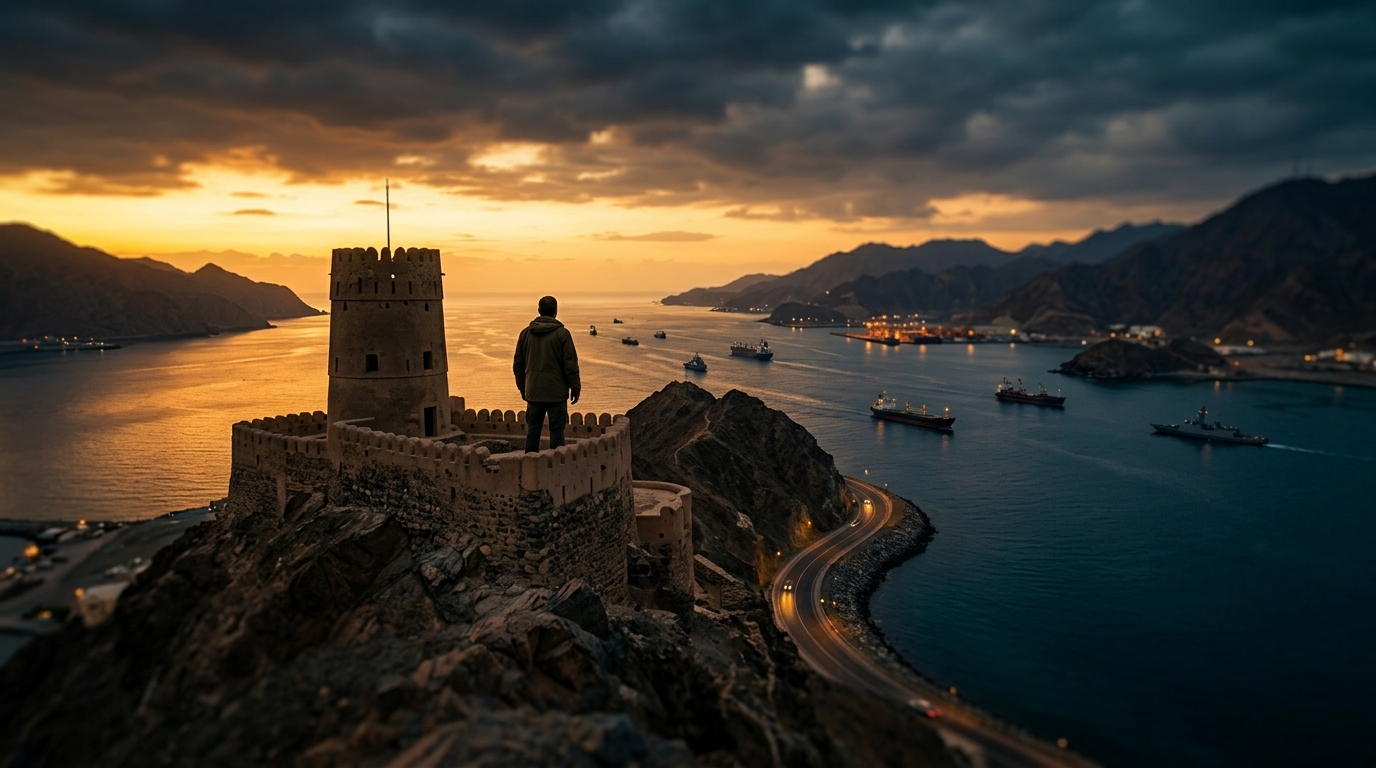
Written by: Khushboo Kumari10 min readNew DelhiUpdated: Apr 4, 2026 11:10 AM ISTUPSC Prelims has often featured places in the news—here are key locations highlighted during the ongoing US–Israel–Iran conflict. (Express Photo)Make us preferred source on GoogleWhatsapptwitterFacebookRedditPRINTTake a look at the essential concepts, terms, quotes, or phenomena every day and brush up your knowledge. Here’s your knowledge nugget on strategic locations in ongoing the Iran vs Israel-US War.
Knowledge Nugget: Geographical locations in the news due to the Iran vs. the US-Israel War
Subject: Geography
(Relevance: Questions have been asked on places in the news, countries surrounding important rivers, and straits. In this regard, knowing about the important places that were in the news amidst the Iran vs US-Israel war becomes important map work for your UPSC exam.)
Why in the news?
US President Donald Trump, on the night of 2nd March, issued a stark warning to Iran, threatening further devastation after reported strikes hit a major bridge linking Tehran and Karaj. Taking responsibility for the attack, Trump urged Iran to agree to a deal “before it’s too late,” adding that power infrastructure could be the next target.
Subscribe | UPSC Essentials of The Indian Express to stay ahead in your Civil Services preparation with focused, exam-relevant insights.
In this conflict, strategic water routes and critical infrastructure have been targeted, reflecting a shift to geo-economic warfare. Let’s look at these important locations.
Key takeaways:
Iran has effectively blockaded the Strait of Hormuz, the chokepoint through which 20–25 per cent of global oil supply normally flows.
#1 Strait of Hormuz
Iran’s effective blockade of the Strait of Hormuz has emerged as its most effective strategic tool in the war, allowing it to maintain leverage and stonewall the US’s attempts to push for peace.
The Strait of Hormuz lies between Oman and Iran, linking the Persian Gulf with the Gulf of Oman and the Arabian Sea. It is between 48 and 80 km wide (35–40 kilometres at its narrowest point), with only a few kilometres available for actual shipping lanes.Story continues below this ad
#2 Bab el-Mandeb Strait
Iran-backed Yemeni Houthis have entered the war, launching their first attack on Israel since the US-Israeli war on Iran began on February 28. Houthis control the Yemeni capital of Sanaa, which is located close to the Bab el-Mandab in the Red Sea — a key reason why concerns are now rising.
The Bab el-Mandab, also known as the “Gate of Tears” in Arabic, lies at the southern tip of the Red Sea, between Yemen and the Horn of Africa. It connects the Red Sea to the Gulf of Aden and further to the Indian Ocean. It accounts for roughly 10 to 12 per cent of global oil and natural gas shipments.
Red Sea and Bab el-Mandeb. (Source: US Energy Information Administration)
#3 Red Sea
With the Houthis joining the war, concerns have increased over possible attacks on Red Sea shipping — something the group has done before. The nearly 2,000-km Red Sea connects the Mediterranean Sea with the Indian Ocean via the narrow Suez Canal.
The Red Sea is surrounded by Egypt, Sudan, Djibouti, Saudi Arabia, Yemen, and Eritrea. The Gulf of Aqaba is a northeastern extension of the Red Sea, bordered by Egypt, Israel, Jordan, and Saudi Arabia.Story continues below this ad
#4 Kharg Island
Trump has repeatedly asserted that the US may send American troops to seize control of Iran’s key oil export terminal at Kharg Island. Referred to as the “orphan pearl” of the Persian Gulf, Kharg Island, which sits barely 25 kilometres off Iran’s coast, processes 90 per cent of Tehran’s crude oil exports and serves as the jugular of the country’s cash-strapped economy.
ALSO READ | Knowledge Nugget: PM Modi’s Ethanol push at Jewar airport. Why this biofuel is important for your UPSC exam
#5 Natanz enrichment plant
The US and Israel mounted an attack on Iran’s Natanz uranium enrichment facility on March 21, long regarded as Iran’s main enrichment site. The International Atomic Energy Agency (IAEA) has also confirmed entrances to Iran’s underground Natanz Fuel Enrichment Plant (FEP) were bombed.
Long regarded as Iran’s main enrichment site, Natanz, located 220 km southeast of Tehran, is home to two enrichment plants- Fuel Enrichment Plant (FEP) and Pilot Fuel Enrichment Plant (PFEP)- that were operational at the start of Israeli attacks in June 2025.
Debris at the Golestan Palace after the recent air strikes. (Reuters/File)
#6 Damage to historical sites in Iran
Isfahan: The US and Israeli forces struck an ammunition depot in Iran’s Isfahan on March 31. Earlier, UNESCO confirmed damage to the 17th-century Chehel Sotoun palace and the Masjed-e Jāme, the country’s oldest Friday mosque, both located in Isfahan.Story continues below this ad
According to the UNESCO website, “the Masjed-e Jamé (‘Friday mosque’) can be seen as a stunning illustration of the evolution of mosque architecture over twelve centuries, starting in AD 841. It is the oldest preserved edifice of its type in Iran and a prototype for later mosque designs throughout Central Asia.
Golestan Palace: Following military strikes by American and Israeli forces, Iran’s Ministry of Cultural Heritage confirmed catastrophic damage to the Golestan Palace (Kākh-e Golestān), a UNESCO World Heritage site dating back to the 16th century. It is a lavish monument of the Qajar era (1789 to 1925). It became a centre of Qajari arts and architecture, of which it is an outstanding example and has remained a source of inspiration for Iranian artists and architects to this day.
The Golestan Palace is protected under international law, the 1954 Hague Convention for the Protection of Cultural Property in the Event of Armed Conflict.UPSC ESSENTIALS
Iran
Iran, or Persia, has been home to one of the oldest civilisations in the world, beginning with the Elamite empires in the fourth millennium BCE. It has a rich history, bearing the imprint of the many empires, religions, and cultures that have rolled through it over millennia. Cyrus the Great, Darius the Great, Alexander the Great, and Nader Shah are just some of the many emperors who shaped the country’s history and evolution.The Blue Line is the UN-demarcated line marking Israel’s withdrawal from southern Lebanon in 2000, which serves as the de facto border between the two countries.
#7 Litani River
Israel’s defence minister, Israel Katz, on March 24 said his country would occupy southern Lebanon up to the Litani River as a security buffer against Hezbollah attacks.Story continues below this ad
According to the National Litani River Authority, “Litani River is the longest and largest river in Lebanon, with a length of 170 km, and its water capacity is approximately 750 million cubic meters per year.” Blue line, set up by the United Nations, has been the demarcating line separating Lebanon from Israel and the Israeli-occupied Golan Heights. Israeli forces withdrew to the Blue Line when they left South Lebanon in 2000.
ALSO READ | Beyond Trending: What is mediation?
#8 Naquora and Tyre
Israel has also attacked Naquora, the headquarters of the United Nations Interim Force in Lebanon (UNIFIL), which also has Indian troops as members. Tyre, a UNESCO World Heritage site known for its Roman-era ruins, has been attacked. Both are located in Lebanon.
According to UNESCO, Tyre, located on the southern coast of Lebanon, 83 km south of Beirut, was a great Phoenician city that reigned over the seas and founded prosperous colonies such as Cadiz and Carthage.#9 Diego Garcia
Iran fired two ballistic missiles in an attempt to target Diego Gracia which is 4,000 km away from the Iranian mainland. It lies in the central Indian Ocean, south of India and southwest of Sri Lanka. It is the largest island in the Chagos Archipelago and one of only two critical US bomber bases in the Indo-Pacific region.Story continues below this ad
Attacks on energy infra in West Asia. (Express photo)
#10 Attack on energy facilities
South Pars: Israel has struck Iran’s key offshore South Pars natural gas field. It is in the Persian Gulf and accounts for up to three-fourths of Iranian gas production. It is shared between Iran and Qatar. South Pars is the world’s largest gas field. The entire South Pars reservoir contains an estimated 1,800 trillion cubic feet of usable gas — enough to supply the entire world’s needs for 13 years — according to a Reuters report.
Ras Laffan: Qatar’s Ministry of Foreign Affairs has strongly condemned the Iranian missile strikes that hit the Ras Laffan industrial city, the country’s primary gas hub. QatarEnergy’s primary LNG production units, liquefaction plants, and export infrastructure are all concentrated in Ras Laffan, making it the world’s largest LNG hub that accounts for roughly a fifth of global LNG supply.
BEYOND THE NUGGET: Hague Convention of 1954
1. The Hague Convention of 1954, formulated under UNESCO, provides for the Protection of Cultural Property in the Event of Armed Conflict. The Convention was formulated with an aim to protect cultural property such as monuments of architecture, art or history, archaeological sites, works of art, manuscripts, books, and other objects of artistic, historical, and archaeological value as well as scientific collections of any kind regardless of their origin or ownership.
2. The 1954 Hague Convention and the 1999 Second Protocol have established distinctive emblems to facilitate the recognition of cultural property protected under these treaties or inscribed on their respective lists.Story continues below this ad
According to UNESCO, “the distinctive emblem of the Convention, also known as the Blue shield emblem, may be used alone to mark cultural property under general protection, or to indicate personnel engaged in its protection or overseeing the 1954 Hague Convention’s implementation.”
3. To facilitate the identification of immovable cultural property under special protection, transport of cultural facilities, and improvised refuges to house cultural property, the blue shield emblem is presented three times.
As per UNESCO, the blue shield emblem outlined by a detached external red band is the distinctive emblem for cultural property inscribed on the International List of Cultural Property under Enhanced Protection.
Post Read Question
Consider the following pairs:Places in News
Location1. Isfahan
: Iran2. Tyre
: Syria3. Ras Laffan
: QatarWhich of the pairs given above are correctly matched?
(a) 1 and 2 only
(b) 2 and 3 only
(c) 1 and 3 only
(d) 1, 2 and 3Story continues below this ad
(2) The demarcation known as ‘Blue line’ sometimes appears in the news in the context of the events related to
(a) Central Asia
(b) Middle East
(c) South-East Asia
(d) Central AfricaAnswer key1. (c)2. (b)(Sources: From Hormuz to Malacca: India’s stakes in global chokepoints, UNESCO)
Subscribe to our UPSC newsletter. Stay updated with the latest UPSC articles by joining our Telegram channel – IndianExpress UPSC Hub, and follow us on Instagram and X.
🚨 Click Here to read the UPSC Essentials magazine for March 2026. Share your views and suggestions in the comment box or at [email protected]🚨ExpandKhushboo KumariKhushboo Kumari is a Deputy Copy Editor with The Indian Express. She has done her graduation and post-graduation in History from the University of Delhi. At The Indian Express, she writes for the UPSC section. She holds experience in UPSC-related content development. You can contact her via email: [email protected]... Read More© IE Online Media Services Pvt LtdTags:Current Affairsgovernment jobsIran WarMiddle East conflictSarkari NaukriStrait of HormuzUPSCUPSC Civil ServicesUPSC Civil Services Exam
Loading page, please wait…