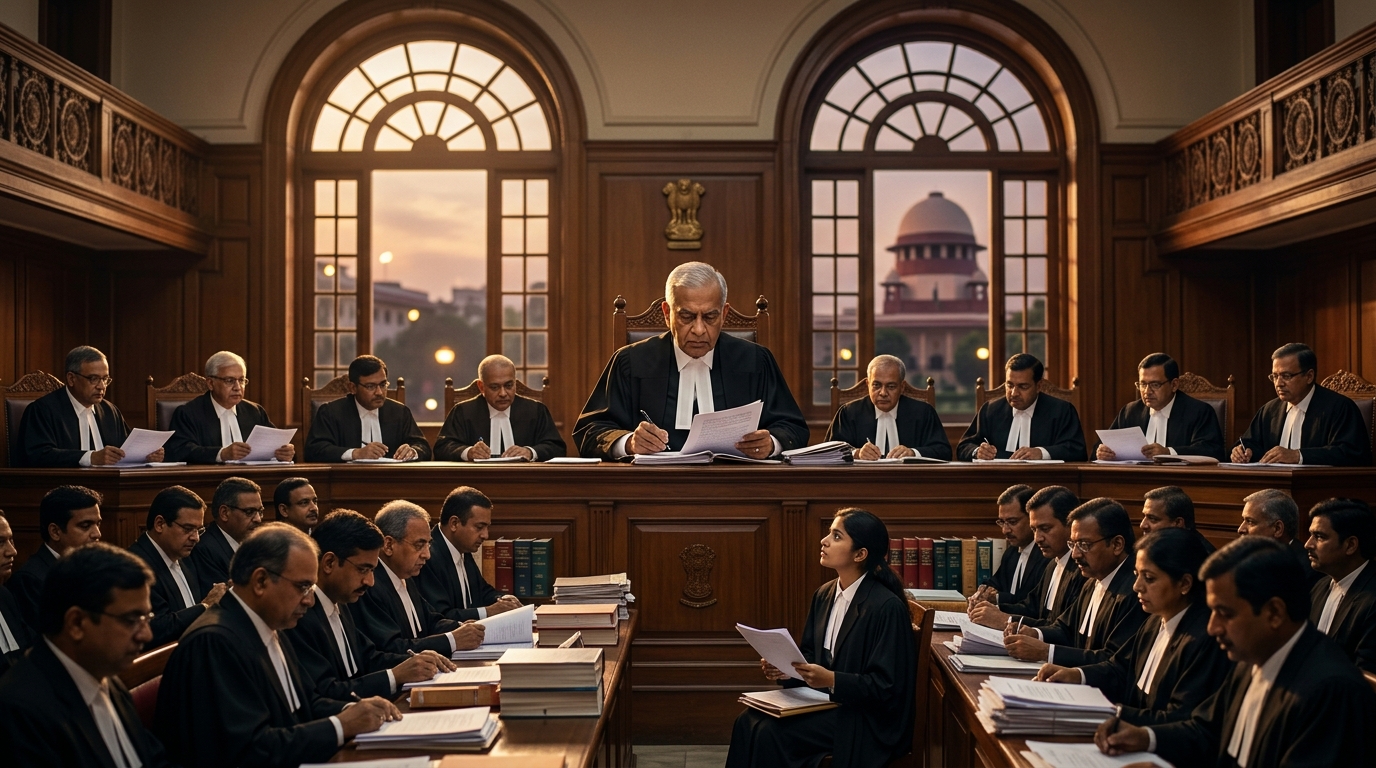
<p>The <span class="key-term" data-definition="Supreme Court — India's apex judicial body that interprets the Constitution and adjudicates disputes involving the Union, states and public interest (GS2: Polity)">Supreme Court</span> convened a <span class="key-term" data-definition="9‑judge bench — a larger constitutional bench formed to hear matters of significant constitutional importance (GS2: Polity)">9‑judge bench</span> on 8 April 2026 to hear the pending <span class="key-term" data-definition="Sabarimala reference — a petition seeking a review of the Supreme Court's 2018 judgment on women’s entry to the Sabarimala temple, raising questions of religious freedom and gender equality (GS2: Polity)">Sabarimala reference</span>. This was the second day of arguments, with the bench reiterating its focus on whether the matter should be dismissed at the threshold or examined on its merits.</p>
<h3>Key Developments (Day 2)</h3>
<ul>
<li><strong>4:41 PM IST</strong>: <span class="key-term" data-definition="CJI Surya Kant — the Chief Justice of India, who heads the Supreme Court and presides over constitutional benches (GS2: Polity)">CJI Surya Kant</span> remarked that if the reference were to be dismissed at the threshold, it should have been done back in 2006, when the original petition was filed.</li>
<li><strong>Senior Advocate Jaising</strong> (referred to as <span class="key-term" data-definition="Senior Advocate — a senior lawyer designated by the Supreme Court for his/her expertise and experience, often appearing in constitutional matters (GS2: Polity)">Sr Adv Jaising</span>) urged the Court to either dismiss the reference outright or proceed to address the substantive issues, emphasizing the 20‑year lapse since the original filing.</li>
</ul>
<h3>Important Facts</h3>
<ul>
<li>The bench composition includes <strong>CJI Surya Kant</strong>, Justice <strong>BV Nagarathna</strong>, Justice <strong>MM Sundresh</strong>, Justice <strong>Ahsanuddin Amanullah</strong>, Justice <strong>Aravind Kumar</strong>, Justice <strong>Augustine George Masih</strong>, Justice <strong>Prasanna B Varale</strong>, Justice <strong>R Mahadevan</strong> and Justice <strong>Joymalya Bagchi</strong>.</li>
<li>The original petition was filed in 2006, challenging the ban on women of menstruating age entering the <span class="key-term" data-definition="Sabarimala temple — a prominent Hindu shrine in Kerala, whose entry rules for women have been the subject of constitutional debate (GS2: Polity)">Sabarimala</span> temple.</li>
<li>The 2018 Supreme Court judgment lifted the ban, prompting a review petition that has now reached this larger bench.</li>
</ul>
<h3>UPSC Relevance</h3>
<p>Understanding the procedural nuances of a <span class="key-term" data-definition="reference — a formal request by a court to a larger bench for reconsideration of a legal issue (GS2: Polity)">reference</span> helps aspirants grasp how constitutional questions are escalated. The case illustrates the balance between <span class="key-term" data-definition="constitutional issues — matters that involve interpretation of fundamental rights, federal structure or separation of powers (GS2: Polity)">constitutional issues</span> such as gender equality, religious freedom and the role of the judiciary in social reform. It also showcases the functioning of a <span class="key-term" data-definition="threshold dismissal — a procedural device where a court can reject a petition without full merits if it lacks jurisdiction or is premature (GS2: Polity)">threshold dismissal</span>, a concept frequently examined in GS‑2.</p>
<h3>Way Forward</h3>
<p>The bench is expected to deliver a verdict on whether to discharge the reference or proceed to a full hearing on the merits. A dismissal would revert the matter to the status quo, while a substantive hearing could reaffirm or modify the 2018 judgment, impacting future jurisprudence on personal laws and religious practices.</p>